Hidden Talent: A Billionaire Discovered a Homeless Girl Tutoring His Daughter in the Park

The pre-dawn air was biting, a sharp reminder that summer had long since faded. Under the small, tattered awning that had served as her sanctuary for the past few weeks, Emily woke with a shiver. At five years old, she had already mastered the grim routines of street survival. The sky was still an inky black, offering no warmth, as she pulled her thin, threadbare blanket tighter around her shoulders.
With fingers stiff from the cold, she adjusted her faded dress. It hung loosely on her frame, a size too big for her malnourished body. She tried to smooth down her matted brown hair, brushing the bangs out of her eyes before turning her attention to her most prized possession: a worn backpack, the final gift she had ever received from her mother. Inside lay her treasures—pencil stubs scavenged from sidewalks, crumpled sheets of paper rescued from trash bins, and fragments of discarded notebooks that still held a few clean lines.
A low growl from her stomach broke the early morning silence. Emily reached into her pocket and retrieved a small wax paper packet containing half a bread roll, a remnant from the previous night. The baker down the street sometimes took pity on her, leaving unsold goods near the back door. She ate with deliberate slowness, savoring every crumb. Life on the pavement had taught her the hard lesson of rationing; one never knew when the next meal would come.
For eight lonely months, this had been Emily’s reality. Before the solitude, there had been the two of them—her and her mother—begging at the busy city intersections. Emily closed her eyes and summoned the memory of her mother’s gentle smile, a beacon of warmth even on days when passersby ignored them. She remembered how they would huddle together for warmth, sharing whatever meager food they had gathered.
“We are rich in other ways, Emily,” her mother would whisper when hunger pangs kept them awake. But then came the hacking cough, followed by the burning fever. One tragic night, they had fallen asleep curled together under the overpass, and by morning, her mother simply didn’t wake up. Strangers passed by until a man in uniform finally called for help, but the ambulance arrived too late. In the chaos that followed, Emily slipped away, and nobody came looking for her.
The only inheritance she had left was her education. Even without a roof over their heads, her mother had been adamant about learning. “Reading is like having wings,” she used to say, tracing letters in the dust by the light of a flickering candle. “With wings, you can fly far away from here.” Emily never knew how her mother had become so learned, but she clung to those lessons desperately.
After her mother passed, Emily continued her studies as a way to keep the memory alive. The dumpsters behind libraries and schools became her goldmines. She salvaged books with torn covers, used workbooks, and old magazines. Under the yellow glow of streetlights, she practiced until letters formed words, and words wove into sentences, unlocking worlds far brighter than her own.
Packing her meager belongings, Emily began her daily pilgrimage. She navigated the city with the instinct of a stray cat, knowing which alleys offered shortcuts and which corners to avoid. She knew where the safe trash bins were and which pedestrians would look through her rather than at her. Fifteen minutes later, she arrived at her destination: St. Thomas School.
The prestigious institution sat behind an imposing iron fence. Emily slipped into her usual observation post, a secluded nook behind a large oak tree that offered a clear view of the main gate while keeping her hidden. She sat cross-legged and waited, just as she had done every morning for months.
Soon, the parade of wealth began. Sleek, polished luxury cars pulled up to the curb, a stark contrast to the crowded city buses Emily sometimes rode to escape the rain. Children emerged in immaculate uniforms—crisp white shirts, navy blue skirts or trousers, and shoes that gleamed without a single scuff. They carried backpacks featuring cartoon characters Emily recognized from discarded comic books.
She watched with a hunger that had nothing to do with food. She observed parents bending down to kiss their children goodbye, friends running to greet one another, the air filling with laughter and chatter about topics she could only guess at. Some children grumbled about waking up early or unfinished homework, and Emily felt a pang of confusion. How could anyone complain about something so magical?
“I forgot to do my math homework,” she heard a boy say, panic in his voice. “Today we have art class!” a girl with bouncing braids squealed nearby. Then, the sharp, authoritative ring of the bell cut through the air. The children formed neat lines and filed into the building, leaving the courtyard silent and empty.
Emily crept closer, her small hands gripping the cold iron bars of the fence. She couldn’t see into the classrooms, but her imagination filled in the blanks. She pictured sitting at a real desk with her name on it, opening a notebook that didn’t smell of refuse, raising her hand to ask a question. She visualized maps on the walls, shelves groaning with books, and a kind teacher explaining the mysteries of the universe.
“I would learn so fast,” she whispered to the empty air. “I know I could.”…
Hours drifted by. When the sun grew too intense, Emily shifted her position, always vigilant of the security guards who patrolled the perimeter. Mid-day brought another bell and the courtyard exploded with life again as children spilled out for recess, unpacking snacks that looked like feasts to Emily’s eyes. She watched the tag games and the secret whispers, her gaze dreamy and devoid of bitterness. She simply wanted to belong, to cross the invisible chasm that separated her world from theirs.
Occasionally, when the coast was clear, she would pull a salvaged notebook from her bag and mimic the students. She practiced writing her letters and solving arithmetic problems, using the dirt as a chalkboard when she ran out of paper. Once, she had found a nearly complete math textbook. It had taken weeks of counting on her fingers and drawing tally marks in the dust, but when she finally solved a two-digit addition problem, the rush of joy was intoxicating.
As the afternoon sun dipped lower, the dismissal bell rang. Emily watched the reunions, the gold-star papers being displayed to proud parents, the animated recounting of the day. She waited until the last car drove away before emerging from her hiding spot. On her trek back to her awning, she scanned the ground for lost treasures—a dropped pencil, a piece of chalk, anything to fuel her solitary schooling.
That night, Emily sat under the weak halo of a streetlamp, reading aloud from a storybook missing its cover. She imagined she was reading to a room full of friends. When exhaustion finally claimed her, she hugged her backpack to her chest, wrapped herself in the thin blanket, and lay on the cardboard that separated her from the freezing concrete. “Tomorrow,” she whispered into the darkness. “Tomorrow might be different.”
The next morning began with the same gray predictability. Breakfast was half a bruised apple salvaged from a park bin and the stale crust of bread from the night before. But as she began her walk to St. Thomas, the atmosphere felt subtly shifted. The sky was a brilliant, piercing blue, and a gentle breeze danced through the trees. Emily felt lighter, as if an invisible thread was pulling her forward.
Arriving at the school, she took her place behind the oak tree. The routine played out: the cars, the uniforms, the bell. But after the courtyard cleared, she spotted something new. In a side garden, typically obscured by overgrown bushes, there was a gap where the earth had eroded beneath the fence.
She scanned the area. The security guard was occupied at the main gate, helping a delivery driver unload heavy boxes. Her heart hammered against her ribs. It was a reckless thought, but the pull was undeniable. crouching low, Emily scrambled through the gap, the bushes snagging her hair as she squeezed through.
Suddenly, she was inside.
The garden was an oasis. The grass was impossibly green and soft beneath her bare, callous feet. Flower beds burst with color, and ancient trees offered cool, dappled shade. It felt like stepping into one of the fairy tales she read by streetlamp. She stood frozen, breathing in the scent of cut grass and privilege, until a soft sobbing sound shattered the spell.
Emily followed the noise to a wooden bench partially obscured by a hydrangea bush. A girl her own age sat there, head in her hands. She wore the pristine uniform, her blonde hair woven into two perfect braids. On her lap lay an open notebook.
Emily hesitated. Flight was the safest option. But the distress in the girl’s posture drew her in. She stepped softly onto the pavement. The girl was staring at a math worksheet with an expression of pure defeat. It was simple addition—problems Emily had mastered weeks ago in her alleyway classroom.
The girl looked up, jumping slightly. For a moment, they just stared at one another—two five-year-olds from opposite ends of the universe.
“Who are you?” the girl asked, wiping a tear from her cheek. “I haven’t seen you in our class.”
Emily swallowed hard. The girl’s blue eyes held curiosity, not malice. “My name is Emily,” she whispered.
“I don’t… you don’t go here,” the girl said, frowning slightly. “Why are your clothes so dirty?”
Shame flushed Emily’s cheeks hot. She looked down at her stained dress and grimy feet. “I just wanted to see what a school looked like inside,” she murmured, backing away. “I should go.”
“Wait,” the girl said quickly. “I didn’t mean to be mean. I’m Sophie.” She patted the empty space on the bench. “Do you want to sit? I’m trying to do this homework, but it’s really hard. The teacher will be upset if I don’t finish.”
Emily approached cautiously and perched on the edge of the bench. She glanced at the paper. “Can I help?”
“I know how to add,” Sophie said, sounding defensive but unsure. “You do? But you don’t go to school.”
Emily offered a tentative smile. “I don’t need to be in school to know math. Can I show you?”
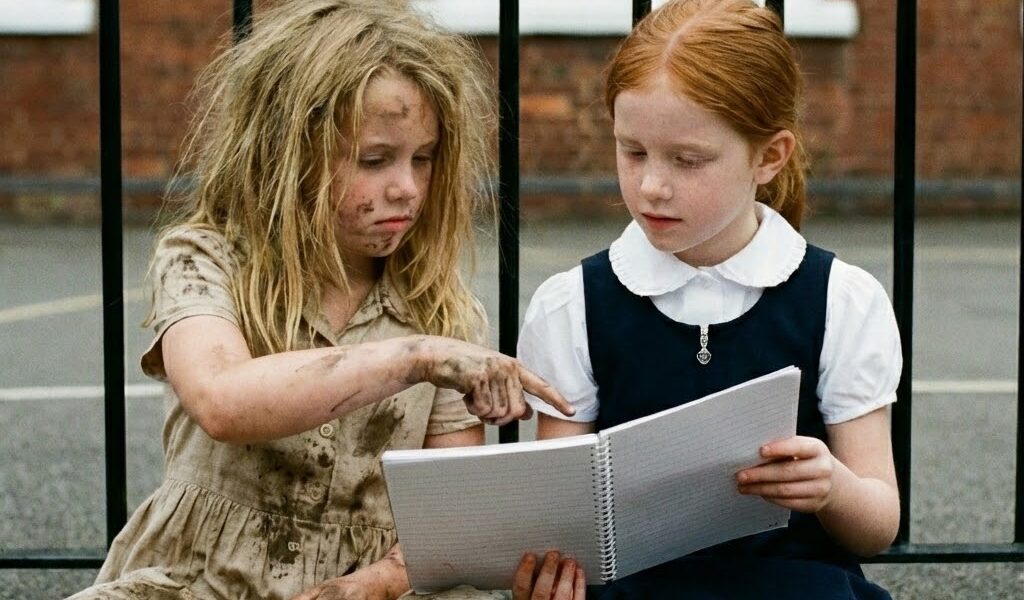
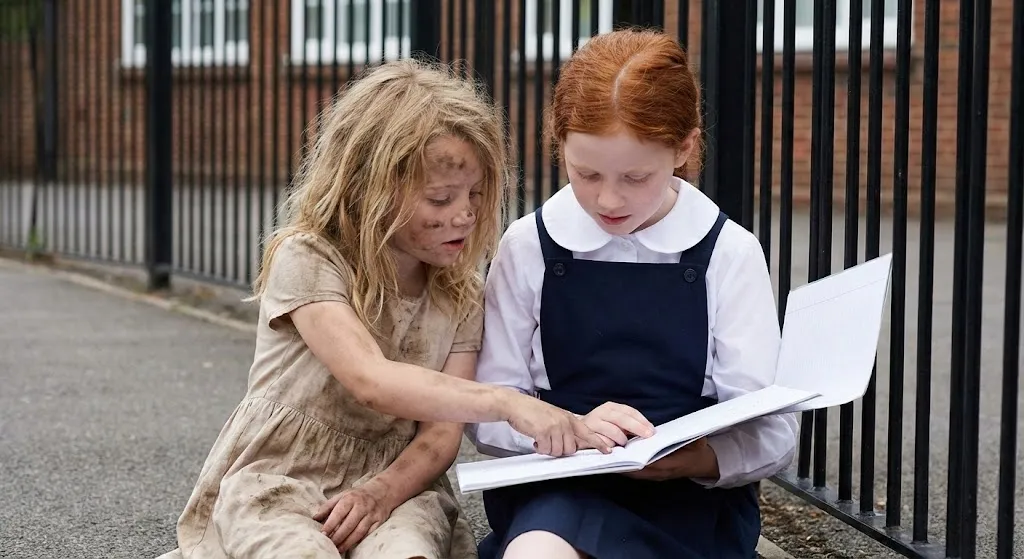
Sophie pushed the notebook toward her. Emily picked up the pencil with reverence. “Look,” she said gently. “You have three fingers here, right?” She held up three dirty fingers. “And five here. Now, count them all together.”
Sophie mimicked her, counting slowly. “One, two… eight. The answer is eight!”
“Exactly,” Emily beamed. “Now try the next one.”
Sophie looked at ‘4 + 2’. She used her fingers, tongue poking out in concentration. “Six! It’s six.” Her face lit up. “How did you learn that? You’re so smart.”
Emily hesitated. “I teach myself. With books I find in the trash.”
“By yourself?” Sophie’s jaw dropped. “Without a teacher? You must be a genius.”
Emily laughed, a rusty sound. “I’m not a genius. I just like to learn.”…
They sat there for a while, Sophie chatting about music class and her friends, Emily listening like it was a broadcast from another planet.
“Where do you live?” Sophie asked eventually.
Emily looked away. “Around. Different places. Depends on the night.”
“You mean… you don’t have a house?”
Before Emily could answer, heavy footsteps crunched on the gravel. A woman in a staff uniform rounded the corner, her face hardening when she saw Emily.
“Hey! You there! How did you get in?” The woman marched over. Emily scrambled to stand, ready to bolt, but Sophie grabbed her hand.
“She’s my friend, Ms. Peterson!” Sophie cried. “She was helping me with math.”
Ms. Peterson looked Emily up and down, noting the poverty etched into her skin. “This is a private campus. Students only,” she said, her voice stern. “Come with me to the principal’s office, young lady.”
Panic seized Emily’s chest. The principal meant authority, and authority meant police.
“Please, she was just helping!” Sophie pleaded.
“Is there a problem here?” A deep, calm voice interrupted them.
A tall man in a tailored dark suit approached. He had brown hair and the same blue eyes as Sophie.
“Mr. Miller,” Ms. Peterson said, straightening up. “I found this trespasser with Sophie. She entered without authorization.”
“Daddy!” Sophie released Emily’s hand to hug the man’s leg. “This is my new friend, Emily. She’s super smart. She taught me how to do the sums on my fingers!”
David Miller looked down at Emily. His gaze took in the matted hair, the dirt-streaked face, and the bare feet. But unlike most adults, his eyes didn’t hold disgust—only a profound, gentle curiosity.
“Is that so?” he asked, crouching down to eye level. “It’s wonderful that you found such a good tutor, Sophie.”
“Mr. Miller, protocol requires we call security and—”
“It’s fine, Ms. Peterson,” David said, standing up with a polite but firm smile. “I’ll handle it. I’ll take full responsibility.”
The woman hesitated, then nodded and walked away, casting a final suspicious glance at Emily. David turned back to the trembling girl. He extended a hand.
“So, you’re the famous Emily. I’m David, Sophie’s dad. Thank you for helping her.”
Emily stared at the hand, then shook it briefly. “It was nothing,” she mumbled.
“Daddy, can we take Emily for a snack?” Sophie asked. “Please? She helped me so much.”
David glanced at his watch, then at Emily. Her stomach chose that exact moment to emit a loud, undeniable growl.
“You know what? That’s a fantastic idea,” David smiled. “Sophie, is the homework done?”
“Yes! Emily taught me everything.”
“Then let’s go. I know a great diner nearby.”
Emily stood frozen. “I… I can leave. I don’t want to cause trouble.”
“What trouble?” David asked gently. “You helped my daughter. A snack is the least I can do. Come on.”
Sophie grabbed her hand again, and Emily found herself walking out through the main gate, past the confused security guard who opened it at David’s nod.
The diner was a burst of neon and chrome, smelling of frying grease and sugar. Emily’s eyes went wide. David ushered them into a red booth near the window. When the waitress arrived, Sophie ordered for them.
“Two burgers, fries, and chocolate milkshakes!”
“And for you?” the waitress asked Emily.
“The same,” David said softly. “Unless you want something else?”
Emily shook her head, overwhelmed. When the food arrived—a burger the size of her face and a milkshake towering with whipped cream—she hesitated.
“Go ahead,” David encouraged.
She took a bite. The flavor was an explosion of salt and savory meat. She made a small noise of pure delight.
“So, Emily,” David said as they ate. “Sophie says you learned math on your own. How?”
“I find books people throw away,” she said between bites. “I read them under the streetlights.”
“And your parents?”
Emily paused. “My mom died. Eight months ago.”
The table went quiet. “I’m so sorry,” David said, his voice thick with emotion. “And your father?”
“Never met him.”
“So… who takes care of you?”
“I do,” Emily said simply. “I live on the street.”…
Sophie looked stricken. “But you’re so small. Aren’t you scared?”
“Sometimes. But I know where to hide.”
David ran a hand through his hair, looking deeply disturbed. “Emily, how did you get into the school today?”
“Through a hole in the fence. I know I shouldn’t have. But I watch every day. I just wanted to see what it was like inside. To pretend I was a student.”
“You watch every day?”
“Yes. I like to imagine I’m learning with them.”
Sophie placed her hand on Emily’s. “Daddy, can she come study with me? Can’t she?”
David sighed, a sad smile touching his lips. “It’s not that simple, sweetie.” He looked at Emily. “Would you like to go to school there?”
“More than anything in the world,” Emily replied.
When the meal ended, Emily wiped her mouth carefully. “Thank you,” she said, looking David in the eye. “That was the best meal I’ve ever had.”
“It was my pleasure.”
Emily slid out of the booth. “I have to go now. Before it gets dark.”
“Do you really?” Sophie asked.
“Maybe I’ll see you again,” Emily said softly. She walked out of the diner, a tiny figure disappearing into the bustling city crowd. David watched her go, a heavy feeling settling in his chest.
That evening, the Miller household was quieter than usual. David had come home early, cancelling his meetings. Over a dinner of spaghetti that he and Sophie cooked together, the conversation inevitably turned to Emily.
“Daddy, where do you think she is right now?” Sophie asked, playing with her food. “Is she cold?”
“Probably,” David admitted, his heart aching.
“It’s not fair,” Sophie said, slamming her fork down. “We have empty rooms. We have food. She has nothing. Mom would have helped her.”
The mention of his late wife, Claire, struck David hard. Sophie was right. Claire would have already been in the car, searching.
“You’re right, Sophie,” David said. “We have to do something.”
“Can we find her tomorrow? Please?”
“We’ll try.”
David spent that night researching child protective services, foster care laws, and adoption procedures. He couldn’t sleep, haunted by the image of Emily’s intelligent eyes and dirty feet.
The search began the next morning. David took the day off. He and Sophie drove through the neighborhood near the school, scanning parks and alleys. Hours passed. Doubt began to creep in. But David remembered Emily mentioning she watched the school “every day.”
He parked near St. Thomas and began a foot search of the surrounding alleys. Finally, behind a bakery, huddled between cardboard boxes, he found a small shape.
“Emily?” he called softly.
She bolted upright, eyes wide with terror. Then recognition dawned. “Mr. Miller?”
“I was looking for you,” David said, crouching down. “Sophie and I were worried.”
“Worried? Why?”
“Because we care. Emily… we want you to come stay with us. Just for a while. A warm bed, food, safety.”
Emily eyed him with deep suspicion. “Why? Adults always change their minds.”
“I can’t promise forever right now,” David said honestly. “But I promise that for as long as you are with us, you will be safe. You can bring your books.”
That clinched it. Emily gathered her backpack. “Okay.”…
The reunion with Sophie was ecstatic. Back at the Miller mansion, Emily was overwhelmed by the sheer size of the space. Sophie led her to a guest room. “This is yours!”
A warm bath revealed a pale, thin child beneath the grime. Dressed in Sophie’s clean clothes, Emily looked like a different person. Over the next few days, a routine formed. Emily was polite, helpful to a fault, and fiercely intelligent. She devoured books from Sophie’s library and continued tutoring Sophie in math.
David observed it all. He saw how Emily blossomed with regular meals and sleep. He saw how Sophie matured, learning empathy and sharing. He heard laughter in the house—a sound that had been scarce since Claire died.
One evening, David overheard Sophie and Emily in the living room.
“Do you like living here?” Sophie asked.
“I love it,” Emily whispered. “But good things don’t last.”
“They can,” Sophie insisted. “I’m going to ask Daddy if you can stay forever.”
David retreated to his study, looking at Claire’s photo. “You’d love her,” he murmured. He made a call to Michael Hernandez, an old friend and family law attorney.
“Michael, I need to start an adoption process. Her name is Emily.”
The legal process was complex. Michael located Emily’s birth certificate and found a surviving relative: a maternal grandmother named Margaret Jenkins.
David’s heart sank. If a relative existed, they had priority. He drove to Margaret’s small home in a neighboring town to break the news.
Margaret was a kind, elderly woman living on a small pension. When David told her about her daughter Rebecca’s death and Emily’s existence, she wept. She explained that Rebecca had run away years ago after an argument.
“I have a granddaughter,” Margaret marveled. “Does she look like Rebecca?”
“Exactly like her,” David said. He took a breath. “Mrs. Jenkins, I intend to adopt Emily. But the law requires I inform you.”
Margaret looked at the photos of Emily that David had brought. “I am old, Mr. Miller. I am sick. I cannot raise a child. But… can I meet her? Can I be her grandmother?”
“Absolutely,” David promised…
The meeting was emotional. Emily was hesitant at first, but when Margaret gave her a box of Rebecca’s childhood keepsakes—hair ribbons, a diary—Emily finally connected with her past. Margaret signed the waiver of custody that afternoon, giving David and Emily her blessing.
Weeks turned into months. Emily thrived. The final court hearing was a formality, but a celebration. When the judge struck the gavel and declared her “Emily Miller,” Sophie cheered so loud the bailiff smiled.
The night before her first official day at St. Thomas, David found Emily organizing her new backpack for the tenth time.
“Nervous?” he asked.
“A little,” she admitted. “What if they remember me as the homeless girl?”
“They will know you as Emily Miller,” David said, hugging her. “My daughter.”
The next morning, David walked both girls to the gate. Emily looked at the school she had watched for so long through the bars. She took a deep breath, gripped Sophie’s hand, and walked through the open gates—no longer an observer, but a participant.
That night, Emily opened a fresh notebook. On the first page, in her careful, beautiful handwriting, she wrote: Property of Emily Miller.
She looked out the window at the stars. They were the same stars she had slept under in the cold, but now, they were just beautiful lights in the sky, watching over a girl who was finally, truly home.