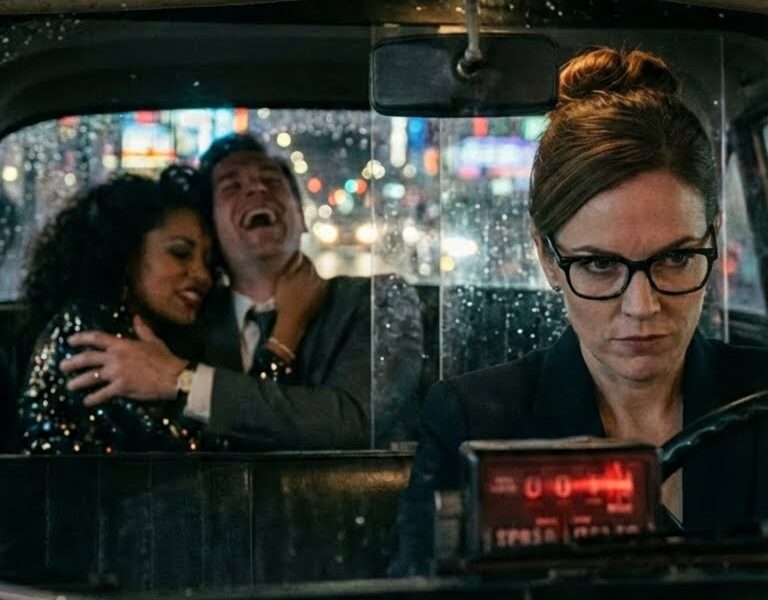
After the divorce, I changed my look and drove a taxi at night. One rainy night, he and his mistress got in my cab. They didn’t recognize me. Then I heard my ex-husband laugh in the back seat: “She’ll never find out. Hannah never questioned me. That was her fatal flaw.” My hands froze on the wheel—and I knew that night would change everything.

After the divorce, I changed my look and drove a taxi at night. One rainy night, he and his mistress got in my cab. They didn’t recognize me. Then I heard my ex-husband laugh in the back seat: “She’ll never find out. Hannah never questioned me. That was her fatal flaw.” My hands froze on the wheel—and I knew that night would change everything.
My name is Hannah Cole, and after my divorce, I didn’t just move houses; I evaporated.
I disappeared on purpose, dissolving into the gray, slush-covered veins of Chicago like salt in boiling water. I didn’t vanish because I harbored some cinematic desire for revenge, nor because I wanted to stalk the life I had lost. I vanished because, quite simply, it was the only way I could figure out how to survive.
When Mark, my husband of twelve years, left me for his twenty-something coworker, Lydia, he didn’t merely dismantle our marriage. He orchestrated a demolition. He took the house with the bay windows I had painted myself. He took the savings account we had built dollar by dollar since our twenties. But most devastatingly, he took the version of myself I recognized.
The court proceedings were a blur of legalese and humiliation. The judge, a man with a face like a crumpled paper bag, ruled “fairly,” a word that in the American legal system apparently meant I walked away with crippling debt and the keys to a studio apartment that smelled perpetually of boiled cabbage and despair.
I remember standing on the courthouse steps, the wind whipping my coat around my legs, feeling less like a woman and more like a ghost. I had been erased.
So, I leaned into the erasure. I cut my blonde hair into a jagged, severe bob and dyed it the color of midnight. I stopped wearing the pastel cardigans Mark had always liked. I scrubbed my face clean of makeup, leaving my skin pale and exposed to the biting city air. I needed money—fast, liquid, and anonymous—so I became a night-shift taxi driver.
It was a liminal existence. I lived in the hours between dusk and dawn, navigating the grid of the city while the rest of the world slept. The taxi was a confession booth where I was the priest who couldn’t speak. I saw lovers fighting, businessmen weeping, and drunks singing to the radio. I saw faces that never looked at me long enough to remember the color of my eyes. To them, I was just the back of a head, a pair of hands on a wheel, a mechanism to get from Point A to Point B.
That anonymity, I would come to learn, was not a curse. It was armor.
For three months, I existed in this fugue state. I ate cheap diner food, slept in fitful bursts during the day, and drove until my spine felt fused to the driver’s seat. I thought I had reached the bottom of the well. I thought the universe was done with me.
Then came a rainy Thursday in November.
The city was weeping, a cold, relentless drizzle that turned the neon streetlights into bleeding watercolors on my windshield. I was idling near the curb of the Palmer House Hilton, watching the doorman hustle guests into waiting cars. My radio crackled with the dispatcher’s bored voice, but I tuned it out.
A couple flagged me down. They were huddled under a shared umbrella, moving with the frantic energy of people who have somewhere important to be and someone important to impress. I unlocked the doors. They slid into the backseat, bringing with them a gust of cold air and the expensive, cloying scent of designer perfume mixed with rain.
They were laughing before the doors even closed. It was a wet, intimate sound, the sound of shared secrets and mutual adoration.
I didn’t look at them in the rearview mirror initially. I was busy resetting the meter, my eyes focused on the red digital numbers. I didn’t need to see them. I just needed to know where they were going.
“River North,” the man said. “And step on it, we’re celebrating.”
My blood froze. The world tilted on its axis.
My hands, which had been resting loosely on the steering wheel, spasmed, gripping the leather so hard my knuckles turned the color of bone.
I knew that voice. I knew the cadence, the slight arrogance in the vowel sounds, the way the pitch dropped when he was feeling superior.
I slowly, terrified of what I would see, lifted my eyes to the rectangular mirror.
It was Mark.
And nestled into the crook of his arm, looking like the cat who had not only eaten the canary but inherited its estate, was Lydia.
A scream rose in my throat, a primal, jagged thing, but I swallowed it down. It tasted like battery acid. I adjusted my glasses—thick, black frames I didn’t actually need but wore as part of my disguise—and pulled into traffic.
They didn’t recognize me. Why would they? The hair. The glasses. The shadowed interior of the cab. To Mark, Hannah Cole was a broken thing left in the rearview mirror of his life, not the person currently driving him to his celebration.
“You really think she bought it?” Lydia asked, her voice high and amused, cutting through the hum of the tires on wet asphalt.
Mark scoffed. It was a dismissive sound, one I had heard a thousand times when I asked about his late nights or missing funds. “Of course she did. Hannah never questioned me. She always trusted me. That was her fatal flaw.”
Trusted. The word hung in the air, heavy and toxic.
“And the accounts?” Lydia pressed, shifting so her hand rested on his knee. “Everything is actually clean?”
My heart was hammering against my ribs so violently I was sure the seatbelt was vibrating. I focused on the taillights of the car in front of me, praying I wouldn’t vomit.
Mark leaned back, expanding into the space, the king of his tiny, stolen kingdom. “The offshore one is safe, babe. Her name was never officially removed—just… buried. Digitally obscured. By the time she ever figures out where to look, if she ever pulls her head out of the sand, the statute of limitations will be a fortress around us.”
The air in the cab seemed to vanish.
“You’re sure the divorce judge didn’t notice the discrepancy?” Lydia asked, a hint of anxiety threading through her tone.
Mark laughed. It was a dark, ugly sound. “I made sure he didn’t. Let’s just say that favor cost me less than a month’s salary. A bargain for total freedom.”
I missed my turn. The GPS chirped a recalculation, but neither of them noticed. They were too drunk on their own cleverness, too high on the adrenaline of their successful heist.
They kept talking. For ten minutes, I was a silent witness to my own autopsy. They joked about forged disclosures. They laughed about hidden assets in shell companies. They mocked my tears in the courtroom, framing my devastation as weakness, my confusion as stupidity.
Then Mark said something that made my vision blur with red-hot rage.
“She’ll never connect the dots,” he said, stroking Lydia’s hair. “She’s too emotional. She doesn’t have the stomach for a fight. Especially not now.”
Lydia leaned forward, whispering against his neck. “Good. Because if she ever finds out the truth, Mark… we’re done. That’s prison time.”
The cab went silent after that, save for the rhythmic thwack-thwack of the wipers.
When I pulled up to the curb in River North, Mark didn’t even look at me. He tossed a twenty-dollar bill onto the front seat.
“Keep the change,” he said magnanimously.
I forced the muscles of my face into a rictus of a smile, staring into the mirror at his retreating back.
“Have a good night,” I said. My voice sounded foreign—scratchy and low.
They walked away, arm in arm, into the glittering night.
But I stayed in the car. I turned off the “For Hire” light. And then, I started to shake. Violent, uncontrollable tremors that started in my hands and rattled my teeth.
Because that night, in the rain-slicked dark of Chicago, I realized my divorce hadn’t just been a tragedy. It hadn’t just been unfair.
It had been a crime scene.
And for the first time in months, I wasn’t just a victim. I was the only witness.
I drove home in a fugue state. I don’t remember the traffic lights or the turns. I remember the rage. It was a cold, clarifying fire burning in my gut.
I didn’t sleep that night. I sat on the floor of my studio apartment, surrounded by the cardboard boxes I still hadn’t unpacked—the sarcophagi of my former life. I dug out the accordion folder labeled Divorce Documents.
For months, I hadn’t been able to look at them. The legalese had made me nauseous; the numbers had swum before my eyes. But tonight, I read them with the precision of a forensic accountant.
I wrote everything down in a spiral notebook. Every word they had said in the cab. Offshore. Buried. Judge. Bribe.
I cross-referenced their conversation with the settlement papers. And suddenly, what I had accepted as “confusing legal language” or “bad luck” began to look deliberate. There were gaps. Holes where money should have been. Transfers to entities with vague names like Apex Holdings and Cerulean LLC.
At 3:00 AM, I found it. A transfer of eighty thousand dollars, initiated two weeks before Mark asked for the divorce, moved to an account in the Cayman Islands. It was labeled “Consulting Fees.”
My husband was a mid-level marketing manager. He didn’t have consulting fees in the Caymans.
The next morning, I contacted a legal aid clinic on the South Side. I used a fake name on the initial intake form, terrified that Mark might somehow have tendrils reaching even there.
When I finally sat across from an attorney—a sharp-eyed woman named Sarah Jenkins with coffee stains on her blouse and a mind like a steel trap—I asked a simple question.
“Hypothetically,” I said, my hands clasped tightly in my lap, “what happens if assets were intentionally concealed during a divorce? And what if a judge was paid to look the other way?”
Sarah stopped typing. She took off her glasses and looked at me, really looked at me.
“That’s not a divorce case anymore, honey,” she said, her voice dropping an octave. “That’s fraud. That’s a felony. And the judgment can be reopened.”
“What would I need?” I asked. “To prove it?”
“Evidence,” she said. “Documents are good. But confessions? Confessions are the holy grail. If you can prove they knew they were breaking the law… you can bury them.”
I walked out of that clinic with a plan forming in the back of my mind. A dangerous, insane plan.
I spent the next two weeks stalking my ex-husband.
Not in a way that would get me arrested, but in a way that only a night-shift driver could. I learned their patterns. Thursday nights. They always went out on Thursday nights to celebrate the end of the work week. They always started at the Palmer House bar for cocktails, then moved to River North for dinner around 8:00 PM.
I knew the rhythm of the city. I knew that when it rained, taxis were scarce, and people became desperate. They wouldn’t look closely at the driver. They would just be grateful for the ride.
I also invested in something my taxi company didn’t require but allowed: a high-definition dual-lens dash camera with interior audio recording.
I installed it myself, tucking the wires into the headliner. I put a small sticker on the passenger window: Audio and Video Recording in Progress. It was legally required in Illinois, but I knew Mark. He never read the fine print. That was why he was in this mess to begin with.
I was ready.
Two Thursdays later, the forecast called for a thunderstorm.
I positioned myself outside the Palmer House at 7:45 PM. I turned off my app so I wouldn’t get other hails. I waited. The rain lashed against the roof of the car, a drumbeat for my anxiety.
My palms were sweating against the wheel. What if they don’t come? What if they take an Uber? What if he recognizes me this time?
7:52 PM. The revolving doors spun.
There they were.
Mark was wearing a trench coat I had bought him for his birthday three years ago. Lydia was in a silver dress that shimmered like fish scales. They looked radiant. They looked guilty.
They stepped to the curb, scanning the street. A businessman stepped in front of them to hail a cab. Mark shouted something aggressive, pushing forward.
I pulled up. I didn’t wait for the wave. I rolled precisely to where they were standing and unlocked the doors.
“Taxi?” I called out, deepening my voice, keeping my face turned toward the dash.
“Finally!” Mark grumbled, holding the door open for Lydia.
They piled in.
“Where to?” I asked, my eyes fixed on the rain-streaked windshield.
“Sugo’s on grand,” Mark commanded. “And try to miss the potholes this time, will you?”
I didn’t answer. I just reached up and tapped the dash cam. A tiny red light blinked to life.
We merged into traffic.
For the first five minutes, they talked about mundane things—office politics, a vacation they were planning to Tulum. My heart sank. I needed them to talk about the money. I needed the confession.
I decided to take a risk. A massive, calculated risk.
“Bad weather for driving,” I mumbled, loud enough for them to hear. “Radio says the flooding is gonna get the basements in the suburbs. Hope you folks got good insurance. My cousin got wiped out last year. Lost everything. Banks didn’t leave him a dime.”
It was a generic complaint, but I knew Mark. He couldn’t resist correcting someone he viewed as inferior. He couldn’t resist bragging.
“Insurance is for suckers,” Mark said to Lydia, loud enough for me to hear. “You don’t need insurance if you know how to hide your assets, right?”
Lydia giggled, but it sounded nervous. “Mark, shh. The driver.”
“The driver doesn’t care,” Mark said, his arrogance swelling like a balloon. “He’s just happy to get a tip. Besides, like I told you, Hannah is never going to find the Cayman accounts. She’s probably eating ramen in a basement somewhere.”
My grip on the wheel tightened until my tendons screamed. Keep talking, I willed him. Dig your grave.
“I still worry about the transfer logs,” Lydia whispered, but the high-gain microphone picked it up perfectly. “The eighty thousand you moved right before the filing. If they audit the LLC…”
“They won’t audit Apex Holdings,” Mark assured her. “I told you, Judge Reynolds made sure the file was sealed. Sealed, Lydia. That means buried. Forever. It cost me five grand in cash in an envelope, but it bought us a lifetime of peace.”
I almost crashed the car.
He had named the judge. He had named the shell company. He had admitted to bribery.
The little red light on the dash blinked steadily. Record. Record. Record.
“She was so weak,” Mark continued, rewriting history for his audience of one. “She just sat there crying in the lawyer’s office. She didn’t even read the final decree. I could have stolen the teeth out of her head and she would have thanked me.”
Tears pricked my eyes, hot and angry. Weak, he called me.
I looked in the mirror. I saw the man I had washed socks for, the man I had nursed through the flu, the man I had loved. And I saw a stranger. A parasite in a trench coat.
“Well,” I said, my voice trembling slightly, masquerading as a cough. “Here we are.”
I pulled up to the restaurant.
Mark didn’t tip me this time. He threw the exact fare on the seat.
“Drive safe,” he said dismissively.
As the door closed, I locked it. I sat there for a moment, listening to the rain.
Then, I reached up and stopped the recording. I popped the SD card out of the camera and held it in my hand. It was smaller than a postage stamp.
It weighed a ton.
I didn’t go home. I drove straight to an all-night internet cafe. I made three copies of the audio file. I uploaded one to a secure cloud server. I emailed one to Sarah Jenkins. I put the third on a thumb drive and wore it around my neck.
The next morning, I walked into Sarah’s office without an appointment. I placed the thumb drive on her desk.
“You told me confessions were the holy grail,” I said, my eyes dark with lack of sleep but bright with victory. “I brought you the cup.”
Sarah plugged it in. We sat in silence as Mark’s voice filled the small, dusty office. We heard the arrogance. We heard the specific details of the fraud. We heard him admit to bribing Judge Reynolds.
When the recording ended, Sarah sat back in her chair. She let out a long, low whistle.
“They handed you a gift,” she said, a slow, terrifying smile spreading across her face. “They didn’t just confess. They implicated a sitting judge. Hannah, this isn’t just a reopened divorce case. This is a district attorney’s dream.”
The wheels of justice, usually slow and rusty, began to spin with terrifying speed.
Sarah filed an emergency motion to reopen the judgment based on newly discovered evidence of fraud. She attached a transcript of the recording. She subpoenaed the bank records of Apex Holdings. She sent a notification to the Ethics Committee regarding Judge Reynolds.
The element of surprise was absolute.
Subpoenas went out like drone strikes. Mark’s accounts were frozen on a Tuesday morning. I imagined him trying to buy his morning latte and getting a “Declined” message. The image kept me warm.
The offshore bank in the Caymans, facing pressure from federal investigators regarding money laundering, cooperated immediately. They released the logs. The eighty thousand dollars was there. The transfer dates matched.
Mark’s confidence evaporated overnight.
He tried to contact me. It started with confusion.
Hannah, there’s been a mistake with the bank. Call me.
Then, desperation.
We need to talk. Don’t do this. We can settle this privately.
Then, threats.
You think anyone will believe a taxi driver? You’re crazy. I’ll ruin you.
I didn’t respond. I blocked his number. I didn’t need to speak to him. My lawyer was doing all the talking for me.
The revised court hearing was set for two months later.
The courtroom was different this time. The air was sharper.
Mark sat at the defense table. He looked smaller. The trench coat seemed too big for him now. He was pale, his eyes darting around the room like a trapped animal. Lydia wasn’t there. Rumor had it she had moved out the day the accounts were frozen, taking her silver dresses and her survival instincts with her.
A new judge presided over the case—a stern woman with no patience for nonsense.
When my name was called, I stood up.
I wasn’t wearing my taxi driver disguise. I had grown my hair out slightly, styled it. I wore a tailored suit I had bought at a thrift store and had altered to fit perfectly. I wore lipstick.
I turned and looked at Mark.
For the first time in a year, our eyes met.
I saw the shock register on his face. He was looking for the broken woman he had left in the dust. He was looking for the “weak” wife who cried in offices.
Instead, he saw the Night Driver. He saw the woman who had navigated the darkest streets of Chicago alone. He saw the witness.
The hearing was brutal and short.
Sarah played the recording.
Mark’s voice echoed off the mahogany walls. Sealed means buried… Insurance is for suckers… She’s too emotional.
Every person in the courtroom heard it. The court reporter stopped typing to listen. The bailiff shook his head.
Mark put his head in his hands.
The ruling was decisive. The original settlement was vacated. The judge ruled that Mark had committed perjury and fraud.
I was awarded the house. I was awarded the entirety of the hidden Cayman account. I was awarded punitive damages that decimated what was left of Mark’s savings.
But the judge wasn’t done.
“Mr. Cole,” she said, her voice like a gavel strike. “I am referring the matters of bribery and fraud to the District Attorney’s office. You should expect to be taken into custody pending an indictment.”
Two officers stepped forward.
As they led Mark away, he turned to look at me one last time. His arrogance was gone. He looked terrified. He looked at me as if asking, How? How did you do this?
I didn’t smile. I didn’t wave. I just watched him disappear through the side door.
I didn’t feel the surge of triumphant joy I had expected. I didn’t feel like dancing.
I felt something better.
I felt lighter.
I quit driving taxis a month later.
I didn’t quit because I was ashamed of the work. That job had saved my life. It had taught me how to listen, how to watch, and how to be patient. But I didn’t need to hide in the dark anymore.
I sold the big house with the bay windows. It held too many ghosts. I used the money to buy a modest, bright condo in Lincoln Park with a view of the lake. I started a small business helping women navigate financial abuse during divorces.
People often ask me if I planned it. They ask if becoming a taxi driver was some elaborate, Count of Monte Cristo revenge plot.
It wasn’t.
It was survival. I was just trying to keep my head above water.
But here is what I learned in the backstreets of Chicago: invisibility is a superpower.
When people think you are nobody—when they see a uniform, a service worker, a “weak” ex-wife—they reveal their true selves. They take off their masks because they don’t think you are worthy of the performance.
Mark thought I was invisible. He thought I was a ghost he had successfully exorcised.
He was wrong. I wasn’t a ghost. I was the karma he never saw coming.
If you have ever been underestimated, ignored, or written off, remember this: Your quiet moments are not wasted. They are preparation. You are gathering data. You are learning the terrain.
And if you are sitting in the back of a taxi tonight, whispering secrets you think are safe… take a look at the eyes in the rearview mirror.
You never know who is listening. And sometimes, justice is just waiting for the right turn.