“I… I can’t move my legs,” the six-year-old whispered to 911, holding back tears. What doctors uncovered after she was rescued left the entire room completely silent…

“I… I can’t move my legs,” the six-year-old whispered to 911, holding back tears. What doctors uncovered after she was rescued left the entire room completely silent…
The first thing people don’t understand about 911 is that we don’t hear emergencies the way movies do.
We don’t hear clean dialogue with dramatic pauses and perfectly timed sirens in the background. We hear the real thing. We hear the ugly parts. The parts people don’t record because they don’t want to remember them later.
We hear the quietest sounds first.
A breath that doesn’t match the words.
A swallow that comes too late.
A door closing somewhere far away when the caller swears they’re alone.
We hear what isn’t said.
I have spent twenty-two years learning that kind of listening. Twenty-two years as a ghost.

My name is Helen Ward. I live in a windowless room in Silverwood, Michigan, surrounded by the low hum of cooling fans and the smell of ozone. I exist under fluorescent lights that turn every face pale and tired. To the people who call me, I am not a person. I am a disembodied voice. A lifeline. A confessor. Sometimes the last thing they ever hear.
The dispatch center has its own weather. A pressurized silence that sits heavy on your chest. It smells like stale coffee, industrial carpet cleaner, and the metallic tang of adrenaline that seems to leak out of the operators sitting in the glowing blue dark. We make our world small because if we let it be as big as the one outside, it would swallow us.
Most people think my job is about talking. They imagine me shouting instructions, commanding responders, calming sobbing strangers with perfectly measured words.
They’re wrong.
The job is about listening until the truth shows itself.
It was a Tuesday morning in late October—the kind of deceptive autumn day where the sun is bright but gives no warmth. Outside, the maples of Silverwood were burning with gold and crimson, dying beautifully. Inside, my world was reduced to three monitors, a headset, and a mug of coffee that had been reheated so many times it tasted like regret.
The morning had been slow. A fender bender on Route 9. A neighbor dispute over a barking dog. Routine calls. The kind that let your guard down if you’re careless.
I had just lifted my mug—my third lukewarm coffee of the shift—when my headset chirped.
It wasn’t the sharp, urgent ring of a cell phone patch.
It was the dull, heavy tone of a landline.
Rare these days.
Landlines usually mean the elderly, or the very poor, or someone who has lived long enough to be afraid of change.
“911, what’s your emergency?” I said.
My voice was on autopilot—steady, professional, detached. It is a shield you build layer by layer, year by year. You cannot survive this job if you let panic in through the cracks.
For a long, agonizing moment, there was no response.
I pressed the headset tighter against my ear. “911, this is a recorded line. Can you state your emergency?”
Nothing.
But it wasn’t empty silence.
It was living silence.
I could hear breathing—wet, rhythmic, shallow and terrified. It sounded like a small animal trapped in a wall. There was a faint buzzing too, but it was so soft I couldn’t be sure if it was the line, my headset, or something in the room.
I leaned forward. My coffee cooled in my hand, forgotten.
My fingers hovered over the volume knob, and I turned it up until the static became a hiss under the breath.
“Hello?” I softened my tone, letting the authoritative dispatcher voice slip away and the human one come forward. “I can hear you breathing. You don’t have to be scared. My name is Helen. Can you tell me what’s wrong?”
A small voice finally answered, fragile as spun glass.
“There’s… there’s ants in my bed… and my legs hurt.”
My hand froze over the keyboard.
Ants.
Kids call about strange things sometimes. Nightmares. Monsters. Shadows under the bed. But this voice didn’t sound like a child describing a bad dream. It sounded like a child describing a truth she couldn’t afford to embellish.
The trace was triangulating, bouncing off old copper wires. I watched the address field blink “Searching…”
“Okay,” I said softly. “You’re doing a really good job talking to me. What’s your name, sweetheart?”
“Mia,” she whispered. The name trembled as if it weighed too much. “I’m six.”
Six.
My grandson Leo was six. He was probably in first grade right then, worrying about whether he’d get the red crayon or the blue one. Mia was somewhere else, trapped in a world that didn’t feel safe enough for crayons.
“Mia,” I said, slow and gentle, “are you alone right now? Is your mommy or daddy there?
“Mommy went to work,” she whimpered. A wet sniffle followed. “She works at the diner. She told me… she told me not to open the door for anybody. Not ever.”
A latchkey kid.
It wasn’t uncommon in Silverwood. The factories had closed ten years ago, and the town had been bleeding out ever since. Parents worked two, three jobs just to keep the lights on. Leaving a six-year-old alone wasn’t always negligence born of malice. Sometimes it was the only option between rent and hunger.
Still, my stomach tightened.
“Mia,” I asked carefully, dread coiling in my gut, “you said your legs hurt. Where do they hurt?”
“Everywhere,” she whispered. “It burns.”
A sharp gasp followed, an involuntary sound of pain so sudden my own body flinched.
“It feels like… like fire.”
My brain started pulling up its internal index. Swelling. Burning. Impossibility to move. Weakness.
“Mia,” I said, keeping my voice calm because her nervous system would mirror mine, “can you tell me… can you move your legs?”
“No,” she whispered.
And then she said the words that stopped my heart cold.
“I can’t close them.”
My hand froze midair.
The dispatch room around me seemed to drop ten degrees, like my body had triggered its own internal winter.
“Okay,” I said, forcing steadiness. “Mia, I’m here. You’re not alone. When you say you can’t close them… do you mean you can’t put your legs together?”
“I can’t,” she whimpered. “They’re… too big.”
Too big.
Swollen.
Fire ants.
I didn’t want to jump to conclusions. You never jump on one symptom. That’s how you miss the real one. But I’d been doing this long enough to know what my gut was screaming.
“All right, Mia,” I said, typing with my right hand while my left pressed the headset tight. “I’m going to send someone to help you. I promise.”
The address field finally populated.
404 Elm Street.
My chest tightened.
Elm Street was on the south side, down by the old textile mill. A neighborhood of crumbling bungalows and overgrown yards where streetlights had been broken for months. A place where “help” sometimes arrived late because resources were thin and the town had learned to triage suffering.
I signaled my supervisor, David, waving hard over the partition. I mouthed: Child alone. Medical distress. Possible shock.
David’s eyes widened immediately. He slid his headset on to listen in, then nodded sharply—keep her talking.
I dispatched the nearest units.
“Dispatch to Unit 4-Alpha and 4-Bravo,” I spoke into the main channel, voice snapping back into command tone. “Respond to 404 Elm Street. Six-year-old female, unaccompanied. Reports severe pain, swelling, immobility. Possible insect infestation, possible allergic reaction. Priority One.”
“Copy, Dispatch. 4-Alpha rolling,” came the voice of Officer James Keller.
James was good. A father of three girls. A man who didn’t treat calls like numbers. If anyone could walk into a chaotic scene and keep his head, it was him.
But he was ten minutes out.
Ten minutes can be forever.
“Mia,” I said, voice dropping soft again, “I need you to stay on the phone with me, okay? Friends are coming in a big car with loud sirens. Can you do that?”
“I’m tired,” she slurred.
My heart lurched.
Her voice was changing. Losing crispness. Becoming thick, heavy.
No, no, no.
“No sleeping,” I said, not caring if my voice rose a little. “Mia, listen to me. I need you to keep talking to me. Can you tell me what you can see in your room?”
“I can see… the TV,” she mumbled. “Cartoons.”
I could hear it faintly now—the manic cheerfulness of morning animation. Bright music. Fake laughter. Sound effects.
It was grotesque, hearing that childish soundtrack behind the wet, terrified breathing of a real child in danger.
“Okay,” I said. “Cartoons are good. Can you tell me… can you look out the window?”
“I can’t… move,” she sobbed, weak and breathless. “It hurts to move.”
“Okay,” I said, making myself slow down. “That’s okay. You don’t need to move. You’re doing everything right. Mia, can you tell me… are there lots of ants?”
“Yes,” she breathed. “They are red. They are everywhere.”
Red.
Fire ants.
My mind clicked into a different gear. I’d heard calls like this before. Not often. But enough to know what it looked like when an allergy became a race against time.
“Mia,” I said, speaking slowly, clearly, “your body is having a big reaction. That’s why your legs feel big and why you feel sleepy. I need you to fight the sleep, okay? Like a superhero.”
A tiny pause.
“Like… like Batman?” she whispered.
“Exactly like Batman,” I said, lying gently. “Batman doesn’t sleep when he’s on a mission. And your mission is to wait for the sirens.”
I signaled David again, and he spoke into the radio with me, coordinating EMS.
“Ambulance is en route,” he mouthed.
“Mia,” I said, “what color is your house? I need to tell the officer how to find you.”
“It’s… green,” she managed. “Paint is falling off. Like… scabs.”
My throat tightened at that.
“And there’s… a broken flower pot by the stairs.”
“Good girl,” I whispered. “You’re doing so well. Stay with me.”
I broke protocol and keyed into the officer channel, because at a certain point protocol becomes less important than a living child.
“James,” I said into the radio, using his first name, “she’s going into shock. I think it’s anaphylaxis. She’s fading.”
“I’m putting the pedal through the floor, Helen,” James’s voice crackled back, tight with tension. “ETA three minutes.”
Three minutes.
I kept Mia talking like my voice could physically hold her airway open.
“Tell me about your favorite stuffed animal,” I asked.
“Mr… Mr. Bear,” she whispered. “But he’s covered in them too.”
The image hit me—small room, ants crawling, a child trapped in her bed, swelling, burning, terrified.
“Mia,” I said, voice low, “you’re very brave. You’re doing the hardest part right now. Just keep listening for the siren.”
Her breathing turned wetter.
A sound like she was trying to pull air through something narrowing.
“Mia?” I said quickly. “Are you still there?”
Silence.
My stomach dropped.
“Mia!” I shouted, not caring who in the room heard me.
A gasp.
“I’m… here,” she wheezed. The sound was thin, like breathing through a straw.
“Okay,” I said, steady but urgent. “Listen for the siren. It’s coming. It’s so close.”
And then, through the line, I heard it faintly—a distant wail. Siren sound filtering through blankets on windows, through a cracked foundation, through fear.
“Mia,” I said, “do you hear it?”
“Maybe,” she whispered, and even that word sounded heavy.
In the field, James Keller whipped his cruiser around Main and Elm, tires skidding. Siren bouncing off boarded-up storefronts and empty factories.
He saw the house immediately.
Sad lime-green bungalow. Overgrown yard. Rusted bike parts. And that broken flower pot by the porch—split in half like it had fallen and never been fixed.
James stepped out and immediately swatted at his ankle.
Ants.
A thick, rusty line of them flowed up the porch steps and disappeared under the door.
“Jesus,” he muttered into his mic. “Dispatch, I’m at the scene. Ambulance is thirty seconds behind.”
He didn’t wait.
He kicked the door just below the lock plate.
Rotting wood splintered with a sickening crunch.
Inside, the smell hit him: damp carpet, old frying oil, and a sharp sweet chemical tang he recognized—ant pheromones.
“Mia!” he shouted.
No answer.
He sprinted down the hallway and pushed into the bedroom.
Then he stopped dead.
The room was alive.
Walls crawling.
Nightstand swarming.
But the bed was the epicenter.
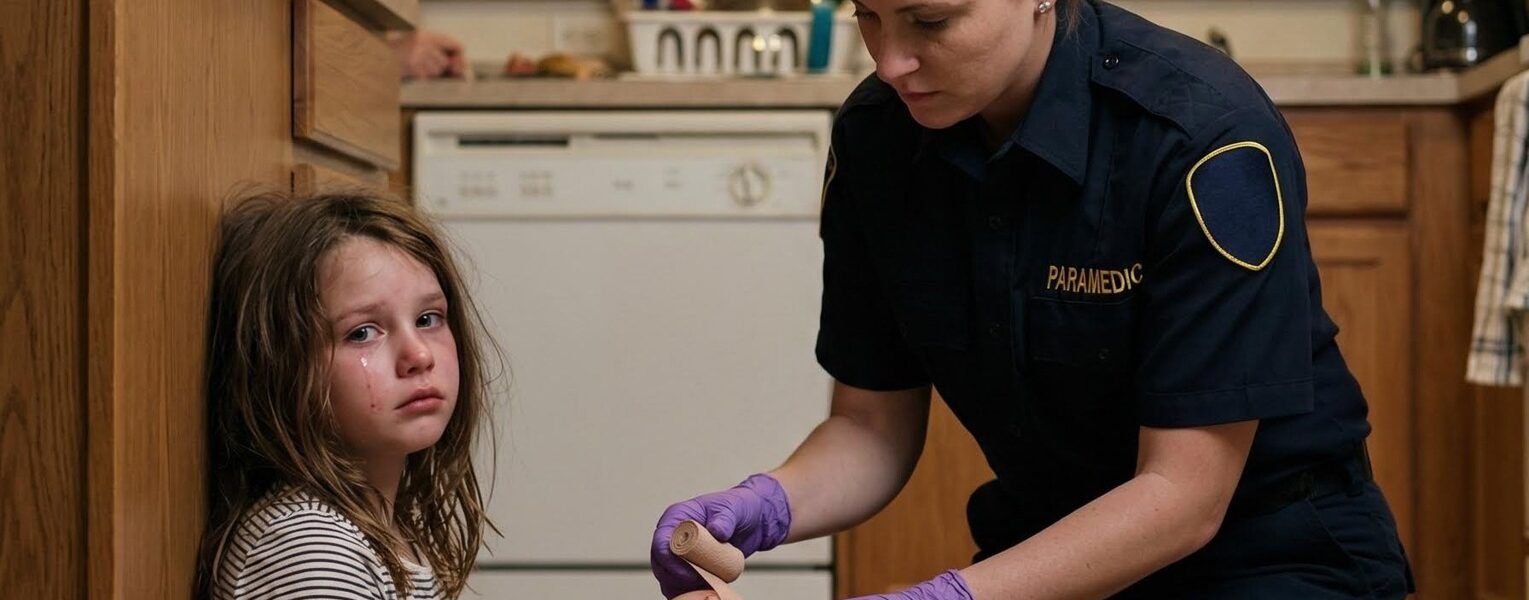
Mia lay on the mattress, eyes wide and glassy, body frozen. She wasn’t moving. She couldn’t.
Her legs were swollen to three times their size, the skin stretched shiny and tight. Red welts merged into a single furious map.
The swelling forced her legs outward.
She literally could not close them.
And the ants moved over her flesh in chaotic biting frenzy.
The paramedics rushed in, profanity catching in their throats.
“Get her out,” James barked, voice raw. “Now.”
He grabbed the sheet, wrapped it around her upper body, scooped her up.
She was light—terrifyingly light. Hot with fever. And when she found his face, she made a tiny sound that was more whimper than word.
“Am I… in trouble?” she slurred.
James felt a lump rise in his throat.
“No,” he said fiercely, running. “You’re not in trouble. You’re the bravest kid I’ve ever met.”
Back in dispatch, the line went dead.
I sat with my headset pressed to my ear, listening to static like it could tell me whether she was alive. David stood behind me, hand on my shoulder, grounding me.
Radio chatter came through.
“Airway compromised. BP 70/40. Administering epi. Code 3 to St. Jude’s.”
My hands shook so badly I couldn’t type.
“Did she make it?” I whispered.
“They have a pulse,” David said softly. “She’s fighting.”
Two hours later, the update came.
She’d been stabilized. ICU. Severe anaphylaxis. Hundreds of bites. Another ten minutes and her airway would’ve closed completely.
Relief hit me so hard my eyes burned.
Then James texted me something that made that relief change shape.
“The mom got here. Works double shifts at the diner. Didn’t know there was a nest under the foundation. She collapsed in the hall when she saw Mia.”
I pictured the mother—exhausted, guilty, probably already blaming herself in the way the poor always do when the world hurts their child.
Because she couldn’t afford a better house.
Because she couldn’t afford to be home.
Because survival demanded absence.
That evening, just before my shift ended, a message came from the hospital liaison.
“Mia wants to speak to the ‘phone lady.’ Nurse says it might calm her.”
I went to the soundproof booth and picked up the handset like it weighed something sacred.
“Hello?” I whispered.
“Helen?” the voice rasped.
Weak.
Groggy.
But alive.
“It’s me,” I said, and my throat tightened. “Hi, Mia.”
“Did… did the ants go away?” she asked.
“Yes,” I told her. “Officer James and his friends made sure they’re gone. You’re safe.”
A pause.
Then a tiny rustle.
“The doctor gave me a bear,” she said. “He doesn’t have honey. He has a bandage.”
I laughed, wet and shaky.
“A bandage bear is the best kind,” I said. “That means he’s tough. Just like you.”
“Helen?” she whispered again, smaller.
“Yes, baby?”
“Thank you for helping me close the door.”
For a second I didn’t understand.
Then I did.
She wasn’t talking about the front door.
She was talking about terror.
“You’re welcome,” I whispered. “You rest now.”
Three months later, winter had settled over Silverwood again. Snow covered the old factories and broken streetlights, making the town look clean if you didn’t look too close.
I was sorting through morning mail when I found a brightly colored envelope addressed to:
THE LADY WHO LISTENS
Inside was a crooked piece of construction paper with a drawing in crayon.
A stick figure girl with red polka dots on her legs—but she was standing up.
Next to her was a tall police officer in blue.
And a woman at a desk with a giant headset.
Underneath, shaky block letters:
DEAR HELEN.
MY LEGS ARE FIXED.
MOMMY GOT A NEW APARTMENT. NO ANTS.
I AM BRAVE LIKE BATMAN.
LOVE, MIA.
I pinned it to the fabric wall of my cubicle next to my emergency codes and the photo of my grandson.
People think this job is about sirens.
It isn’t.
It’s about the moment before the sirens.
The whisper.
The breath.
The child who calls because she has nothing else.
Sometimes help arrives with flashing lights.
Sometimes it starts with a voice in the dark.
And as long as there is someone there to answer, there is hope.