CEO Fires a Woman for Being 5 Minutes Late – Three Weeks Later, on a Freezing Park Bench, He Kneels Before the Woman He Once Fired
Five Minutes Late
In Jonathan Hale’s world, time meant far more than clocks and calendars.
Time was discipline. Time was respect. Time was control. And being five minutes late meant you didn’t belong.
Jonathan had built his success around that philosophy. He ran a major property and investment firm in Chicago, managing luxury residences, commercial developments, and a network of contracts that rewarded precision and punished weakness. He valued clean lines, rigid routines, and people who followed instructions without excuses.
For illustrative purposes only
That was why, on a quiet Tuesday morning, when the woman who cleaned his mansion arrived five minutes after her scheduled start time, he didn’t pause.
He didn’t even lift his eyes from his phone.
“You’re dismissed,” he said flatly.
She stood motionless in the marble kitchen, hands folded over her worn uniform. Her eyes were red-rimmed, as though sleep had barely touched her.
“I’m sorry,” she said softly. “The train was delayed, and my mother—”
Jonathan raised his hand.
“I don’t need explanations,” he replied. “I need reliability.”
She nodded, swallowing the rest of her words, and quietly collected her belongings. He watched only long enough to ensure the door had closed behind her.
Then he turned back to his coffee, already behind schedule for his next meeting.
He never asked her name.
A City That Teaches You Not to Look
Three weeks later, Chicago settled into one of those winters that arrived without spectacle.
There was no blizzard.
No screaming wind.
Just cold.
The kind that slipped under coats and gloves, crept into bones, and made even familiar streets feel hollow.
Jonathan left a late board meeting downtown and chose to walk through Lincoln Park before heading home. It was a habit he kept when his thoughts grew too loud. At night, the park was quiet, its paths lit by aging streetlamps that flickered as if unsure whether to stay awake.
His coat was expensive, perfectly insulated. His shoes barely whispered against the frost-dusted pavement.
He walked briskly, his mind still tangled in contracts, acquisitions, and the numbers that ruled his days.
That was when he noticed the bench.
At first, it barely registered. Just another bundled shape beneath layers of fabric, another person the city had trained him not to see.
In Chicago, ignoring hardship wasn’t always cruelty.
Sometimes, it felt like survival.
Jonathan took three steps past the bench before something made him slow.
It might have been the stillness.
Too still.
Or the way the figure curled inward, arms locked tightly around a faded canvas bag, as if it were the only thing keeping her whole.
With a quiet sigh—more at himself than anything else—Jonathan turned back.
The streetlamp above the bench flickered, throwing uneven light across the woman’s face.
And suddenly, the world seemed to tilt.
For illustrative purposes only
Recognition Under a Flickering Light
Jonathan forgot to breathe.
The curls were unmistakable.
The soft curve of her cheek.
The faint scar near her eyebrow.
His chest tightened.
“No…” he murmured. “That can’t be…”
He stepped closer.
It was her.
Maya.
The woman he had fired for being five minutes late.
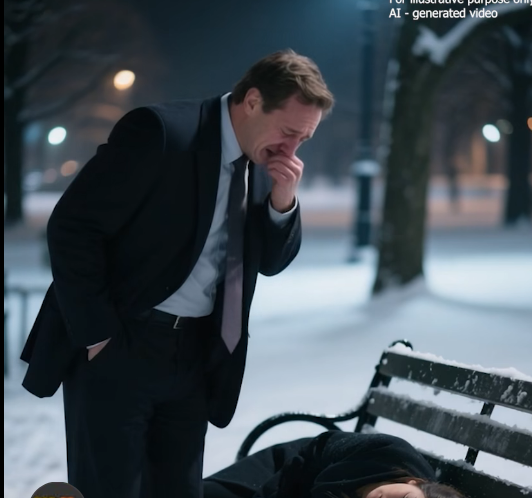
She was slumped sideways on the bench, her head tilted at an unnatural angle. Her skin looked pale under the weak light, her lips faintly discolored by the cold.
Jonathan dropped to one knee beside her.
“Maya,” he said quietly, touching her arm. “Maya, can you hear me?”
She didn’t respond.
Unease surged through him.
“Maya,” he said again, louder.
Nothing.
Her hands were clenched tightly against her chest, fingers wrapped around something he couldn’t see. Carefully—almost reverently—Jonathan eased her grip open.
What he found made his chest ache.
The Paper She Wouldn’t Let Go
It was a hospital statement.
Folded and refolded until the paper had softened along the creases.
Patient Name: Elena Rivera Outstanding Balance: $3,860 Payment Due: December 20
Jonathan stared at the date.
It was December 22.
Two days overdue.
In her other hand was a small roll of cash—tens, fives, a few crumpled bills. Hardly enough to matter, yet held as if it were priceless.
Memory struck sharply.
That morning in his kitchen.
The exhaustion in her eyes.
The tremble in her voice when she tried to explain.
He hadn’t asked about her mother.
He hadn’t listened.
Without thinking, Jonathan shrugged off his coat and wrapped it around her frail frame, pulling it tight around her shoulders.
“Hold on,” he whispered, his voice unsteady. “Please.”
He pulled out his phone and called for help, words spilling out faster than he could control.
“I need an ambulance,” he said. “Lincoln Park, near the main entrance. She’s unconscious and exposed to the cold. Please hurry.”
When the call ended, he stayed there, kneeling beside her, refusing to look away.
For the first time in years, Jonathan Hale did not move on.
Waking to White Light
Maya woke slowly.
The first thing she noticed was the sound—a steady, mechanical rhythm. The second was the smell: sharp, sterile, overwhelming.
She tried to open her eyes, but the light burned.
“Easy,” a voice said gently. “You’re safe.”
She turned her head.
Jonathan Hale sat beside the hospital bed.
His tie was loosened. His hair slightly out of place. Dark circles framed his eyes, as if sleep had avoided him.
For a moment, she thought she was dreaming.
“Am I… not here anymore?” she whispered.
Jonathan shook his head.
“You’re still here,” he said softly.
She tried to sit up, but pain surged through her body.
“Don’t,” he said quickly. “The doctor said you were severely dehydrated and exposed to the cold for too long. You arrived just in time.”
Tears slid silently along her temples.
For illustrative purposes only
Her thoughts rushed to one place.
“My mom,” she said. “The hospital bill…”
Jonathan lowered his gaze.
For a heartbeat, fear filled her chest.
Then he spoke.
“It’s paid.”
Maya’s eyes widened.
“What?”
“All of it,” he said. “And she was transferred to a better facility this morning. She’s stable.”
Maya turned her face toward the pillow, her shoulders trembling.
She cried—not because of money, but because someone had finally seen her.
The Question That Couldn’t Be Avoided
Later, when the room grew quiet, Maya looked back at him.
“Why?” she asked softly. “You didn’t even listen to me before.”
Jonathan leaned forward, resting his elbows on his knees.
For the first time since she had known him, uncertainty crossed his face.
“Because I was wrong,” he said. “And because I was comfortable being wrong.”
He rubbed his face, shame carved into every line.
“I built a life where ignoring people like you was easy,” he continued. “And I convinced myself that was normal.”
Maya listened, her heart heavy.
Then Jonathan took a slow breath.
“While you were unconscious, I started asking questions,” he said. “About my company. About our partnerships.”
His jaw tightened.
“The hospital treating your mother is one of many we pressured with unethical pricing agreements,” he admitted. “Your suffering wasn’t an accident. It was part of the system I benefited from.”
A chill settled deep inside her.
“So my mother paid the price,” she said quietly.
Jonathan nodded once.
“Yes.”
No excuses.
No justifications.
“I’m going to dismantle it,” he said. “Even if it costs me everything.”
When the Truth Came Out
Three months later, Jonathan Hale’s name dominated the headlines.