Beneath the Frozen River Where Silence Learned to Cry, One K9, One Broken Officer, and a Forgotten Baby Exposed the Darkest Lie a Corrupt City Ever Tried to Bury Alive

Beneath the Frozen River Where Silence Learned to Cry, One K9, One Broken Officer, and a Forgotten Baby Exposed the Darkest Lie a Corrupt City Ever Tried to Bury Alive
Beneath the Frozen River Where Silence Learned to Cry, One K9, One Broken Officer, and a Forgotten Baby Exposed the Darkest Lie a Corrupt City Ever Tried to Bu:.ry Alive
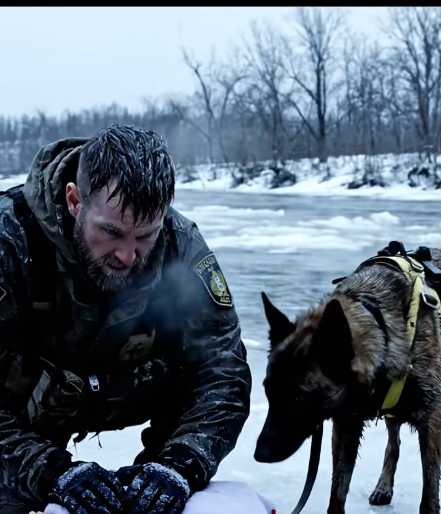
The river made a sound that morning that Elias Monroe had learned to distrust over years of winter patrols, a faint brittle clicking beneath the wind that most people mistook for harmless ice shifting, but which to him sounded like warning bones snapping slowly under pressure, and it was that sound, thin and uneven, that caused Atlas to stop so abruptly that the leash went taut and nearly burned Elias’s palm through his glove.
Atlas did not bark, did not growl, did not move at all, and that was what frightened Elias most, because his Belgian Malinois had many tells when he caught a scent, but this posture, rigid and locked, muscles drawn tight along his spine, ears angled forward as if listening to something beneath the surface of the world, only happened when something was deeply wrong. The Hawthorne River slid past them in dark, heavy sheets, the water slow but powerful, carrying broken ice like scattered teeth, and Atlas’s eyes were fixed on one particular place near the bank where the reeds bent unnaturally, as if something had recently disturbed them and then vanished.
Elias took a cautious step forward, meaning to check the footing, meaning to restrain the dog before instinct overruled training, but Atlas launched himself down the muddy slope without hesitation, the leash ripping free from Elias’s grip as his boots slid uselessly on frozen ground. The dog hit the water hard, disappearing waist-deep into the black current, and the shock of it punched the breath from Elias’s chest even before he followed, because there was no universe in which he stood on shore and watched his partner drown alone.
Cold swallowed him instantly, a violent, searing grip that turned his limbs heavy and uncooperative, but Elias forced himself forward, teeth clenched so hard his jaw screamed, fighting the current that tried to twist him sideways and steal his footing. Atlas had clamped his jaws onto something submerged, something heavy, and he pulled with a relentless fury that came from a place deeper than obedience, dragging the object inch by inch toward the bank while Elias grabbed the harness straps and added his own strength until together they hauled a soaked tactical backpack onto the icy shore.
The bag was wrong immediately, wrong in a way Elias felt in his gut before his brain caught up, because it was too carefully sealed, too deliberately weighted, and Atlas began clawing at it with frantic urgency, whining in a pitch Elias had only heard once before, years ago, on a night that had ended with a folded flag and a knock on a stranger’s door. His hands shook as he cut the zipper open with his knife, fabric tearing unevenly, and when he peeled the flap back, time seemed to hesitate, as if the world itself was unsure whether to let him see what was inside.
Wrapped tightly in a pale lavender fleece was a baby.

For half a second Elias’s mind rejected the image entirely, because the infant was too still, too pale, the tiny lips tinged blue, the skin waxed by cold into something that looked unreal, and silence pressed down so heavily that his ears rang. Memory surged without permission, sharp and brutal, because seven years earlier he and his wife had buried a daughter who never took a breath, and that grief had carved itself into his ribs so deeply that moments like this felt less like new pain and more like old wounds reopening on command.
“No,” Elias whispered, voice breaking before it fully formed, but Atlas barked once, sharp and commanding, snapping him back into motion like a lifeline thrown to a drowning man, because training existed precisely for moments when emotion threatened to paralyze. Elias laid the baby on the blanket, positioned his fingers carefully, and began compressions with controlled precision despite the way his hands trembled and his vision blurred, counting rhythmically, breathing for her, begging under his breath for a miracle he didn’t believe he deserved to witness again.
Seconds stretched grotesquely, turning elastic and cruel, until the infant’s tiny body spasmed, a fragile cough broke free, and then a cry emerged, thin and raw but undeniably alive, and Elias nearly collapsed with relief so intense it felt like pain. He pulled the baby against his bare chest, ignoring the way cold bit into his skin, because warmth mattered more than comfort, and ran for his cruiser with Atlas bounding behind him, paws slapping wet ice like a drumbeat racing death itself.
He drove as if the road were on fire, one hand on the wheel, the other shielding the baby’s head, voice shaking as he radioed in an infant recovered from the river with severe hypothermia, code three to Northlake Memorial, whispering reassurances to a child who had no reason yet to trust the world.
The hospital swallowed them in motion and noise, doctors and nurses appearing in a rush of scrubs and gloved hands, and the baby vanished down a corridor under harsh lights while Elias stood dripping river water onto polished tile, chest heaving, staring at the space she had occupied as if his focus alone could keep her alive. Atlas pressed against his leg, steady and warm, an anchor when everything else felt dangerously close to shattering.
Nearly an hour later, Investigator Marcus Hale arrived, his expression tight with the exhaustion of a man who had lived too long among bad endings, and he confirmed the baby would survive, but something else had been found inside the bag, sealed carefully as if someone had anticipated water, time, and discovery.
A birth certificate.
The mother was listed as Lena Cross, age nineteen, reported missing four months earlier, a case that had quietly gone cold despite unanswered questions and rumors that powerful people preferred buried. Alongside it lay a gold pendant engraved with a symbol Elias recognized instantly, because every cop in Grayhaven knew it belonged to Victor Calderón, a crime financier whose money ran through the city like rot through old beams.
Elias understood then, with terrifying clarity, that the river had not been an act of abandonment but of protection, that Lena had hidden her baby in a waterproof bag to keep her alive and unseen, and that someone had discovered the truth too late to save the mother. If Calderón knew the child existed, he would erase her without hesitation, because living evidence was dangerous, and Grayhaven had never been gentle with dangerous truths.
Elias made a decision that settled into his bones like fate, vowing silently that he would not leave that pediatric ward until he knew exactly who could be trusted, because trust in Grayhaven was a liability, and tonight authority felt like camouflage for something predatory.
Hours later, that instinct proved right when Captain Roland Fitch arrived flanked by officers Elias knew to be compromised, their posture too relaxed, hands hovering too close to their weapons, accompanied by a social services agent carrying transfer papers that looked official enough to kill with. Fitch announced plans to move the baby to a secure facility, his voice smooth with expectation rather than request, but Dr. Evelyn Hart stepped forward, arms crossed, refusing to be brushed aside, stating flatly that the infant was not stable enough to transport.
Fitch pulled Elias aside, lowering his voice, and revealed the truth with chilling casualness, explaining that the baby belonged to Calderón, that the transport van would never reach its destination, and that fifty thousand dollars could make Elias forget he’d ever heard her cry.
Elias stared at him, heart steady, and replied that the baby had a name now, Mira, and naming her had changed something permanent inside him, because names meant responsibility. He warned Dr. Hart, and together they discovered something sewn into the blanket lining, a small flash drive and a handwritten note from Lena, explaining that the drive contained Calderón’s financial ledger and begging whoever found it to save her daughter.
Footsteps thundered outside. Time collapsed.
What followed was chaos born of courage rather than planning, Atlas creating a diversion, Elias and Evelyn fleeing into the hospital’s forgotten underbelly, tunnels echoing with gunfire as Calderón’s men closed in, and a brutal confrontation that ended with Marcus Hale revealing his own corruption but choosing redemption at the cost of his life, buying them the seconds they needed to escape.
The final chase ended outside the federal building in Lakeport, Elias pinned in wreckage, bleeding and fading, drawing fire so Evelyn could run screaming into the light with Mira and the evidence, and when floodlights snapped on and federal agents swarmed the scene, the war for the baby finally ended.
Elias woke days later, battered but alive, to learn Calderón had fallen, Fitch arrested, Grayhaven exposed, and Mira safe. When Evelyn placed the baby into his arms and asked him if he would foster her, Elias felt something mend that he had believed permanently broken, because second chances, like rivers, sometimes carried life instead of loss if you were brave enough to dive in after them.
Atlas rested his head against the bed, watching calmly, because some guardians understood exactly what had been saved.
Lesson of the Story
True courage is not found in authority, rank, or power, but in the quiet moments when a person chooses to protect what is vulnerable even when no one is watching, because saving one life can unravel an entire system of lies, and sometimes the bravest thing a broken soul can do is believe they are still worthy of being someone’s safe place.