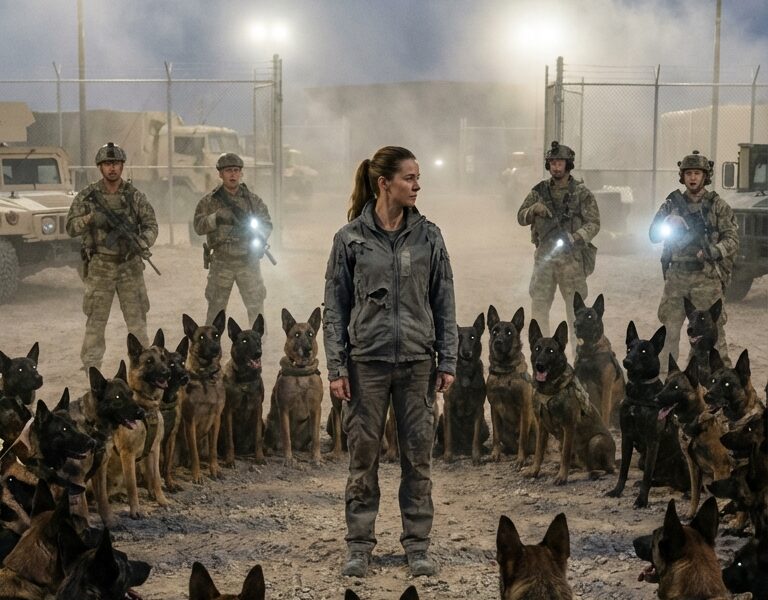
A Navy SEAL commander brushed off a quiet janitor, assuming she didn’t matter. Moments later, fifty military dogs surrounded her, forcing everyone watching to realize they had gravely misjudged who she was—and why the animals answered only to her.

A Navy SEAL commander brushed off a quiet janitor, assuming she didn’t matter. Moments later, fifty military dogs surrounded her, forcing everyone watching to realize they had gravely misjudged who she was—and why the animals answered only to her.
A Navy SEAL commander brushed off a quiet janitor, assuming she didn’t matter. Moments later, fifty military dogs surrounded her, forcing everyone watching to realize they had gravely misjudged who she was—and why the animals answered only to her.
At dawn, the coastal air around Blackwater Naval Canine Facility carried a salt-heavy chill that seeped into concrete and steel alike, and to most of the uniformed personnel arriving for duty that morning, the woman waiting at the security checkpoint barely registered as anything more than another name on a clipboard, another civilian contractor shuffled in through budget necessity rather than respect, her posture small, her clothes practical to the point of invisibility, the kind of person people forget moments after walking past her, unless they have learned the hard way that silence is sometimes the loudest signal of all.
Her badge read Lena Ward.
That was not the name she was born with, nor the one etched into records that no longer officially existed, but it was the name she used now, and the one that would soon unsettle an entire base of elite operators who believed, with the comfortable certainty of hierarchy, that power always announced itself loudly.
Commander Ethan Rowe, executive officer of the facility, noticed her only because she stood still when the dogs didn’t.
Fifty military working dogs, housed across reinforced kennel blocks designed to contain controlled violence in its most disciplined form, erupted the moment she stepped beyond the inner gate, their barking not chaotic but unified, a deep, rolling surge that struck the chest like pressure rather than sound, the kind that rattled ribs and reminded even battle-hardened men why these animals were considered weapons before they were companions, and yet, in the center of that storm, Lena Ward didn’t flinch, didn’t tense, didn’t even glance around in alarm, her breathing slow, her eyes steady, her body relaxed as though the noise confirmed something rather than threatened it.
Rowe frowned.
Most civilians froze the first time they heard that sound. Some quit before lunch.
Chief Handler Marcus Hale, however, found the moment amusing.
He stepped forward, boots striking concrete with deliberate volume, and without a word kicked a broom from a nearby cart so that it skidded across the ground and stopped at Lena’s feet, the handle rolling once before settling as if waiting for judgment.
“Pick it up,” he said, not loudly, because dominance, in his mind, didn’t require volume, only certainty.
Lena looked down, then up, meeting his eyes for the briefest moment, something unreadable passing between them before she bent and lifted the broom with careful, unhurried movements, as if time itself had no authority over her.
“Good,” Marcus said, lips curling into something that might have been a smile if there were warmth behind it. “You’ll start in Delta Block. That’s where we keep the problem dogs.”
Around them, handlers watched with casual interest, the way people observe a small, inevitable cruelty they’ve normalized through repetition, betting quietly on how long the new janitor would last before fear or injury or humiliation sent her back through the gate.
No one noticed Senior Master Handler Jonah Price step away from the shade of the maintenance shed, his eyes narrowing not at Lena, but at the dogs.
They were listening.

Delta Block was louder than the rest, its residents bred for aggression control under combat conditions, dogs whose files carried red annotations and incident reports that read like condensed war stories, and when Lena approached the first kennel, the barking intensified, steel rattling under the force of muscle and teeth, saliva flecking the mesh as bodies hurled themselves forward in displays designed to dominate, to warn, to test.
She kept walking.
At the third kennel, a massive Dutch Shepherd named Brutus launched himself at the barrier, jaws snapping inches from her face, the impact echoing like a gunshot.
Lena stopped.
Not abruptly, not in fear, but with the quiet certainty of someone who knows when attention matters, and she turned her head slightly, not making direct eye contact, her posture angled, her presence reduced without becoming submissive, a balance so subtle that most humans missed it entirely.
Brutus froze.
His growl faded into a confused huff, his weight shifting back, ears twitching as if recalibrating to a frequency he hadn’t heard in years.
Jonah Price felt a chill climb his spine.
By the time Lena reached the far end of the block, every kennel had gone quiet, not in the brittle silence of suppression, but in something closer to recognition, fifty pairs of eyes tracking her with an intensity that had nothing to do with threat and everything to do with memory.
Marcus Hale noticed too.
“Lucky,” he muttered, already irritated that his private entertainment had failed to deliver blood or panic, and when Lena stepped inside the enclosure of Titan, a German Shepherd officially labeled “non-reassignable” due to behavioral volatility, Marcus didn’t stop her, didn’t warn her, didn’t unlock the emergency override that would have allowed immediate extraction, because on some level he wanted the moment to correct itself, wanted the hierarchy to reassert its natural order through teeth and consequence.
Titan rose slowly, his movement controlled, deliberate, every inch of his body communicating power held in reserve, and when he advanced, the handlers held their breath, waiting for the inevitable lunge.
Lena crouched.
Not in surrender, but in invitation.
Titan halted, confusion rippling through his stance as something older than training reached up through instinct and overrode protocol, and when he pressed his head against her knee, the sound he made was not a growl, but a whine so low it barely registered as sound at all, the noise of an animal who had been waiting.
The facility changed after that.
Not all at once, not loudly, but in the way gravity shifts without permission.
Dogs that had snapped at handlers began responding to Lena’s presence with calm attentiveness, injuries that resisted treatment settled under her hands, and when a training accident left an operator concussed and disoriented, it was Lena who reached him first, stabilizing his spine and calming his dog with a series of gestures no civilian training could explain.
Questions followed.
Commander Rowe ordered a background check.
It came back clean.
Too clean.
When Intelligence Liaison Aaron Keats tried to dig deeper, his access locked, his screen flashing a classification warning he’d never seen outside black-site briefings, and within minutes, a call came down from an office that didn’t exist on paper, instructing him, politely but firmly, to stop.
“Who is she?” Rowe asked later that night, watching Lena move through the kennels on the security feed, dogs sitting, lying, orienting themselves around her without command.
Keats swallowed. “Sir, whoever she is, she outranks curiosity.”
The breaking point came during a live demonstration for visiting defense officials, when Brutus, mid-assault run, veered off course and crossed the field to sit at Lena’s feet, ignoring every command screamed after him, and when Marcus Hale grabbed her arm in front of everyone, demanding answers he had forfeited the right to demand days earlier, the fabric of her jacket tore, revealing ink that silenced the yard.
A three-headed hound.
Seven stars.
The insignia of Project HECATE, a K-9 special operations unit dissolved after a classified mission in eastern Afghanistan went catastrophically wrong, officially erased along with the handlers who never came home.
Jonah Price removed his cap.
“So it’s true,” he whispered. “You’re Rhea Calder.”
Lena—Rhea—didn’t correct him.
She didn’t need to.
The dogs already knew.
The twist came hours later, when a perimeter breach triggered a full lockdown and a man stepped from the darkness calling her by a name only one person still alive should remember, a former teammate presumed dead, carrying evidence that the mission hadn’t failed by chance, but by betrayal, and as fifty military dogs formed a silent wall behind her, choosing her without hesitation, the base realized too late that they hadn’t been protecting assets.
They had been protecting a legacy.
And she had come back for a reason.
The Lesson
Power does not always arrive wearing rank, nor does experience announce itself with volume or entitlement, and the most dangerous mistake any system can make is assuming that worth is visible at first glance, because respect based on appearance will always fail where respect based on understanding endures, and sometimes, the ones sweeping the floor are the ones who already survived the war you’re pretending to train for.