Here’s who’s really leading Iran with supreme leader MIA and top commanders killed in strikes

Here’s who’s really leading Iran with supreme leader MIA and top commanders killed in strikes
Seventeen days — that’s how long the latest leader of Iran lasted.
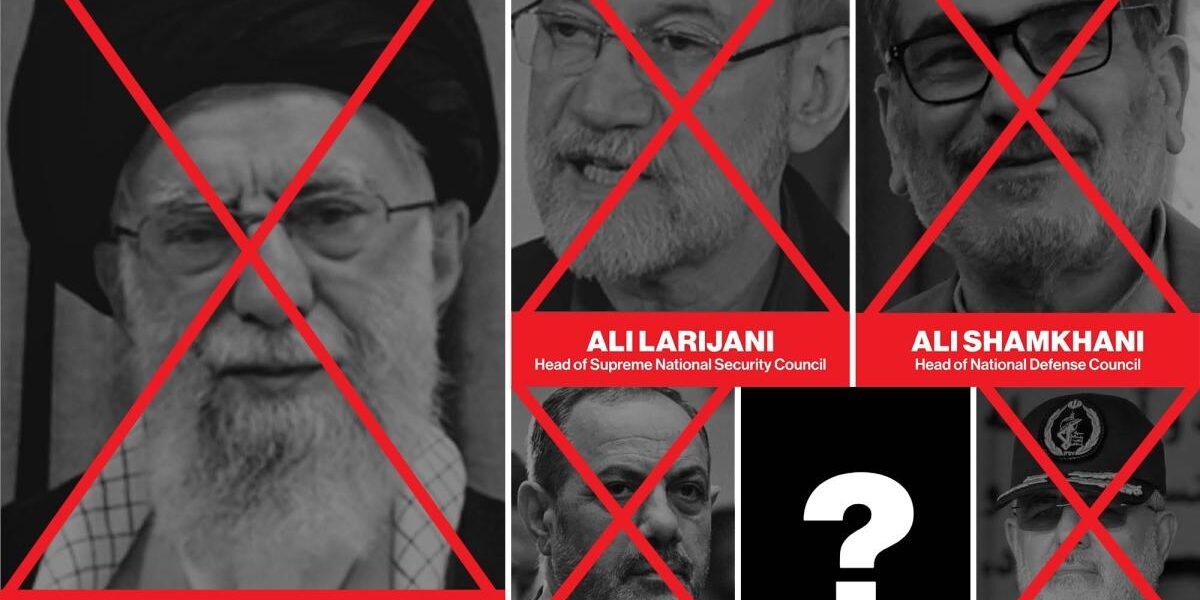
Ali Larijani just became the de facto head of the oppressive Islamic regime after Supreme Leader Ayatollah Ali Khamenei was killed by Israeli missiles from space on Feb. 28.
Larijani was killed Tuesday in targeted strikes that also took out the head of the brutal Basij militia unit of the Iranian Revolutionary Guard Corps (IRGC).

They are just the latest hardline leaders killed since the start of the war. Others include the head of Iran’s National Defense Council, the commander of the IRGC, the defense minister and the intelligence chief.
Since then, Iran’s clerics elected Khamenei’s “probably gay” son Mojtaba Khamenei as the new supreme leader — but he’s not been seen in public since the strike that killed his father, wife and son.
Even President Trump said he’s not sure whether Mojtaba is alive.
All of this begs the question: Who’s really running Iran? According to observers of the Islamic Republic, the answer appears, increasingly, to be hardline IRGC commanders, who are going to pick even more hardliners.
Just as Khamenei’s replacement was another Khamenei, Larijani’s replacement is likely to be another Larijani, experts told The Post.

Ali Larijani’s brother Sadiq Larijani is among the favorites to replace his brother and lead Iran while Mojtaba remains hidden from the public eye, said Yigal Carmon, president of the Middle East Media Research Institute in Israel.
“He might be a candidate because the IRGC would want a hardliner. They need someone who will go with them, who will move with them, who will collaborate with them,” Carmon said.

“He’s not a competitor with them. He will work with them,” he added.
Janatan Sayeh, an Iran analyst at the Foundation for Defense of Democracies, also said Sadiq would be the likely candidate given his role as the chair of Tehran’s Expediency Discernment Council, a body that advises the supreme leader.
His rank as a grand ayatollah whose father had clashed with Shah Mohammad Reza Pahlavi is also likely to help his standing as a committed member of the Islamic regime.
Iran’s Parliament Speaker Mohammad Bagher Ghalibaf, Larijani’s main rival, could also take the reins given his strong ties with the IRGC, said Khosro Isfahani, research director for the Washington-based National Union for Democracy in Iran think tank.
Ghalibaf had previously served as the commander of the IRGC air force and has constantly appeared on Iranian state TV leading Parliament in chants of “Death to America! Death to Israel!”

Ghalibaf is widely seen as the man serving as a link among Mojtaba, the state bureaucracy, and the IRGC.
The likelihood of Iran selecting a moderate to replace Larijani is slim given the IRGC’s push to name hardline successors during the war with Israel and the US.
Technically, a three-man council has been named to lead the nation of 90 million people after the supreme leader’s death: Iranian President Masoud Pezeshkian; Ayatollah Alireza Aarafi, the head of Iran’s Guardian Council, a collection of clerics and lawyers tasked with ensuring the country’s political candidates and elections are sufficiently Islamic; and Justice Gholam-Hossein Mohseni-Ejei, the head of the courts.

But all three men are drawn from the political classes of Iran — and the real power in recent years has always been with the IRGC, according to observers.
Ali Larijani had risen to become the second-most powerful man in Iran before the war — behind only the supreme leader.
He had served as a central figure with deep roots across Tehran’s political and economic landscape, making it difficult to find someone capable of replacing him, said Mona Yacoubian, director of the Center for Strategic and International Studies’ Middle East Program.

“We’re seeing a continuing trend of an Iranian rump regime that’s hardline and more connected to the IRGC,” she added.
Larijani’s stature allowed him to effectively run Iran despite the Islamic Republic naming Mojtaba Khamenei as its new supreme leader last week.
Larijani was previously viewed as a pragmatic moderate, but in recent years had taken over Iran’s nuclear negotiations and led the brutal crackdown against protesters, which saw thousands killed in the streets, and more tortured and executed in Iran’s prisons.

The IRGC’s new commander, Gen. Ahmad Vahid, had pushed Iran’s Assembly of Experts to vote for Mojtaba as a way to spite the US and Israel and signal Tehran’s animosity toward the West, the New York Times reported.
The push came despite Larijani and other moderates calling for more centrist candidates like Aarafi, former Iranian President Hassan Rouhani, and Hassan Khomeini, the grandson of the founding father of the theocracy, Ayatollah Ruhollah Khomeini.
Follow The Post’s coverage of the United States’ airstrikes on Iran:
- Follow live updates on the US and Israel’s war with Iran
- Top Iran security official Ali Larijani killed days after goading US and Israel in live interview
- National Counterterrorism Center Director Joe Kent resigns over Iran war
- Israel destroyed more than 60% of Iran’s rocket launchers — as war expected to last at least 3 more weeks
- Ukraine ready to jump in to help US as other American allies drag feet, Zelensky tells Post
As with Mojtaba’s appointment, the IRGC will likely be the mastermind to select Larijani’s replacement to serve its own needs, said Vali Nasr, a professor at Johns Hopkins School of Advanced International Studies.
“With every assassination US and Israel [are] engineering greater radicalization of Iran’s leadership. It will make for a bleak future for Iran, Iranians, the region and ultimately makes it far more difficult for US to disentangle itself from endless conflict in the region,” Nasr wrote on X.

But whoever takes the reins could face a short lifespan of his own if he’s not willing to negotiate with Trump to end the war.
“As senior officials watch figures such as Khamenei and Larijani get eliminated, they notice that the personal risk associated with holding high office in the Islamic Republic rises sharply,” Isfahani said.
“Such operations will make regime officials realize that they have two options: absolute annihilation or total surrender.”
LEAVE A RESPONSE




What do you think? Post a comment.