“Drop her now!” someone shouted as a soldier’s dog suddenly growled in a crowded courtroom. In that tense moment, the animal’s reaction revealed a hidden danger, exposing the true monster everyone had failed to notice.

“Drop her now!” someone shouted as a soldier’s dog suddenly growled in a crowded courtroom. In that tense moment, the animal’s reaction revealed a hidden danger, exposing the true monster everyone had failed to notice.
“Drop her now!” someone shouted as a soldier’s dog suddenly growled in a crowded courtroom. In that tense moment, the animal’s reaction revealed a hidden danger, exposing the true monster everyone had failed to notice.
There are some men who come back from war in one piece, and then there are those like Caleb Mercer, who technically make it home but never quite return. Caleb used to joke, back when joking still came easily, that he left half of himself somewhere in the mountains overseas—buried under dust, gunpowder, and the echoes of voices that never made it back. What remained was enough to pass for normal at a glance: a broad-shouldered man in his late thirties, a quiet presence in a modest neighborhood outside Columbus, a father who showed up for school pickups and remembered to cut the crusts off sandwiches. But underneath that thin surface, something hummed constantly—like an old fluorescent light that never stopped flickering.
He walked with a limp that got worse in the cold, his left knee stiff from an explosion that had ended his final deployment early. He rarely talked about it. The medals he’d earned were tucked into a shoebox in the back of his closet, buried beneath old tax documents and a broken flashlight. If anyone ever asked, he would shrug it off with a half-smile and say, “Just did my job.” But at night, when the house went quiet, the past didn’t stay buried. It leaked into his dreams, into the way he flinched at sudden noises, into the way his eyes scanned every unfamiliar face a little too carefully.
And then there was Rook.
Rook wasn’t much to look at if you didn’t know better—a black Labrador mix with a graying muzzle, one torn ear, and the kind of steady gaze that made people uncomfortable if they held it too long. He wasn’t the kind of dog that bounded up to strangers or wagged his tail at every passerby. He observed. He assessed. He waited. Caleb used to say, only half-joking, that Rook trusted fewer people than he did—and that was saying something.
They had served together, though Caleb never used that word lightly. Rook had been trained for silence, for precision, for the kind of work that didn’t make it into headlines. He had saved Caleb’s life more than once, pulling him out of situations where instinct alone wouldn’t have been enough. When Caleb was discharged, there had been no question: Rook came home with him.
But if Rook was Caleb’s anchor to the past, his daughter Lila was everything that pulled him forward.
She was six years old, all elbows and energy, with a laugh that came out in bursts like fireworks. She had a gap where her front teeth used to be, a habit of talking to herself when she drew, and an imagination so vivid it spilled into everything she touched. She believed the cracks in the sidewalk were secret maps. She believed clouds followed her home. And lately, she had become obsessed with drawing what she called “safe places”—little chalk gardens on the driveway, full of loops and spirals and uneven flowers.
“They keep bad things away,” she told Caleb one afternoon, kneeling on the warm concrete, her fingers stained blue and pink from chalk dust. “Like invisible fences. But prettier.”
Caleb leaned against the porch railing, his cane resting beside him, watching her work with a quiet kind of awe. There were days when her laughter felt like the only thing keeping the static in his head from swallowing everything else. He didn’t understand her drawings—not really—but he understood what they meant to her. And that was enough.
That Saturday had been one of the good days. The kind that felt almost normal. The sky stretched wide and clear, the air thick with the smell of cut grass and summer heat. Somewhere down the street, a lawnmower droned lazily. Lila sat cross-legged in the driveway, humming to herself as she added another crooked flower to her “magic garden.”
Caleb’s knee had started to ache about ten minutes earlier—a slow, creeping pain that he recognized immediately. It wasn’t sharp, not yet, but it carried a warning. He shifted his weight, trying to ignore it, but the pressure built until it demanded attention.
“Hey, bug,” he called gently, pushing himself upright with a soft grunt. “Stay right there, okay? I’m just grabbing some ice.”
Lila didn’t look up, her tongue peeking out in concentration as she outlined a petal. “Okay, Daddy. Don’t step on the purple ones. Those are the strongest.”
“I’ll be careful,” he said, smiling despite himself.
He stepped inside, the screen door creaking shut behind him. The kitchen felt cooler, dimmer. For a moment, everything was ordinary—the hum of the refrigerator, the faint tick of the wall clock. He reached into the freezer, pulling open the tray, the ice cubes clattering against each other.
And then something shifted.
It wasn’t a scream that reached him. Not exactly. It was smaller than that, thinner—like the sound of breath being cut short. A choked gasp that didn’t belong to a normal afternoon.
Caleb froze.
Every muscle in his body tightened at once, instinct slamming into him faster than thought. The ice tray slipped from his hand, crashing to the floor, cubes scattering across the tile.
He was moving before he even realized it, shoving the door open so hard it bounced off the frame.
The world outside had changed.

At the edge of the yard, near the old oak tree where the shadows pooled darkest, a man stood half-hidden. He wore a dark hoodie despite the heat, the fabric stained and worn. One arm was locked around Lila’s chest, lifting her off the ground as she kicked helplessly, her sneakers scraping the air. The other hand pressed something against her face—a cloth, damp and wrong.
Time didn’t slow down. It sharpened.
Caleb saw everything at once: the tension in the man’s grip, the way Lila’s small hands clawed at his arm, the angle of his stance. And just a few feet away—
Rook.
The dog stood perfectly still, his body low, coiled. No barking. No warning. Just a silent, focused readiness that radiated danger. His eyes flicked once toward Caleb, waiting.
Always waiting.
Caleb’s voice, when it came, didn’t sound like it belonged to the man who had been standing on the porch moments earlier.
“Put her down.”
It was quiet. Flat. Final.
The man jerked slightly, startled, tightening his grip. “Stay back!” he snapped, his voice edged with panic. “Don’t come any closer!”
Lila made a muffled sound against the cloth, her eyes wide and glassy.
Caleb took a single step forward, ignoring the flare of pain in his knee. “You don’t want to do this,” he said, his tone dropping lower. “Last chance. Put her down.”
The man’s gaze darted toward the street, where a dented silver sedan idled, engine sputtering unevenly. An escape. A plan already in motion.
“Back off!” he shouted. “I’ll hurt her!”
Caleb didn’t look at the car. He didn’t look at the man’s face. His eyes went to Rook.
Just for a second.
It was enough.
A subtle motion of his hand—barely more than a flick.
Rook exploded into motion.
He didn’t bark. Didn’t hesitate. One moment he was still, the next he was airborne, a dark blur cutting through the space between them. He hit the man low, slamming into his thigh with controlled force, teeth finding purchase with brutal precision.
The man screamed, a raw, high sound that shattered the quiet afternoon. His grip broke instantly.
Lila dropped.
Caleb was already there, catching her against his chest, turning his body to shield her as he sank to one knee. She clung to him, trembling violently, her breath coming in short, panicked bursts.
“It’s okay,” he murmured, his voice softer now, though his heart pounded like a drum. “I’ve got you. I’ve got you.”
Behind them, the man staggered back, clutching his leg, blood seeping through his jeans. He stumbled toward the car, half-limping, half-running, and threw himself into the driver’s seat.
The engine roared.
Tires screeched.
And then he was gone.
Caleb tried to stand, to give chase, but his knee buckled under him, sending him crashing back down. He swore under his breath, frustration and adrenaline tangling together, but he didn’t let go of Lila.
Not even for a second.
What followed should have been the end of it.
The police came. Statements were taken. Neighbors gathered in small, whispering clusters. A report was filed. Words like “attempted abduction” and “suspect at large” floated through the air, heavy and unreal.
But the real damage didn’t show up in reports.
It showed up in silence.
Lila stopped speaking.
Not gradually. Not with hesitation. Just… stopped. As if someone had flipped a switch inside her and turned her voice off completely. At first, Caleb thought she was in shock, that it would pass. He gave her space, sat beside her, tried to coax her gently.
Nothing.
Days turned into weeks. Weeks into months.
Doctors called it “selective mutism,” explaining it in careful, clinical terms. Trauma response. Psychological shutdown. They said her voice wasn’t gone—just locked away somewhere her mind believed was safer.
Caleb nodded when they spoke, but their words felt hollow.
Because he could see it in her eyes.
She wasn’t just quiet. She was… withdrawn. Like part of her had stepped back from the world and refused to return.
The only place she seemed at ease was beside Rook.
She followed him everywhere, her small hand buried in his fur, as if letting go might cause something terrible to happen. At night, she slept curled against him, her breathing finally steady only when she felt the rise and fall of his chest.
Rook changed too.
He became even quieter, if that was possible. More watchful. He positioned himself between Lila and everything else—doors, windows, strangers. Caleb caught him more than once staring at nothing in particular, as if replaying something only he could see.
Three months later, the police made an arrest.
The man’s name was Ethan Kade. A local handyman. The kind of person no one paid much attention to—friendly enough, always around, easy to overlook. He had been working on a fence two streets over the day of the incident.
He denied everything.
Of course he did.
He had an alibi. A lawyer. A calm, practiced demeanor that made him seem almost offended by the accusation. The case moved to court, and Caleb found himself stepping into a different kind of battlefield—one where the rules were less clear, and the enemy smiled politely while trying to dismantle his credibility piece by piece.
The defense painted him as unstable. A veteran with PTSD. A man prone to overreaction, to seeing threats where there were none.
“And your daughter?” the lawyer asked smoothly during cross-examination. “She hasn’t spoken since the incident, correct?”
Caleb’s jaw tightened. “Correct.”
“So there is no verbal confirmation of your version of events from her.”
“No,” he said, his voice steady despite the pressure building in his chest.
“And yet you expect this court to rely solely on your perception—one potentially influenced by trauma.”
Caleb didn’t answer right away. He didn’t trust himself to.
Because anger, once it started rising, didn’t always stop where it should.
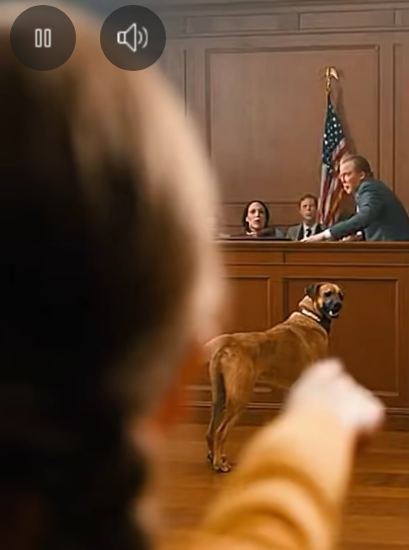
Rook lay at his feet beneath the bench, still as stone. Lila sat beside him, small and silent, her gaze fixed on the floor.
Then came the moment no one expected.
The prosecutor requested that Rook be brought closer to the stand. A demonstration, he said. Of the dog’s behavior.
There was a ripple of curiosity through the room as Caleb rose, guiding Rook forward on a short lead.
Ethan Kade didn’t flinch.
If anything, he smiled.
“Hey there, buddy,” he said lightly, extending a hand as if greeting an old friend. “Good dog.”
Rook didn’t move.
Didn’t react.
For a heartbeat, it seemed like nothing would happen.
And then—
A recording played.
The sound of a car engine, uneven, metallic. A distinctive whine, like something slightly broken but still running.
Kade’s fingers twitched.
Just slightly.
A small, repetitive clicking against his thumb—nails tapping in a nervous rhythm.
Caleb’s stomach dropped.
He knew that sound.
He had heard it once before, etched into his memory by the way Lila had clung to him that day, describing in broken whispers the man who had taken her.
Rook heard it too.
His body stiffened.
Slowly, deliberately, he stood.
A low growl rolled out of him—not loud, not explosive, but deep. Resonant. The kind of sound that seemed to vibrate through bone.
Every head in the courtroom turned.
Rook’s gaze locked onto Kade.
Unblinking.
Unmistakable.
Kade’s composure cracked.
“Get him away from me!” he shouted suddenly, stumbling back. “He’s going to attack!”
The room went silent.
Because in that one moment, he had said too much.
Again.
The word hung there, heavy and undeniable.
And then, through the silence, came a sound no one expected.
A small voice.
“I remember.”
Caleb’s breath caught.
He turned.
Lila was standing.
Her hand trembled as she pointed at Kade, her eyes clearer than they had been in months.
“He smelled like the chalk,” she said, her voice fragile but real. “And he said… he said no one would hear me.”
Tears blurred Caleb’s vision as she stepped toward him, climbing into his lap like she used to, burying her face against his shoulder.
“I’m here,” she whispered. “Rook didn’t let him take me.”
Kade confessed within the hour.
Not just to that attempt—but to others.
And when it was over, when the courtroom emptied and the weight of it all finally began to settle, Caleb stepped outside into the sunlight.
It felt different somehow.
Warmer.
More real.
He stood there for a moment, his cane steady beneath him, Lila’s small hand wrapped tightly in his.
Rook stood between them.
Silent as ever.
But no longer the only one carrying the truth.
Lesson of the Story
Sometimes, the truth doesn’t shout. It doesn’t arrive in grand speeches or perfect evidence. Sometimes, it waits—in instincts we don’t question enough, in quiet loyalty, in the courage that finds its way back when it matters most. Healing isn’t loud, and neither is justice. But both have a way of breaking through silence when we least expect it—especially when someone, or something, refuses to stop listening.