
The Weight of the Wind and the Rusted Iron of Forgotten Men
CHAPTER 1: The Liars Current
“Is this some kind of joke?”
The gunnery sergeant’s voice cracked like a dry branch, cutting through the heavy, suffocating silence of the firing line. The air above Whiskey Jack Range tasted of pulverized chalk and spent brass. The heat radiating off the baked earth was a physical weight, distorting the horizon into a shimmering, watery mirage.
Gunnery Sergeant Miller did not look at his Marines. His glare was a physical pressure directed solely at the old man standing just behind the mats. Miller was a monument to modern warfare—wrapped in modular ceramic plates, a ballistic solver strapped to his forearm, and a state-of-the-art Kestrel wind meter humming frantically on a tripod beside him. The little plastic fan blades spun uselessly, trying to quantify the desert’s breath.
“Do you even know where you are, old man?” Miller demanded, stepping forward, the Kevlar of his rig grinding like crushed stone.
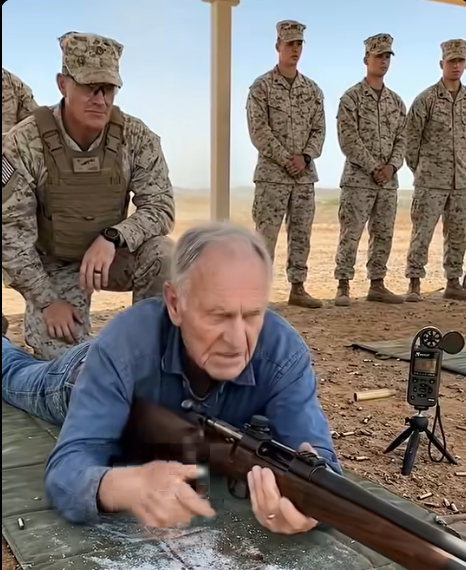
Dean Peters, eighty-two years old, did not step back. His faded denim jeans and worn cotton work shirt felt remarkably thin against the hostility rolling off the younger man. He held a long, canvas-wrapped object across his chest. His posture was loose, but his eyes—the color of a bruised, winter sky—were locked on the distant red flags downrange.
“The wind is tricky today,” Dean said. His voice was a low rumble, worn down by decades of disuse, like stones grinding in a riverbed. “It’s not just one wind. It’s three.”
Miller let out a sharp, metallic laugh. Down the line, Lance Corporal Evans flinched, his eye pulling away from his $30,000 spotting scope. They had been bleeding ammunition all morning. The ballistic algorithms kept spitting out clean, mathematical truths, and the wind kept tearing those truths to shreds. The steel silhouette, one thousand seven hundred yards away, remained untouched.
“Listen, Pops,” Miller scoffed, tapping the glass screen of his wrist computer. “I appreciate the folk wisdom. But we’re dealing with Coriolis effect, spin drift, and barometric variables. It’s a little more complex than holding up a wet finger. You are a civilian, and you are creating a safety hazard. Put whatever that is down and step away.”
Slowly, the joints in his hands popping with the dry sound of old leather, Dean unwrapped the canvas.
The snipers around them went completely still. It wasn’t carbon fiber or machined aluminum. It was scarred, darkened walnut and blued steel. An M40. The wood sweated linseed oil in the punishing sun. As Dean adjusted his grip, his thumb instinctively sought out a deep, jagged gouge near the bolt assembly. Deep within the trench of the scarred wood, a microscopic, blackened sliver of rusted shrapnel remained permanently fused into the grain—a flaw he had refused to ever sand out.
“Grandpa’s squirrel rifle,” Dean murmured. The rifle was heavy. It pulled at his shoulders, an anchor to a time when the air was wet and smelled of rot.
Miller scoffed, pointing a rigid finger at the battered stock. “You cannot be serious. That relic belongs in a museum. You’re going to hurt yourself.”
Miller closed the distance, his hand reaching out to forcefully grab Dean’s shoulder to escort him away. As the gunnery sergeant invaded his space, Dean’s eyes flicked down to the glowing digital display on Miller’s chest rig. It wasn’t displaying the Whiskey Jack Range layout.
The screen was quietly flashing a secondary, encrypted topographical overlay. *Grid 44-Alpha-Tango.* Dean’s breathing stopped. The dry desert air suddenly turned to ash in his lungs. That wasn’t a standard training grid. It was the exact, unmapped elevation profile of the A Shau Valley. They weren’t just practicing a long shot. They were rehearsing a ghost.
CHAPTER 2: The Copper Wire Protocol
Grid 44-Alpha-Tango.
The digital green lines on the Gunnery Sergeant’s wrist monitor pulsed against the glaring desert sun, mapping a ghost. It was the A Shau Valley. Dean Peters stared at the topography—the steep, unforgiving ravines, the choke points that had swallowed entire platoons whole. It wasn’t a generic long-distance simulation. They were mathematically reconstructing a graveyard.
Before the realization could fully settle into Dean’s bones, Gunnery Sergeant Miller’s heavy, Kevlar-gloved hand clamped down on his shoulder.
“We’re done talking,” Miller snapped.
The physical contact was meant to be a fulcrum, a lever to force the old man off the firing line. But Dean did not move. He didn’t shift his weight, didn’t brace. He simply absorbed the kinetic energy of the grab like a rusted iron piling in a dry riverbed. Miller’s fingers dug into the faded cotton of Dean’s work shirt, expecting the fragile give of an octogenarian. Instead, he met the dense, unyielding muscle of a man who had spent sixty years carrying the invisible weight of the dead.
Five yards down the line, Lance Corporal Evans watched the interaction through the boiling heat mirage.
Evans was twenty-two, pragmatic to a fault, and acutely aware of the mechanical grinding of the military machine. He lived in a world of strict hierarchies and consequences. But watching Miller lay hands on the old man made a cold, metallic dread pool in the pit of Evans’ stomach. It felt fundamentally wrong—like watching someone strike a match inside a powder magazine.
Evans looked at the old man’s canvas rifle bag resting on the dirt. There was a faded, peeling yellow sticker affixed to the reinforced stitching. It didn’t bear a civilian manufacturer’s logo. It read: USMC-ORD-EX-99. An obsolete ordnance code. Evans had spent enough hours doing inventory in the Armory’s deep storage to recognize the classification of decommissioned, restricted assets.
The old man wasn’t just a stray civilian.
The friction in the air was palpable, tasting of burnt copper and pulverized limestone. Miller was escalating, his jaw tight, preparing to physically drag the old man toward the access road. Evans realized with sudden, terrifying clarity that if he let this play out, something irreversible was going to break. And it wasn’t going to be the old man.
Evans made a tactical calculation. He reached up, blindly twisting the elevation turret on his $30,000 spotting scope until he felt the gears grind past their zero-stop.
“Gunny,” Evans called out, his voice deliberately flat, cutting through the standoff.
Miller’s head snapped over, his grip still locked on Dean. “What, Evans? Speak.”
Evans stood up, dusting the red clay from his knee pads. He grabbed his scope off the tripod. “My reticle is swimming, Staff Sergeant. The nitrogen seal just popped from the heat block. Internal optics are fogging.” It was a lie, but a highly technical, plausible one. “Permission to fall back to the vehicles and recalibrate.”
Miller, his patience frayed to a wire, waved a dismissive hand, not letting go of Dean. “Whatever. Fix it. We are not packing up until we ping that steel.”
Evans didn’t salute. He just nodded, turned, and walked away from the firing line. Every step felt heavy, his boots crunching loudly in the dead grass. He didn’t stop at the gear staging area. He kept walking until he rounded the armored rear of the command Humvee.
The heat radiating off the vehicle’s steel plating was scalding. Evans leaned against the hot, scuffed desert-tan paint, shielded from the firing line’s line-of-sight. The smell of leaking diesel and hot rubber filled his lungs. He pulled his mobile phone from his cargo pocket. His hands, usually steady enough to thread a needle at a thousand yards, were shaking slightly. He brought up his contact list, his thumb hovering over the screen, leaving a smear of sweat and dust on the glass.
He tapped the number for the Main Armory.
The line hummed with static, the signal struggling to punch through the valley’s interference. It rang twice. A voice answered—deep, gravelly, and entirely out of patience.
“Armory. Master Gunnery Sergeant Phillips.”
“Master Guns,” Evans said, keeping his voice to a low, tight whisper. “It’s Lance Corporal Evans. Charlie Company.”
“Evans,” Phillips growled, the sound like metal dragging across concrete. “Don’t tell me you stripped the threading on another chassis out there.”
“No, Master Guns. I’m at Whiskey Jack Range. With Gunny Miller’s detachment.” Evans pressed his shoulder harder against the boiling steel of the Humvee, peering around the taillight to keep an eye on the firing line. Miller was still in Dean’s face, aggressively gesturing toward the dirt road. “You need to listen to me. Gunny Miller is tearing into the old man who does the groundskeeping. The quiet one with the limp.”
A beat of silence on the line. Just the hiss of cellular static.
“The old man,” Phillips repeated. The irritation in his voice had vanished, replaced by a sudden, chilling neutrality. “Is that all, Evans?”
“He brought a rifle, Master Guns. An old M40. Wood stock. Wrapped in canvas with an EX-99 ordnance tag.” Evans swallowed dryly. “Gunny Miller is about to place him under apprehension for trespassing. He’s got his hands on him.” Evans hesitated, the words feeling heavy on his tongue. “He called him Dean Peters.”
The silence that followed wasn’t just a pause; it was an absolute vacuum. It stretched for three seconds. Four. Five. Evans thought the call had dropped. He looked at the screen, but the timer was still ticking.
When Phillips finally spoke, his voice was unrecognizable. The gruff, administrative exhaustion was gone. It was replaced by the razor-wire tension of a man reacting to an incoming mortar whistle.
“Son,” Phillips said, the words biting and precise. “Are you telling me that Dean Peters is standing on an active firing line right now?”
“Yes, Master Guns.”
“Listen to me very carefully, Evans.” The authority in Phillips’ voice bypassed ranks and regulations, striking straight at the core of survival protocol. “Stay exactly where you are. Do not, under any circumstances, let Gunnery Sergeant Miller put another hand on that man. Do you understand me? Do whatever you have to do to stop him.”
“Master Guns, he’s my commanding—”
“I don’t care if he’s the Commandant of the Marine Corps,” Phillips snarled. “You break his jaw if you have to. I am making a call. Keep them locked in place.”
The line clicked dead.
Evans lowered the phone. The desert sun beat down mercilessly, but a cold sweat broke out across his neck. Do whatever you have to do. That wasn’t an instruction. It was a blank check for mutiny.
Evans holstered his phone and peeked around the Humvee again. Miller had taken a step back from Dean, his hand dropping to rest aggressively on the grip of his holstered sidearm—a subconscious intimidation tactic. Dean remained perfectly still, his pale blue eyes staring right through the Gunnery Sergeant, analyzing him not as a threat, but as a tragic, mathematical error in the wind.
The primary action of making the call was over, but the consequence was just beginning. Evans couldn’t stay hidden behind the armored truck. The order was to intervene.
He pushed off the scalding metal of the Humvee. He checked the empty chamber of his own sidearm out of pure muscle memory, feeling the worn, textured grip of the polymer. It grounded him. He began the long, agonizing walk back to the firing line. He wasn’t a subordinate returning to his post anymore. He was a proximity fuse, calculating the exact distance—twenty yards, fifteen, ten—measuring how fast he would have to sprint to tackle his own commanding officer into the dirt before a legend was put in handcuffs.
CHAPTER 3: The Brass and the Dust
Fifteen yards.
Lance Corporal Evans measured the distance in fractions of a second. The dry, brittle grass snapped beneath his boots, a sound swallowed by the oppressive heat of the valley. Up ahead, Gunnery Sergeant Miller’s jaw was set like a steel trap. His hand remained resting aggressively on the textured polymer grip of his holstered sidearm.
Ten yards.
“I am giving you a direct order to vacate this military installation,” Miller barked, his voice stripped of all military bearing, reduced to raw, cornered frustration. He took another half-step into Dean Peters’ space. “If you refuse, I will place you under apprehension myself.”
Five yards.
Evans felt the copper taste of adrenaline flood his mouth. His muscles coiled. He was a junior enlisted Marine about to physically assault a senior non-commissioned officer on an active firing line. It was career suicide. It was a court-martial waiting to happen. But the absolute terror in Master Gunnery Sergeant Phillips’ voice echoed in his skull. Do whatever you have to do. Evans lowered his center of gravity, his eyes locked on Miller’s shoulder, waiting for the twitch that would signal a draw or a strike. He prepared to launch himself forward.
Then, the valley tore open.
It didn’t start as a sound, but as a vibration—a low, rhythmic thudding that traveled through the baked crust of the earth, rising into the soles of their boots. Evans froze, his weight pitched dangerously forward. Miller’s head snapped toward the access road.
A jagged, mechanical wail slashed through the dead air. Sirens.
A massive plume of choking, red-brown dust was boiling up from the two-lane dirt road leading from the main cantonment area. It looked less like a convoy and more like a localized sandstorm violently tearing its way toward the range. Three vehicles breached the crest of the hill, moving at a speed that threatened to snap their axles on the deeply rutted terrain. Two up-armored black command Humvees flanked a military police cruiser, their light bars flashing silently against the blinding glare of the sun.
The vehicles didn’t decelerate until they were practically on top of the staging area.
They locked their brakes in unison. The heavy tires chewed into the gravel, sending a spray of sharp rocks clattering against the aluminum deployment boxes. The smell of scorched brake pads and burning rubber immediately overpowered the scent of dry earth.
Before the dust cloud could even settle over the firing line, the doors of the lead Humvee blew open.
The entire range went deathly silent. The younger snipers, who had been watching the standoff with a mixture of morbid curiosity and dread, scrambled to their feet, their bodies snapping into rigid attention.
Colonel Marcus Hayes, the commanding officer of the Marine Raider Training Center, stepped out into the swirling grit. His combat uniform was immaculate, but his face was a mask of cold, forged iron. Right behind him, stepping out with the heavy, deliberate tread of an executioner, was the Base Sergeant Major.
Evans let out a breath he didn’t realize he was holding, his knees suddenly feeling like water. He stepped back, melting into the periphery. The fuse had been blown. The blast was out of his hands.
Miller stood paralyzed. His hand slipped limply away from his holster. The digital Kestrel meter beside him beeped a futile warning about a wind shift, but the Gunnery Sergeant didn’t hear it. He had spent fifteen years in the Corps and had never seen the base commander deploy to a training range with the urgency of a QRF unit.
Colonel Hayes did not look at the targets. He did not look at the high-tech ballistic computers or the million dollars’ worth of glass and carbon fiber scattered across the mats. He ignored Miller entirely.
His boots ground heavily into the dirt as he strode directly past the Gunnery Sergeant, stopping two feet in front of the old man in the faded work shirt.
The dust settled over Dean Peters’ shoulders, dusting the dark walnut of the M40 rifle in his hands. Dean didn’t brace at the Colonel’s approach. He just looked at him with those pale, weary eyes.
Colonel Hayes, a man who held the careers of two thousand elite operators in his palm, snapped his heels together. The sound was a sharp, percussive crack. His back straightened into a ramrod line of absolute deference, and he threw a salute so crisp and precise it seemed to cut the air. On his right hand, a heavy silver insignia ring caught the sun—a relic from an old, classified detachment.
“Mr. Peters,” Colonel Hayes’ voice boomed, carrying the heavy, rusted weight of command across the silent expanse. “Sir. I apologize for the conduct of my Marines. There is no excuse for the disrespect you have been shown here today.”
A collective, silent shockwave rippled through the young Marines. Miller looked as if the oxygen had been vacuumed from his lungs. His face drained of color, his aggressive posture collapsing into a hollow shell of sheer panic.
Colonel Hayes held the salute. He did not drop his arm until Dean, moving with the slow, aching stiffness of his eighty-two years, gave a slight, tired nod.
Only then did the Colonel lower his hand. He turned his head slowly, his gaze shifting like a gun turret to lock onto Miller. The temperature on the range seemed to drop ten degrees.
“Gunnery Sergeant,” the Base Sergeant Major hissed, stepping up beside Miller. The whisper was more terrifying than a scream. “What in God’s name did you think you were doing?”
“Sir, I—” Miller stammered, his eyes darting to his wrist computer as if the algorithm could save him. “He was in a restricted zone. The safety protocols—”
“You have been failing this evolution all morning,” Hayes interrupted, his voice a low, lethal grind. “Because you believe the microchips strapped to your wrists make you marksmen. You have been humbled by a mile of chaotic air. And in your frustration, you chose to aim your profound ignorance at a man whose boots you are not fit to lace.”
Hayes gestured sharply toward Dean, though his eyes never left Miller’s pale face.
“Allow me to educate you on the asset you just threatened with arrest,” Hayes stated. “This is Chief Warrant Officer Five Dean Peters, United States Marine Corps, Retired. He is the author of the very extreme-crosswind doctrine your men are currently failing to apply. He is an active, classified consultant for Naval Special Warfare’s analog retention program.”
Evans felt his stomach drop. The peeling yellow sticker on the canvas bag suddenly made perfect sense. The old man wasn’t a relic; he was the baseline. He was the anchor they were secretly being measured against.
“In the A Shau Valley,” Hayes continued, the name of the place hanging in the air like a curse, “they didn’t have names for the enemy snipers. But the enemy had a name for him. Mr. Peters holds the third longest confirmed kill in our history. A shot made in a monsoon, without a ballistic solver, without a Kestrel.”
Hayes stepped closer to Miller, the physical distance between them evaporating.
“And he made it,” the Colonel finished, his voice dropping to a terrifying calm, “with the exact rifle you just called a museum piece.”
Miller swallowed hard, his Adam’s apple bobbing. The sophisticated gear strapped to his chest suddenly looked like cheap, plastic toys. The digital map of grid 44-Alpha-Tango still blinked on his wrist, a sterile simulation of a valley that the old man beside him had actually bled in.
Dean watched the dismantling of the Gunnery Sergeant without a trace of triumph. There was no joy in being right. It was just maintenance. Another necessary, exhausting correction in a world that kept forgetting the cost of its own history. He adjusted his grip on the heavy wooden stock of the M40, his thumb tracing the jagged scar of shrapnel embedded in the wood, preparing to do the one thing he had come here to do.
CHAPTER 4: The Physics of Rust
Dean’s thumb pressed into the splintered trench of the walnut stock, feeling the microscopic, blackened sliver of rusted shrapnel permanently fused into the grain. It was an anchor point. As Colonel Hayes’s voice echoed across the silent firing line, hanging in the dead air like the tolling of a heavy bell, Dean did not look at the stunned faces of the young Marines. He looked only at the shimmering expanse of the valley.
The range was no longer a training ground. It was a crucible.
Dean stepped forward, moving past Gunnery Sergeant Miller. Miller had been reduced to a hollow, ashen shell, his eyes locked forward, completely paralyzed by the sudden collapse of his authority. Colonel Hayes took a deliberate half-step backward, clearing the path to the firing mat, his hands resting naturally on his gun belt.
As Hayes moved, the harsh desert sun caught the heavy silver insignia ring on his right hand.
Dean’s pale eyes flicked to the metal. It wasn’t a standard academy ring. It was heavily scored, the details worn flat by years of friction, but Dean recognized the crude etching of a winged dagger piercing a stone. It was the unofficial marque of a highly classified joint-task element that only operated in one specific theater. The same theater blinking in green light on Miller’s wrist computer. Grid 44-Alpha-Tango.
The pieces locked together with the heavy, oiled click of a chambering round. Hayes wasn’t just here to discipline a rogue Gunnery Sergeant. The Colonel was standing on this firing line because his men were about to drop into that exact valley topography in the real world. The steel silhouette at one thousand seven hundred yards wasn’t a training target. It was a proxy for a high-value asset. Hayes needed to know if the shot was mathematically possible, or if he was sending his operators into a meat grinder.
Dean lowered himself onto the dust-choked mat.
It wasn’t a graceful movement. His knees popped with the sound of snapping dry branches. The cartilage in his lower spine ground together, sending a hot, rusted spike of pain up his neck. Every joint in his eighty-two-year-old body fought the descent. The younger Marines watched in absolute, breathless silence. They were accustomed to the slick, mechanized efficiency of modern war. They were watching a man trade physical agony just to assume a prone position.
He didn’t use a bipod. The M40 had no modular rail system. Dean dragged his battered, faded canvas rucksack in front of him, the fabric stiff with decades of dried sweat and dirt. He rested the rifle’s forestock over the canvas.
The pain in his shoulder was immediate. The old mortar wound throbbed, reacting to the tension required to seat the rifle into his pocket.
“Your computers are looking for data,” Dean said. His voice was a low, scraping rasp, meant only for the men immediately behind him. He didn’t turn around. His right eye settled behind the simple, unilluminated glass of the old optic. “You need to look for signs.”
The Kestrel wind meter beside Miller’s boot emitted a sharp, erratic beep. The digital readout flashed, unable to average the sudden chaos in the air.
“See that shimmer over the rocks at one thousand yards?” Dean instructed, his breathing slowing, becoming a shallow, mechanical rhythm. “It’s flowing right to left. That’s a thermal updraft. Your software thinks the air is uniform. It’s not. The heat is pushing the bullet up and left.”
Evans, kneeling in the dirt ten yards away, stared at the rocks. Without his spotting scope, he couldn’t see the mirage, but he could feel the sudden, uneven pressure on his own skin.
“But look at the sagebrush on the berm at fifteen hundred,” Dean continued, his voice straining slightly as his muscles fought to keep the heavy barrel stable. “It’s barely moving. And it’s leaning toward us. The wind is rolling back on itself there. A vortex. The flag at the target is all the way in the back, catching the main current. It’s a head fake. It’s lying to you. You have to aim for a window in the wind.”
Dean reached up to the elevation turret. No digital clicks. Just the tactile, metallic grinding of internal gears. He turned it, feeling the friction, listening to the rusted mechanics of the scope.
Then, the valley fought back.
A violent, localized shear wind ripped across the firing line. It picked up a sheet of red dust, whipping it across the mats. The Kestrel screamed a continuous, high-pitched warning. The sudden drop in barometric pressure caused the air to physically thicken.
Dean’s vision swam. The strain on his neck muscles reached a breaking point, his hands trembling violently against the wooden stock. The desert heat suddenly felt heavy, suffocating. The smell of dry earth vanished, replaced by the suffocating stench of rotting vegetation and monsoon rain. For a terrifying micro-second, he wasn’t in the desert. He was back in the mud, nineteen years old, the enemy machine gunner dialing in on his platoon. The trembling in his hands worsened. The crosshairs danced wildly off the steel silhouette.
He was failing. The physical degradation of his body was overriding his mind. He couldn’t hold the weight.
Do not abort, a pragmatic voice echoed in his skull. If you fail, they trust the machine. If they trust the machine, they die in the valley.
Dean closed his eyes, shutting out the scope, shutting out the blinking computers and the suffocating memory. He stopped fighting the rifle. He let the heavy wooden stock sink deeper into his bruised shoulder, accepting the pain, welding the steel to his own failing bones. He didn’t try to overpower the wind; he let it wash over his face, feeling the microscopic drop in temperature on his left cheek as the gust began to die.
He opened his eye. The crosshairs were steady. Not because his muscles were strong, but because he had found the absolute bottom of his skeletal frame.
He didn’t check the flag. He pulled the heavy, single-stage trigger.
The crack of the M40 was deafening. It wasn’t the suppressed, high-tech thwip of a modern sniper system. It was raw, uncontained explosive violence. The heavy walnut stock slammed backward. The recoil punched into Dean’s collarbone like a hammer strike, a dull, agonizing crunch of bruised tissue that radiated down to his ribs.
He didn’t flinch. He kept his eye in the scope, absorbing the violence.
The brass casing ejected with a sharp ring, flipping through the hot air.
Silence slammed back down over the range. Every sniper on the line leaned forward, holding their breath.
One second.
Two seconds.
Two and a half seconds. An eternity of dead air.
Then, faint, metallic, and utterly definitive, the sound returned across the mile of shimmering heat.
Ping.
A dead-center strike on hardened steel.
The young Marines erupted. It wasn’t standard military applause; it was a spontaneous, ragged cheer of pure disbelief and raw relief. The tension that had strangled the range all morning shattered. Evans let out a breath that sounded like a laugh, sinking back onto his heels.
Colonel Hayes did not cheer. He stood perfectly still, his eyes locked on the distant, invisible steel plate. He slowly brought his right hand up, the silver ring catching the sun one last time, and rubbed his jaw. He had his answer.
Dean Peters remained on the mat. He didn’t smile. He didn’t acknowledge the cheering. He slowly opened the bolt, his knuckles white with the effort, and let his forehead rest against the scarred walnut stock. His shoulder was burning, his chest heaving with exhaustion. He had made the shot. He had saved the ghost in the machine. But as the pain ground into his bones, he knew the absolute truth: the war never ended; it just waited for the wind to shift.
CHAPTER 5: The Soil and the Copper
The echo of the one-thousand-seven-hundred-yard steel plate took exactly thirty days to fade from Gunnery Sergeant Miller’s ears.
It was replaced by the low, mechanical hum of flickering fluorescent tubes in aisle four of the local hardware store. The air here didn’t smell of pulverized limestone and spent brass; it smelled of dry nitrogen fertilizer, cut keys, and the sharp, metallic tang of oxidized copper.
Miller stood before a bin of half-inch brass sprinkler fittings. He was in civilian clothes—faded denim and a dark t-shirt—but he didn’t stand like a civilian. His posture was rigidly maintained, his weight perfectly balanced on the balls of his feet. He picked up a copper T-joint, feeling the cold, heavy metal between his calloused fingers. It was a simple piece of hardware. No microchips. No algorithms. Just pure, unthinking utility.
For the past month, his world had been stripped down to exactly this kind of brutal simplicity.
The immediate consequence of that day on Whiskey Jack Range had been absolute. Colonel Hayes hadn’t just humiliated Miller; he had fundamentally dismantled his curriculum. For four weeks, Miller and his elite detachment of snipers had sat in the red dirt. They had left the ballistic computers, the Kestrel meters, and the laser rangefinders locked in the armory.
Instead, they had listened to an eighty-two-year-old man explain the friction of the world.
Dean Peters had taught them to read the mirage not as a mathematical obstacle, but as a living current. He had forced them to watch the way a single blade of dry grass fought the wind, to understand that the air was a massive, chaotic fluid that didn’t care about their software. The Marine Corps had officially designated the new training block the Peters Wind Doctrine, but to Miller, it was just survival. It was the desperate, grinding labor of unlearning his own arrogance.
Miller tossed the copper fitting back into the bin with a dull clatter.
He turned the corner into the next aisle and stopped dead.
The aisle was dedicated to seasonal gardening. Standing near a rusted metal rack of seed packets was Dean Peters.
The old man looked exactly as he had on the firing line, wearing a worn flannel shirt and heavy work boots that had seen decades of hard labor. He was holding a small, brightly colored packet of seeds, studying the small print on the back with quiet intensity.
Miller’s chest tightened. The urge to snap to attention, to bark a greeting, was an ingrained reflex, but the setting demanded a different set of rules. He took a slow breath, forcing the tension out of his shoulders, and closed the distance.
“Mr. Peters,” Miller said, his voice dropping into a low, respectful register.
Dean didn’t startle. He didn’t even look up immediately. He finished reading the line of text on the packet, his thumb rubbing thoughtfully over the cheap paper.
“Gunny,” Dean replied, his voice a familiar, gravelly rumble. “How are those tomatoes of yours doing?”
Miller blinked, entirely thrown off balance by the mundane question. “Sir?”
Dean finally turned his head. His pale blue eyes were entirely devoid of malice, carrying only the heavy, quiet weight of a man who noticed absolutely everything. A small, grandfatherly smile creased the deep lines around his mouth.
“I saw you planting them last weekend behind the base housing,” Dean said, his tone casual but laced with lethal precision. “You put them too close together.”
Miller felt a sudden, cold spike of realization. He had been alone behind his quarters. Or so he thought.
“They’re going to crowd each other out,” Dean continued, turning his attention back to the seed packet. “Roots need room to fight for the water. You cluster them tight because you want a bigger yield in a small grid, but all you’re doing is ensuring they suffocate when the heat spikes. You have to space them out. Give them a wide perimeter.”
It wasn’t about the tomatoes.
Miller felt the blood drain from his face. Grid 44-Alpha-Tango. The simulation they had been running. His patrol formations. He had been drafting tight, mutually supporting squad movements for the impending deployment into that valley. He had prioritized concentrated firepower over maneuverability.
Dean had just told him that his men were going to die if he didn’t spread them out.
“I…” Miller swallowed hard, his throat dry. “I’ll adjust the spacing, sir. Immediately.”
Dean nodded slowly, accepting the answer. He held up the seed packet he had been studying. Miller’s eyes flicked to the label. Heirloom Nightshade. He looked closer at the faded print on the back. It didn’t list standard watering instructions. It listed a highly specific, highly acidic soil pH requirement. A soil composition identical to the deeply corrupted, chemical-soaked earth of the A Shau Valley.
The ghost they were hunting. Dean knew exactly what was waiting for them in the dirt. He was studying the soil not to grow something, but to remember how things died in it.
“Sir,” Miller said, taking a step closer, abandoning the military pretense. He spoke with guarded vulnerability, stripping away his rank. “I just wanted to say thank you. For everything. You taught me more in that one week in the dirt than I’ve learned in the last five years of my career.”
Dean’s expression softened slightly. The rusted iron of his demeanor gave way to a tired, enduring empathy. He reached out, his calloused hand clasping Miller’s shoulder. It was the exact spot Miller had grabbed him a month prior. The physical weight of the grip was immense.
“You’re a good Marine, son,” Dean said quietly. “You care about your men. You were just trying to read the book instead of the weather.”
Dean let his hand fall away. He slipped the seed packet into his flannel pocket. He didn’t offer any grand speeches. He didn’t reveal the classified parameters of Grid 44-Alpha-Tango, nor did he explain who exactly the Colonel was sending them to hunt. Some truths were too heavy to carry unless you were standing in the mud yourself.
Dean turned to walk down the aisle, his heavy boots scuffing against the polished linoleum floor.
He paused at the end of the row, the fluorescent lights casting long, sharp shadows across his shoulders. He looked back over his shoulder.
“Just keep listening, son,” Dean said, the words echoing in the quiet store. “Just keep listening.”
Miller stood in the artificial light, surrounded by rusted metal shelves and bags of dry earth. He watched the old man disappear around the corner. He didn’t know what was waiting for them in the valley. The ultimate reality of the mission remained locked in the dark. But as Miller reached out and picked up a heavy iron wrench from the display, feeling its cold, brutal weight in his hand, he knew one thing for certain.
When the wind shifted in the valley, he would be ready.