
The ruck was killing her shoulders.
Not the pack. The man.
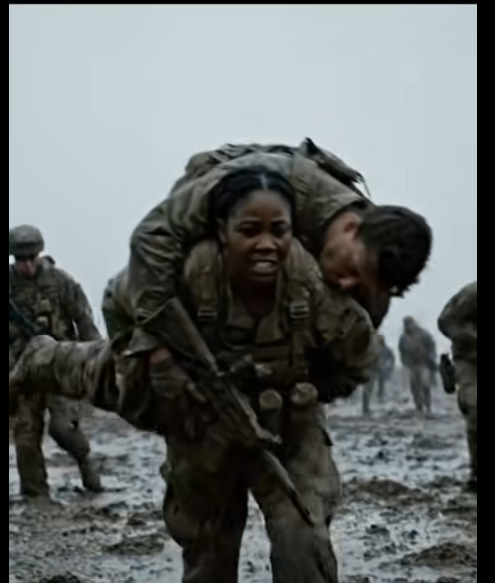
Two hundred and twelve pounds of dead weight draped across her back, his arms limp over her collarbones, his boots dragging lines in the dirt behind her.
She could feel his blood soaking through her uniform. Warm at first. Then cooling. Then just wet.
Her knees buckled on the third hill.
She caught herself with one hand, fingers clawing into the mud, and pushed back up before anyone could see. Before anyone could offer. Before anyone could take him from her.

Because they would try.
They always tried.
Sergeant Hale had already radioed it in. Medevac was seven clicks east. Seven clicks might as well have been seven hundred when the terrain looked like God had crumpled it up and thrown it away.
Her spine screamed.
Her quads were on fire, that deep fire, the kind that makes your vision narrow and your teeth clench on their own.
She whispered it the first time at the bottom of the ravine.
I can do it. Just one more step.
And she took it.
Then she whispered it again.
I can do it. Just one more.
It became a rhythm. A heartbeat outside her heartbeat. A cadence no drill sergeant ever taught her but one her body learned right there, right then, in the worst classroom on earth.
His breathing changed somewhere around the fourth click. Shallower. Faster. She felt it against her neck, little puffs of air that kept slowing down.
So she walked faster.
Her boots split open on the rocks. She felt gravel grind into the sole of her left foot and didn’t stop. Couldn’t stop. Stopping meant thinking, and thinking meant math, and the math was not on her side.
Another soldier fell in beside her. Private Odom. Young kid. Big arms. He reached out.
Let me carry him.
She shook her head.
I got him.
He matched her pace for half a click, then fell back. Not because he was tired. Because he understood something he couldn’t explain.
The last hill was the steepest.
She went to her knees twice. The second time, she stayed down for four full seconds. Her lungs were pulling air like it wasn’t enough, like the atmosphere had thinned to nothing, like the sky was punishing her personally.
She heard the rotors before she saw them.
That sound. That beautiful, ugly, mechanical sound thumping through the valley like a second chance.
She stood up.
I can do it. Just one more.
When she crested the ridge, the medics were already running toward her. Two of them grabbed him off her back and she almost collapsed from the sudden absence of weight. Her body didn’t know what to do without the burden. She stumbled forward like a puppet with cut strings.
Someone put a hand on her shoulder.
She didn’t hear what they said.
She just stood there, hands on her knees, watching them load him onto the bird. Watching the doors close. Watching it lift off in a cloud of dust that stung her eyes or maybe that wasn’t the dust at all.
He made it.
She found out three days later in a field hospital sixty miles south. Stable. Breathing on his own. Something about a collapsed lung that they caught just in time.
Just in time.
She sat on the edge of a cot, boots still caked in dried mud and his blood, and pressed her palms into her eyes until she saw colors.
No one asked her how she did it.
But if they had, she would have told them the truth.
She didn’t carry him seven clicks.
She carried him one step. Over and over and over again.
Her name was Corporal Davies. The man was Sergeant Miller.
And the story wasn’t over. Not by a long shot.
The field hospital was a world of beige canvas and the constant, low hum of generators. It smelled of antiseptic and despair.
A medic, a tired-looking man with kind eyes, stitched up the gash on her foot without a word. He just cleaned it, pulled the skin together, and wrapped it tight.
When he was done, he looked at her.
You’re Corporal Davies.
She just nodded.
The one who carried Sergeant Miller.
Another nod.
He shook his head slowly, a look of quiet wonder on his face.
I was on the bird that picked him up. We didn’t think he’d make it to the pad.
Davies found her voice. It was raspy, like it had been scraped with sandpaper.
Is he okay? Really?
The medic gave her a small, reassuring smile.
He’s tough. They flew him to Landstuhl. Best care he can get. He’s got a long road, but the road exists. Because of you.
She didn’t feel like a hero. She felt hollowed out. Every muscle in her body was a knot of protest. Her back felt permanently bent into the shape of carrying a man.
For the next week, she was on light duty. It was worse than patrol. It meant time to think. Time to replay every step, every stumble.
Private Odom found her cleaning her rifle for the third time that day.
Heard you’re heading stateside, Corporal.
She didn’t look up. Just kept running the cloth over the barrel.
Medical leave. My back’s shot.
Odom shifted his weight.
We all saw what you did. It was… something else.
She finally looked at him. His face was so young, still unlined by the things that would haunt him later.
I did what anyone would have done.
He shook his head, a little too quickly.
No. No, ma’am. That’s not true. I offered. Hale was ready to order a team to take over. You wouldn’t let us.
Why not? was the question in his eyes. He was too respectful to ask it out loud.
She didn’t have an answer for him. Not a simple one, anyway.
Two weeks later, she was on a transport plane, the droning of the engines a lullaby she couldn’t sleep to. She stared out the small window at the endless clouds, feeling like she was leaving a part of herself behind.
The military, for all its flaws, gave you a simple purpose. Follow orders. Protect your own. Come home.
What was her purpose now?
Her body healed slowly. Physical therapy was a new kind of pain, a methodical torture designed to put her back together. But they didn’t have therapy for the silence that now filled her days.
She tried calling the hospital in Germany, but privacy rules were strict. She could only get vague, official updates. Improving. Stable. No new information.
She felt adrift in her own life. The quiet suburban street she’d grown up on felt alien. The hum of a lawnmower made her jumpy. The cheerful greetings from neighbors felt like a language she no longer understood.
She was thinking about Miller. Always about Miller.
He’d been her first sergeant when she joined the unit. A tough, fair man who saw the scared nineteen-year-old girl behind the bravado. He’d pushed her harder than anyone else.
Davies, you don’t stop when you’re tired. You stop when you’re done.
He’d taught her how to read a map until she could do it in her sleep. How to break down her weapon blindfolded. How to tell the difference between incoming and outgoing fire just by the whistle.
He was the anchor of their platoon. The calm voice in the chaos.
And he talked about his family constantly. His wife, Anna. His daughter, Sarah, who was learning to ride a bike. He carried a stack of their letters in his left breast pocket, tied with a faded ribbon.
Sometimes, on quiet nights, he’d read one aloud. They were simple letters, full of misspelled words from a six-year-old and loving reassurances from a wife. They were letters about scraped knees, a leaky faucet, the dog chasing a squirrel.
They were letters about a life that felt a million miles away. A life they were all fighting for.
One day, an official-looking envelope arrived. It was from Walter Reed Medical Center. Her hands shook as she opened it.
It was a short, handwritten note on a hospital card.
Room 314. Come see me. You owe me a new uniform. – Miller.
A laugh escaped her lips. It was the first time she’d laughed in months, and it felt rusty.
The drive to Maryland was long. She played the radio to fill the silence, but heard none of the songs. She was just taking one step. One more mile. Over and over.
Walter Reed was an imposing place. Clean, quiet, and filled with a kind of courage that was different from the battlefield. It was the courage of endurance.
She found Room 314 and hesitated, her hand hovering over the door. What would she say? What could she possibly say?
She took a breath and pushed the door open.
He was sitting up in a chair by the window, looking out at the manicured lawn. He was thinner, paler, but his eyes were the same. They found hers and a slow grin spread across his face.
Took you long enough, Davies.
She walked in, her boots suddenly loud on the polished floor.
Had to make sure my back was okay, Sergeant. You’re not exactly light.
He chuckled, a raspy sound.
Yeah, well. Too many MREs. Have a seat.
She sat on the edge of the visitor’s chair, feeling like a nervous private all over again.
They talked for a while. Small talk. About the doctors, the food, the other guys in the unit. It was safe. Easy.
Then he grew serious. His gaze was intense.
They told me what you did. Seven clicks. Over broken ground. By yourself.
She looked down at her hands.
I had to.
Why? Why you? Odom was there. Hale could have sent others.
This was the question. The one she didn’t want to answer.
She finally met his eyes.
Because you would have done it for me.
He nodded slowly, accepting that. But there was something else in his eyes. A deeper question.
He reached over to the bedside table and picked up a small, messy bundle. It was the stack of letters, still tied with the ribbon. They were stiff and stained a dark, rusty brown.
The medics gave me these. Said they were in your hand when they loaded you on the bird.
She looked confused.
No. They were in your pocket. I made sure.
He shook his head.
No. I remember. Right before everything went black. The blast knocked them out of my pocket. You stopped. You went back for them while everyone else was taking cover. You shoved them into my pocket before you picked me up.
The memory came back in a flash. The explosion. The ringing in her ears. Seeing the letters scattered in the dust a few feet from his body. Scrabbling on the ground to gather them.
She had forgotten that part completely. Her mind had blocked it out, focusing only on the long walk that followed.
Why, Davies? Why risk it for some stupid letters?
Her voice was barely a whisper.
They’re not stupid letters, Sergeant. They’re your life. It’s Sarah learning to ride her bike. It’s Anna fixing the faucet. It’s everything we were fighting for, right there in your pocket.
He stared at the letters in his hand, his knuckles white.
The doctor told me. The main piece of shrapnel… it was headed right for my heart. It hit this.
He tapped the thick bundle of paper.
It slowed it down just enough. Went into my lung instead. The letters. My daughter’s crayon drawings and my wife’s grocery lists… they saved my life.
Davies felt the air leave her lungs. She had been carrying more than a man. She had been carrying the very thing that saved him.
He looked up at her, his eyes shining with tears he refused to let fall.
You didn’t just save my life, Davies. You saved my reason for living.
They sat in silence for a long time after that. A silence that was full of understanding.
Months turned into a year. Davies was medically discharged. Her back would never be the same. The civilian world was still a puzzle she couldn’t solve. She got a job stocking shelves at a grocery store. The routine was mindless, but it paid the bills.
She felt like a ghost.
Then, she got a call from Miller. His voice was stronger. Healthier.
I’m back home in Virginia. Anna and Sarah want to meet the person I won’t shut up about. We’re having a barbecue on Saturday. It’s not a request. It’s an order.
She almost said no. It was easier to be alone. But it was an order from her sergeant. So she went.
His house was a small, charming colonial with a big oak tree in the front yard. A little girl with her father’s eyes and a bright pink helmet was wobbling on a bicycle on the sidewalk. A woman with a warm smile, Anna, came out and wrapped Davies in a hug before she even got to the front door.
Thank you, she whispered. Just, thank you.
The afternoon was a blur of burgers, laughter, and stories. For the first time in over a year, Davies felt her shoulders relax. She felt… normal.
As the sun began to set, Miller asked her to take a walk with him. He had a slight limp, a permanent reminder of the day their lives changed.
They ended up in his garage. It wasn’t full of cars, but woodworking tools. Saws, planers, and stacks of fragrant lumber.
This is my new mission, he said, running a hand over a half-finished tabletop.
He explained that he’d started a small non-profit. He taught woodworking to other wounded veterans. He gave them a place to go, a skill to learn, a purpose to hold onto.
It’s hard, coming back, he said, not looking at her. You spend all that time being a part of something huge. Then you come home and you’re just… you. It’s a quiet kind of war, and a lot of guys lose it.
She knew exactly what he meant.
We’re getting bigger, he continued. I need someone to help me run this place. Someone who understands the mission. Someone who knows how to keep going, one step at a time, no matter how heavy the load is.
He turned to face her, his expression serious.
The job is yours, if you want it, Corporal.
Tears welled in her eyes. It wasn’t a job offer. It was a lifeline. It was a new purpose.
She thought about that day on the mountain. The fire in her legs, the scream in her spine, the weight of a man on her back.
She thought about her mantra.
I can do it. Just one more.
She looked at Miller, her sergeant, her friend. And she saw all the other soldiers, lost and adrift, who needed someone to help them take that next step.
The load was heavy. But she was strong enough to carry it.
I can do it, Sergeant, she said, a real smile finally reaching her eyes. I can do it.
Life isn’t about the great, heroic leaps we take, but about the small, determined steps we make when we think we can’t go on. Sometimes, we carry the burden for someone else. And sometimes, if we’re lucky, they turn around and help us carry our own. It’s in that exchange – that quiet, unbreakable promise to take one more step for each other – that we find our way home.