
The Weight of the Ash: A Study in Rusted Surfaces and Forgotten Men
CHAPTER 1: The Friction of the Sweep
“What is this? Bring your grandpa to work day?”
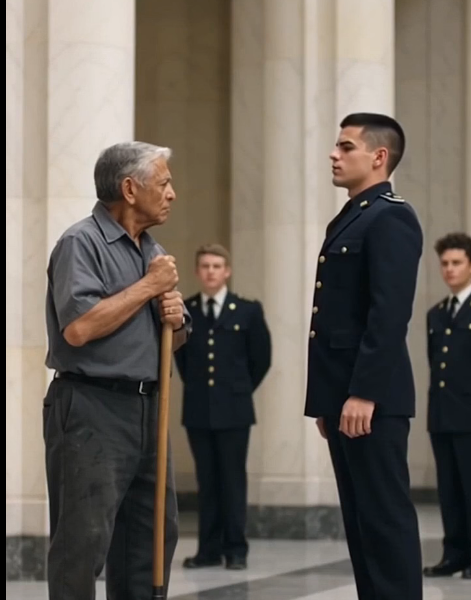
The voice was a jagged edge, cutting through the heavy, humid silence of the Hart Senate office building. Wayne Jenkins didn’t stop the rhythmic, sandpaper drag of his push-broom. One. Two. Three. The marble was a vast, white desert, and the dust was his only concern. He kept his eyes on the floor, watching the gray motes gather into a neat, sacrificial pile.
“Hey, I’m talking to you, old man. You deaf?”
A pair of spit-shined boots, black and soulless as obsidian, stepped into the path of the broom. Wayne halted. The friction stopped, and in the sudden vacuum of sound, the cavernous hallway felt like it was holding its breath. He didn’t look up immediately. He focused on the boots. They were West Point issue, stiff and unyielding, worn by someone who hadn’t yet learned how to walk through mud that smelled like iron and rot.
“I’m just doing my job, son,” Wayne said. His voice was a low gravel, the sound of stones grinding at the bottom of a well. It was a voice he had to hold tight, like a leashed dog, to keep it from snapping.
“Your job?” The lead cadet—Peterson, the name tag screamed in brass—stepped closer. The scent of cheap, aggressive cologne and youthful sweat invaded Wayne’s space. “Your job is to be invisible. You’re a relic. You should be standing at attention when the future of this military walks past you. Move. Now.”
Wayne’s hands tightened on the long wooden handle. The wood was smooth, seasoned by decades of his own palm-oil, but in his mind, the texture was changing. The grain was becoming the checkered grip of an M16. The weight of his gray work shirt started to feel like a flak vest, heavy and hot. He felt the phantom itch of a jungle sore on his shoulder.
He raised his eyes. They were the color of a winter sky over a battlefield—pale, washed out, and terrifyingly still. He didn’t see a cadet. He saw a target. He saw the way Peterson’s center of gravity was too high, the way his jaw jutted out, a structural weakness waiting for a blunt-force correction.
“You boys have a class to get to,” Wayne stated. It wasn’t a question. It was a tactical assessment.
Peterson’s face reddened, the color of raw beef. He looked at his two snickering companions, then back at the stooped man in the janitor’s uniform. “You think you’re funny, pops?”
Peterson’s boot moved—a sudden, violent blur. He kicked the pile of dust Wayne had meticulously gathered. The gray ash exploded into the air, coating the polished floor, coating Wayne’s boots, coating the silence.
“Clean it up,” Peterson sneered, leaning in so close Wayne could see the individual pores on his nose. “And this time, do it while you’re looking at the floor where you belong.”
Wayne didn’t blink. He felt the “Rusted Truth” of his life grinding against the present. His hand reached up, almost unconsciously, to the small, faded silver pin on his collar—a cheap piece of metal that shouldn’t have been there. As his fingers brushed the dulled points of the star, the marble floor beneath him began to liquefy into stinking, black sludge. The fluorescent lights flickered into a blinding, midday sun. The air didn’t smell like floor wax anymore; it smelled like cordite and the copper-sweet tang of fresh blood.
His spine, curved by seventy-eight years of gravity, began to lock into a position that had nothing to do with age and everything to do with a Hill called 937.
Wayne’s gaze shifted past Peterson’s shoulder. He wasn’t looking at the exit. He was looking at the small, silver pin reflected in the glass of a nearby trophy case, and for the first time in forty years, the ghost of Sergeant Major Jenkins didn’t just whisper—it screamed.
CHAPTER 2: The Breaking Rhythm
The dust didn’t just settle; it hovered, a suspended ghost of gray silt that tasted of dry earth and ancient gunpowder.
Wayne didn’t move. He shouldn’t have been able to hear it—not over the distant hum of the building’s HVAC or the muffled chatter of aides three hallways over—but the sound was there. Thwamp. Thwamp. Thwamp. It was the heartbeat of a heavy bird, the rhythmic bruising of the air by rotor blades. To anyone else, the Hart building was a temple of law. To Wayne, the sudden silence following Peterson’s kick was the “quiet” before an ambush.
“I told you to clean it up, pops,” Peterson’s voice drifted in, thin and tinny, like a radio signal losing power.
Wayne’s fingers didn’t just grip the broom handle; they mapped it. He felt the grain, the slight splintering near the top, the coldness of the wood. In his mind, it was the smooth, parkerized steel of an M16. His thumb twitched, looking for a safety selector that wasn’t there. He wasn’t looking at the cadet anymore. He was looking through him, scanning the marble pillars as if they were ancient teak trees capable of hiding a sniper.
“Hey! I’m talking to you!” Peterson reached out, his hand closing on Wayne’s shoulder to shake him.
The contact was a mistake.
Wayne didn’t think. He didn’t decide. The “Sovereign Protector” didn’t ask for permission. Before Peterson’s fingers could even find purchase on the gray work shirt, Wayne’s shoulder dropped and pivoted. It was a micro-movement, a rusted hinge suddenly snapping into place. The cadet’s hand slipped, his momentum carrying him forward into the space Wayne had occupied a millisecond prior.
Wayne didn’t strike. He simply stood, his center of gravity absolute, his feet planted in the “Rusted Truth” of a thousand miles of jungle patrol. Peterson stumbled, his boots squeaking indignantly on the marble he had just fouled.
“Don’t touch me, son,” Wayne said.
The gravel in his voice had turned to iron. The “son” wasn’t an endearment; it was a demarcation line. On one side stood a boy playing soldier; on the other stood a man who had forgotten more about violence than Peterson would ever learn in a classroom.
“You… you just assaulted a future officer,” Peterson stammered, his face turning a shade of white that matched the walls. His two friends had stopped snickering. They saw it now—the way Wayne’s knees were slightly bent, the way his chin was tucked, the way his eyes didn’t blink. They weren’t looking at a janitor. They were looking at a claymore mine with the pin pulled.
“I didn’t touch you,” Wayne said, the metronome of the rotor blades in his head slowing down, merging back into the hum of the ceiling lights. “You tripped over your own shadow. Now, step back.”
Peterson’s ego was a brittle thing, and it was shattering. He looked around, desperate to reclaim the narrative. A few staffers had paused at the end of the corridor, their faces masks of discomfort. They were witnesses to the arrogance, but in this town, silence was a currency.
“You’re done,” Peterson hissed, his voice trembling with a cocktail of fear and fury. “I’ll have your badge by noon. I’ll have you in a psych ward by dinner. You’re a delusional old man who thinks he’s still relevant.”
He kicked the dust again, harder this time, sending a cloud toward Wayne’s face. Wayne didn’t flinch. He let the dust hit him. He let it settle in the deep lines of his face, the grit of it feeling familiar, like the ash of a burned-out village.
Focus on the threat. Ignore the noise.
Behind them, in the shadow of a Corinthian column, Sarah felt the weight of the stack of documents in her arms. She saw the way Wayne stood—not like a victim, but like a man waiting for an order that hadn’t come in fifty years. She saw the silver star on his collar, the one the boys had mocked. Her grandfather had a box in the attic, filled with bits of ribbon and metal that smelled like mothballs and secrets. He had the same look in his eyes whenever the Fourth of July fireworks got too loud.
She didn’t think about her internship. She didn’t think about Senator Bradley’s schedule. She thought about the way Wayne always held the door for her when her hands were full, humming a tune that sounded like a lullaby played on a bugle.
She backed into the alcove, her thumb scrolling through a directory she’d been told never to use unless the world was ending. Colonel Marcus Thorne. Chief of Strategic Liaison. The phone rang. Each tone sounded like a shell casing hitting a stone floor.
“Colonel Thorne’s office.”
“This is Sarah from Senator Bradley’s,” she whispered, her voice cracking like dry parchment. “I’m in the Hart Building, main hall. You need to come down here. There are cadets… they’re cornering Wayne Jenkins.”
A heartbeat of silence followed. Then, the voice on the other end lost its bureaucratic polish. “Repeat the name.”
“Wayne Jenkins. The janitor. They’re… they’re treating him like trash, and he’s… he’s just standing there.”
“Stay where you are,” the voice commanded, now sharp as a bayonet. “Do not intervene. The Colonel is moving.”
Back in the hall, the air was thickening. Peterson was leaning in again, his breath smelling of peppermint and entitlement. “What’s the matter, pops? Lost your spark? Maybe we should see what else is in those pockets. Probably more perfect attendance awards?”
He reached for the pocket of Wayne’s work shirt, his fingers inches from the silver star.
Wayne’s hand hovered near the broom handle. He knew if he moved, he wouldn’t stop. He knew the “Rusted Truth” was that he could break this boy’s throat before the first aide could scream. He felt the phantom weight of the M16 again, the cold trigger guard against his finger. He was the Sovereign Protector of a secret that kept him in the shadows, and if he stepped into the light, everything—the peace, the erasure, the brother he had saved—would burn.
“Think carefully, son,” Wayne whispered, and for the first time, Peterson actually heard the threat.
The boy froze, his hand trembling mid-air, caught between a prank and a catastrophe. The “Thwamp-Thwamp” in Wayne’s head reached a crescendo, a deafening roar of memory and steel, just as the heavy brass doors at the end of the hall swung open with a sound like a thunderclap.
The clicking of hard-soled shoes began. A rhythmic, predatory march that made the marble floor tremble.
CHAPTER 3: The Echo of the Airborne
The brass doors didn’t just open; they announced a change in the hallway’s atmospheric pressure. The sound was a dull, heavy boom that swallowed Peterson’s stuttered insult whole.
Wayne didn’t turn. He didn’t need to. He recognized the cadence of those footsteps—the rhythmic, unyielding strike of hard-soled dress shoes on stone. It was a march, not a walk. He remained locked in his stance, the “Sovereign Protector” standing over a pile of dust that had become, in his mind, the center of a contested perimeter.
“Cadet. Step. Away.”
The voice was a low-frequency vibration, more felt than heard. It wasn’t a request; it was an environmental fact.
Peterson spun around, his hand finally dropping from Wayne’s personal space as if the air there had suddenly turned to liquid nitrogen. A man was striding down the center of the hall, a full Colonel whose uniform was so crisp it looked capable of drawing blood. He was flanked by two security detail members, but they were atmospheric. The Colonel was the storm.
“Sir!” Peterson snapped to a rigid, trembling version of attention. His two companions followed suit, their spines cracking with the suddenness of the transition. The arrogance had vanished, replaced by the hollow, wide-eyed terror of a recruit who had just realized he was standing on a live wire.
Colonel Marcus Thorne didn’t look at the boys. Not yet. His ice-blue eyes were fixed on the stooped man in the gray work shirt. He stopped exactly three feet from Wayne, his boots clicking with a finality that echoed up into the vaulted ceiling.
For a heartbeat, the Hart building vanished. The smell of floor wax was replaced by the humid, heavy scent of a jungle at dawn. The “Thwamp-Thwamp” in Wayne’s head synced perfectly with the pulse in his neck.
Thorne’s jaw tightened. He looked at the dust scattered across Wayne’s boots, then at the broom lying on the floor. His expression didn’t change, but a vein in his temple began to throb—a minute, tactical warning of a system about to overload.
“Airborne,” Thorne barked.
The word hit the marble walls and bounced back, a sonic boom of a different era. To the cadets, it was a vocabulary word from a history quiz. To Wayne, it was an electric shock.
The janitor’s shoulders didn’t just square; they snapped. The curve in his spine didn’t vanish—gravity and age had seen to that—but it transformed. He was no longer a man weighted down by years; he was a man holding a position. His chin came up, and the winter-sky eyes cleared of their fog, burning with a cold, predatory light that made Peterson visibly recoil.
Wayne’s heels didn’t click—they were muffled by the rubber of his work shoes—but the movement was textbook. He stood at an attention so perfect it made the cadets look like they were leaning.
“All the way,” Wayne replied.
His voice wasn’t gravel anymore. It was a roar that had been muffled by forty years of silence, a rusty engine finally catching spark.
Thorne’s hand snapped up to his brow in a salute so sharp it seemed to whistle through the air. He held it. He didn’t blink. He stood there, a high-ranking officer of the modern machine, rendering the highest form of military honors to a man who officially did not exist.
“Sir?” Peterson’s voice was a pathetic squeak, a crack in the absolute silence of the hall. “Sir, this man… he was being belligerent. He refused to move. He assaulted—”
Thorne lowered his hand slowly. He turned his head toward Peterson, and the temperature in the hallway seemed to drop ten degrees.
“Do you know what a ‘ghost’ is, Cadet Peterson?” Thorne’s voice was dangerously quiet.
Peterson blinked, his mouth working silently. “A… a stealth operation, sir?”
“No,” Thorne stepped into Peterson’s space, mirroring the way the boy had bullied Wayne only moments before. “A ghost is what happens when a man does things so necessary, and so terrible, that the records have to burn to keep the world turning. A ghost is a man who died in 1969 so that your father could grow up in a country that didn’t know how close it came to falling apart.”
Thorne reached out and tapped the silver pin on Wayne’s collar.
“You mocked this,” Thorne said. “You saw a janitor. You saw a relic. You didn’t see the recipient of the Distinguished Service Cross. You didn’t see the three Silver Stars. You didn’t see the man who led the charge on Hill 937 after every officer above him was a pile of meat.”
The onlookers—the staffers, the aides, Sarah hiding in her alcove—were frozen. The air was thick with the “Rusted Truth” being dragged into the light.
“You worthless, arrogant child,” Thorne continued, his voice rising now, filling the cavernous space like a prosecutor’s closing argument. “You are standing in the presence of Sergeant Major Wayne Jenkins. And the only reason you aren’t currently being dismantled is because he has more discipline in his thumb than you have in your entire lineage.”
Wayne remained at attention, his eyes fixed on a point in space that existed only in his memory. He felt the weight of the “Double-Layer Mystery”—the KIA records Thorne alluded to, the false bottom of his life. But deeper still was the secret Thorne didn’t know. The reason Wayne chose to stay a ghost. The reason the village elder’s pin was more important than the medals Thorne was listing.
“Your names,” Thorne commanded.
The cadets stammered them out, their voices sounding like they were underwater.
“You will report to my office at 0600 tomorrow,” Thorne said, his voice flat and final. “You will not be attending classes. You will be reading every redacted after-action report from the 101st in ’69. You will write a hundred-page thesis on why you are unworthy of the uniform you currently inhabit. And if I hear one more word from any of you, I will personally see to it that your military careers end before the sun sets.”
He turned back to Wayne. The ice in his eyes melted into something that looked suspiciously like grief.
“Sergeant Major,” Thorne said softly. “It is an honor.”
Wayne’s posture didn’t break, but his eyes softened. He looked at the boys, seeing not enemies, but raw material—unfired clay that had been handled poorly.
“They’re just kids, Marcus,” Wayne said, the use of the first name a subtle shock to the listening staffers. “Full of fire. Just need to be aimed in the right direction.”
Wayne bent down, his movements slow and deliberate, and picked up the broom Peterson had forced him to drop. He looked at the wood, then at the dust Peterson had kicked.
“A man’s worth ain’t in the medals or the rank,” Wayne said, his voice carrying through the hall with a simple, crushing authority. “It’s in the job he does when nobody’s looking. This is my job now. I aim to do it right.”
He began to sweep. The rhythmic One. Two. Three. returned. The “Thwamp-Thwamp” faded into the background, replaced by the honest friction of the broom against the stone.
Thorne watched him for a long moment, then turned to his detail. “Secure the cadets. Clear the hall.”
As the crowd dispersed, Sarah stepped out from the alcove. She watched Wayne sweep, the rhythmic sound a grounding wire for the chaos that had just unfolded. She looked at the silver star on his collar and felt a sudden, sharp realization—the man who cleaned the floors wasn’t hiding from the world. He was holding it up.
CHAPTER 4: The Redacted Ledger
The hallway didn’t feel empty once the boots stopped echoing; it felt hollow.
Wayne watched the grit of the marble dust swirl in the wake of Colonel Thorne’s departure. The air in the Hart building always tasted like filtered oxygen and old paper, but today, it carried the metallic tang of a firing range. He didn’t look at Sarah as she stepped out from the column’s shadow. He didn’t look at the space where Peterson had stood. He just looked at the broom.
The wood felt heavier now. Every pass against the floor was a labor of friction, a reminder that the world he had carefully built—a world of silence and gray shirts—was beginning to peel at the edges.
“Wayne?” Sarah’s voice was small, the sound of a glass marble dropping on velvet.
He stopped the sweep. He didn’t turn his head, but he sensed her approach. She smelled of ink and cheap coffee, the scents of a world that believed in paper trails and legislative intent. Wayne didn’t believe in those things. He believed in the weight of the man standing next to you and the quality of the dirt beneath your boots.
“You should get back to your office, Miss Sarah,” Wayne said. The gravel was back in his throat, thicker than before. “The Senator won’t like those papers being late.”
“The Colonel knew you,” she said, stepping into his line of sight. Her eyes were searching his face, looking for the “legend” Thorne had described. She wouldn’t find it. All that was left was the rust. “He called you a ghost. He said you died in 1969.”
Wayne finally looked at her. He didn’t see an intern; he saw a witness. And witnesses were dangerous. They were the ones who wrote the histories that got men killed for the wrong reasons.
“Paper says a lot of things,” Wayne said, his voice flat. “Most of it’s just ink. You go on now.”
He watched her go, her footsteps hesitant. Once the corridor was truly silent, Wayne reached into his pocket. His fingers brushed against a small, rectangular object—not the broom, not a weapon, but a thick, manila envelope he’d kept tucked behind a janitor’s cart for years. It was a copy of a file he wasn’t supposed to have. It was his own death certificate, stamped with a seal that had been redacted so heavily it looked like it had been dragged through a charcoal pit.
He moved toward a maintenance closet, the heavy steel door groaning on its hinges—rusted, like everything else that mattered. Inside, under the hum of a water heater, he pulled the village elder’s pin from his collar.
In the dim, yellow light, he turned the pin over.
Most people saw a cheap piece of tin, a tourist’s trinket. But Wayne’s thumb found the familiar indentation on the back. He didn’t need a magnifying glass; he knew the names by heart. They weren’t just names of the fallen. They were the names of the men who had turned their rifles inward during the third night on Hill 937. The men who had decided that dying for a hill that didn’t have a name was a bad trade.
He felt the heat of the jungle again, the humid rot of the LZ. He remembered the look in Sergeant Miller’s eyes—not the grin Thorne remembered, but a wide-eyed, frantic terror. Miller hadn’t been killed by enemy fire. He had been the one to start the mutiny.
Wayne’s job hadn’t been to lead a “forlorn hope” charge against the NVA. His job had been to stop his own men from slaughtering the command staff and disappearing into the trees. He had held the line—not against an external enemy, but against the breakdown of the only thing that kept them human: the chain of command.
He had buried the truth in the same mud where he buried the bodies. He had allowed the Army to declare him KIA to bury the investigation. He had become a janitor because cleaning floors was the only way to atone for the blood that hadn’t come from a “gallant action.”
The maintenance closet door creaked.
Wayne didn’t jump. He didn’t reach for a weapon. He simply tucked the file back into the shadows and pinned the silver star back onto his shirt.
“I know you’re there, Marcus.”
Thorne stepped into the cramped space, the polished brass of his rank catching the flickering light of the water heater. He looked out of place among the mops and the chemical smell of bleach. He looked like a man who was still looking for a hero.
“The cadets are processed,” Thorne said. He didn’t mention the “Airborne” call and response. He didn’t mention the salute. He looked at the manila envelope Wayne had tried to hide. “The Ethics Committee is asking questions, Wayne. Sarah’s call wasn’t just to me. It went through a recorded line. They’re pulling the 1969 logs. They’re going to find out the KIA was a fabrication.”
“Let ’em find it,” Wayne said, his back to the Colonel. “The records are old. The men are older. Most of ’em are dead anyway.”
“Not all of them,” Thorne said. “Miller’s sister is a Congresswoman now. She’s been looking for her brother’s real story for thirty years. She thinks there was a cover-up. She thinks the NVA didn’t kill him.”
Wayne went still. The “Rusted Truth” wasn’t just a weight anymore; it was a trap. If the world found out that the legendary Sergeant Major Jenkins had executed his own platoon leader to prevent a mutiny, the “Legacy of Valor” would crumble. The cadets he had just “aimed in the right direction” would see a murderer, not a mentor.
“Marcus,” Wayne said, finally turning around. The iron in his voice was gone, replaced by a desperate, weary pragmallow. “Some things are better left under the dirt. You tell them I’m a ghost. You tell them the janitor is just an old man who got confused.”
“I can’t lie to a Congressional inquiry, Wayne. Not after today.” Thorne stepped closer, his hand hovering near Wayne’s shoulder, then dropping. Even he couldn’t bridge the gap. “They want a hearing. They want the ‘Hero of Hamburger Hill’ to testify.”
Wayne looked at the broom leaning against the mop bucket. The wood was worn, the bristles frayed. It was a tool of maintenance, of keeping things clean.
“I ain’t no hero,” Wayne whispered.
The realization hit him like a physical blow. The “decoy” was his heroism. The “final reality” was the blood on his hands from his own side. He looked at Thorne, and for the first time, the Colonel saw the “equal intellect” in the janitor’s eyes—the calculation of a man who knew he had one chess move left, and it was a move that would destroy him to save the image of the uniform.
“I’ll do the hearing,” Wayne said.
Thorne looked relieved, but Wayne’s mind was already three steps ahead. He knew the geography of the Senate. He knew the lines of sight. He knew how to make a secret disappear forever.
“But I do it my way,” Wayne added. “No cameras. No press. Just me and the records.”
As Thorne nodded and left, Wayne reached back into the shadows and pulled out the manila envelope. He didn’t look at the death certificate. He looked at the village pin.
He had to protect the lie. Not for himself, but for the boys like Peterson. Because if they didn’t believe in the myth, they wouldn’t have anything to hold onto when the jungle started screaming.
He picked up his broom and walked back into the hall. The marble was shifting under his feet, the white desert turning back into mud. He had one more job to do, and he was going to do it right.
CHAPTER 5: The Weight of the Metal
The broom bristles hissed against the marble—a dry, rhythmic warning. Wayne pushed through the double doors of the Senate hearing room before the sun had even fully committed to the D.C. skyline. The building was a tomb of high ceilings and cold echoes, the air smelling of lemon wax and the kind of quiet that precedes a landslide.
He wasn’t here to clean.
Wayne leaned the broom against the mahogany dais, the worn wood of the handle clashing with the polished grandeur of the chamber. He reached into his pocket and pulled out the manila envelope. The edges were frayed, the paper brittle—rusted by time, much like the man holding it. He laid it flat on the desk of the subcommittee chair, the nameplate Senator Bradley shimmering under the dim security lights.
“Early start, Sergeant Major.”
Wayne didn’t flinch. He recognized the dry, sharp tone of Colonel Thorne. Marcus was standing in the shadows of the gallery, his uniform a shadow against the dark velvet curtains.
“The dirt doesn’t wait for the sun, Marcus,” Wayne said. He smoothed the envelope with a calloused palm. “Neither does the truth. You got those files I asked for?”
Thorne stepped down into the light. He carried a leather-bound folder, but he held it like it contained a live grenade. “The original logs from Hill 937. Unredacted. I had to pull favors that I’ll be paying back until I’m in Arlington, Wayne. Are you sure about this? Once these are entered into the record, the ‘Ghost’ is gone. There’s no going back to the broom.”
Wayne looked at his hands. They were steady, but the skin was like old parchment, mapped with scars that had never quite faded. “I’ve been sweeping around the same stains for forty years. It’s time to use the bleach.”
He took the folder from Thorne. The paper inside was yellowed, the typewriter ink faded but legible. He flipped to May 1969. His eyes skipped over the tactical summaries and the casualty counts until they found the entry he had lived every night since. Incident 4-Bravo. Internal disruption.
He felt the humidity of the A Shau Valley pressing in on the room. The “Thwamp-Thwamp” of the Huey helicopters wasn’t a memory anymore; it was the rhythm of his own heart. He remembered the rain—hot, sticky, and smelling of ozone—and the way Sergeant Miller had looked at him through the downpour.
“Jenkins, we’re done,” Miller had whispered, his M16 leveled not at the treeline, but at the Lieutenant’s tent. “We’re not taking that ridge again. Not for a number on a map.”
Wayne had stood between them. He had been the Sovereign Protector of the line. If Miller fired, the platoon would dissolve. The NVA would sweep over them before dawn. There would be no heroes, no survivors—just a massacre that the history books would blame on “superior enemy numbers.”
Wayne had made the trade. One life to save forty. A secret to save a legacy.
“The Congresswoman is here,” Thorne said, his voice cutting through the jungle.
The side door opened. Representative Miller—formerly little Annie Miller, who had cried at the funeral Wayne watched from the back of the church—walked in. She didn’t look like a politician. She looked like a woman who had spent thirty years looking for a ghost. She was followed by Sarah, whose face was pale, her eyes darting between the legendary janitor and the high-ranking officer.
“Mr. Jenkins,” the Congresswoman began, her voice steady but brittle. “Or should I say, Sergeant Major? Colonel Thorne says you have the final report on my brother’s death. The one the Army lost.”
Wayne felt the weight of the village pin in his pocket. He thought about the names etched on the back—the men who had stayed silent because he told them to. The men who had gone home and raised families because he had carried the rust for them.
“Your brother was a soldier, Ma’am,” Wayne said. Every word felt like he was pulling a tooth. “He was tired. We were all tired.”
He opened the manila envelope. But instead of the redacted death certificate, he pulled out a small, handwritten note—a piece of paper he had carried in the lining of his work shirt for decades. It was the “Decoy.” The physical lie he had prepared to protect the “Core Truth.”
“This is the field report I wrote before the hill was overrun,” Wayne lied, his voice absolute and pragmatic. “Your brother didn’t die in an ambush. He died holding the flank while we evacuated the wounded. The records were changed because the mission was classified. They didn’t want the NVA to know we had held that position.”
It was a perfect story. It gave her a hero. It kept the mutiny buried. It preserved the “Rusted Truth” that some victories are just well-managed disasters.
The Congresswoman took the note. Her hands trembled. She read the forged words, her eyes filling with a relief that was almost violent. Sarah watched from the side, her sharp mind catching the slight tremor in Wayne’s grip on the folder Thorne had given him. She saw the folder—the real logs—still tucked under Wayne’s arm, unopened.
She saw the “Equal Intellect” in Wayne’s eyes. He wasn’t giving a testimony; he was performing a final act of protection.
“Thank you,” the Congresswoman whispered. “All these years… I just needed to know he didn’t die for nothing.”
As she turned to leave, Sarah lingered. The room felt colder now. The “Rusted Surfaces” of the chamber—the old wood, the heavy curtains—seemed to close in.
“That wasn’t the real file, was it?” Sarah asked once the door clicked shut.
Wayne didn’t look at her. He picked up his broom. The friction of the bristles was the only sound in the world.
“Miss Sarah,” Wayne said, the “Sovereign Protector” returning to the shadows. “Sometimes the truth is just a different kind of dirt. My job is to make sure people don’t have to walk in it.”
He pushed the broom toward the center of the aisle. The “Thwamp-Thwamp” was gone. The jungle was silent. He had sacrificed his own chance at a public legacy to keep the ghost of a mutiny in the grave.
“You’re staying,” Thorne said, watching Wayne work. “You’re not going to take the DSC? The public apology?”
“I already got my perfect attendance award, Marcus,” Wayne said, glancing at the silver star on his collar. “The floor still needs sweeping.”
He turned his back on the Colonel and the intern, a man of rusted truths moving back into the gray. He was an active driver of his own erasure, making the choice to remain invisible so the myth could stay bright.
CHAPTER 6: The Inventory of Scars
“He’s still just sweeping, Sarah. Every morning. Like the world didn’t change.”
Senator Bradley’s legislative aide didn’t look up from her monitor. She didn’t need to. She could hear the rhythmic, sandpaper drag of the broom from three hallways away. It was a metronome for the Hart Building, a steady pulse that had survived Congressional inquiries, redacted scandals, and the sudden, quiet retirement of a dozen high-ranking officials.
“The world didn’t change, Marcus,” Sarah said, finally meeting Colonel Thorne’s gaze. “He just made sure the rot didn’t spread.”
Thorne stood in the doorway, his uniform looking heavier than it had a year ago. He wasn’t wearing his service cap. He looked like a man who had spent three hundred and sixty-five days staring at a file he couldn’t open and a truth he couldn’t tell. He looked toward the corridor where Wayne Jenkins—the ghost who refused to haunt—continued his labor.
Wayne didn’t look at the clock. The light hitting the marble was a pale, desaturated amber, the color of old oil on a rifle bolt. It was 0700. The transition hour.
He moved the push-broom with a precision that was purely mechanical. One. Two. Three. The wood of the handle was so worn now it felt like an extension of his own calloused skin. He didn’t think about Hill 937 anymore. He didn’t think about Sergeant Miller or the weight of the hammer on that rainy night in the A Shau. He had traded his name for this silence, and it was a trade he made again with every step.
A shadow fell across his path.
Wayne stopped. He didn’t snap to attention this time. He didn’t look for a target. He simply waited, his hands resting on the broom handle, his spine curved like a rusted spring.
It was a Second Lieutenant. The uniform was immaculate, the brass polished to a mirror finish, but the man inside it was different. The jaw didn’t jut out with unearned authority. The eyes weren’t looking for a “pops” to bully.
It was Peterson.
The boy—the man—stood three feet away. He didn’t speak. He didn’t offer a mock apology or a scripted line of gratitude. He looked at the floor Wayne had just cleaned, then at the gray work shirt, and finally at the faded silver pin on Wayne’s collar.
Peterson knew. He had spent six months in Thorne’s “Legacy of Valor” curriculum. He had read the redacted logs—the ones Wayne had let him see. He had learned that a soldier’s greatest burden isn’t the enemy in front of him, but the choices made in the dark.
Slowly, Peterson’s heels came together. The sound was sharp, a single crack against the marble. His hand snapped up to his brow.
It wasn’t the clumsy, performative salute of a cadet. It was slow. It was heavy. It was the rendering of honors to a man who had buried his own glory to keep a nation’s heart from breaking. It was a salute for the janitor, for the sergeant major, and for the man who chose to be neither.
Wayne watched him. He felt the phantom “Thwamp-Thwamp” of the rotors for one last heartbeat, a fading echo in a deep canyon. He didn’t return the salute. He wasn’t a soldier anymore; he was a janitor.
But he gave a slight, almost imperceptible nod—the acknowledgement of one Sovereign Protector to another. The line is held. Now it’s your turn.
Peterson held the salute until Wayne pushed the broom past him. The lieutenant didn’t move until the rhythmic One. Two. Three. had faded into the distance.
Wayne reached the end of the hall, near the maintenance closet where the water heater hummed its mechanical lullaby. He paused and reached into his pocket, pulling out the village elder’s pin. He didn’t look at the names etched on the back this time. He knew they were fading, the metal wearing thin from years of his thumb rubbing against them.
The rust was winning, but that was the point. The secret was becoming part of the surface, invisible to anyone who wasn’t looking for the friction.
He pinned the star back onto his gray shirt, straightened his stooped shoulders as much as the years would allow, and turned back toward the white desert of the hallway. There was a coffee spill near Senator Bradley’s office. There was grit near the east entrance.
The job wasn’t done. It was never done. And as long as there was dirt, Wayne Jenkins would be there to sweep it away, a ghost in a gray shirt, guarding the truth with a wooden handle and a lifetime of silence.