
Teacher’s Final Act Was Grading Papers

Table of Contents [show]
A Photo That Hit a Nerve Online
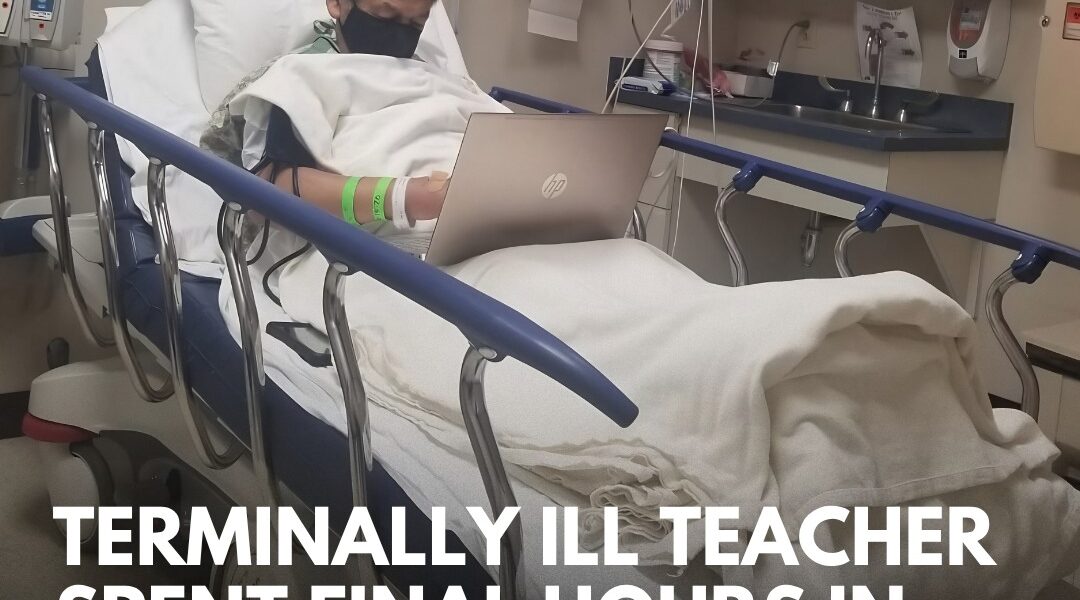
What made the image so powerful was its simplicity. There was no elaborate setup, no polished tribute, and no carefully produced video. It was just a hospital room and a man at his laptop. Yet that plainness is exactly why it resonated. Social media audiences are used to seeing loud declarations of devotion, but here the emotion came from the absence of performance. The teacher was not trying to inspire strangers. He was simply doing what he believed needed to be done. Sandra’s accompanying words sharpened that impact by explaining that teachers put in countless extra hours that many people never see, even during a pandemic and even during a health crisis. Those lines gave the image its emotional frame and helped it spread far beyond her immediate circle.
As the story resurfaced, online reactions followed a familiar but meaningful pattern. Thousands of people praised the teacher, offered condolences to Sandra, and spoke about the educators who had shaped their own lives. Commenters described the story as heartbreaking, inspiring, and unfair all at once. Some focused on the man’s kindness. Others focused on the deeper issue the image seemed to reveal: that teachers are often expected to give more than any profession should ask. That tension is part of why the story stayed with people. It did not fit neatly into a single emotion. It felt admirable, but it also felt tragic.
Sandra Venegas Turned Private Grief Into Public Witness

The center of the story is not only the teacher, but also his daughter. Sandra Venegas did what many grieving family members do in the age of social media: she tried to capture something true about the person she had lost. Her post was not framed as a media campaign or a social experiment. It was an act of remembrance. But because the memory she shared connected so directly with a broader reality of overwork and educational sacrifice, it moved quickly into the public sphere.
That shift from personal grief to public symbol is part of what gives the story its unusual emotional weight. Sandra was not merely telling strangers that her father had been dedicated. She was showing them. The image served as evidence, and her words gave that evidence context. She made visible the kind of labor that is usually invisible: the hours at home, the unfinished grading, the sense of obligation that persists no matter what else is collapsing around it. Once people saw that, they did not just see one teacher. They saw an entire profession reflected back at them.
Why the Story Felt So Familiar to So Many People
Part of the viral power came from recognition. Even people who had never met this teacher understood the type of person he seemed to be. Nearly everyone can remember at least one educator who carried the weight of the job far beyond the classroom. The teacher who stayed late. The teacher who answered emails at night. The teacher who showed up exhausted but prepared. The teacher who cared too much to do the bare minimum. This story gave those memories a face.
That familiarity matters because teaching has long occupied a strange place in public life. It is widely praised in words, but often undervalued in policy, compensation, and everyday understanding. Teachers are expected to be emotionally available, administratively precise, pedagogically skilled, and endlessly patient, often all at once. Their labor is frequently treated as partly vocational, as though care itself should compensate for low recognition. The hospital-bed image cut straight through that contradiction. It showed a man still carrying out his role in what should have been a moment reserved for his own suffering and his own family. That was why people saw both nobility and alarm in the same frame.
The Story Is About Dedication, but Also About Boundaries
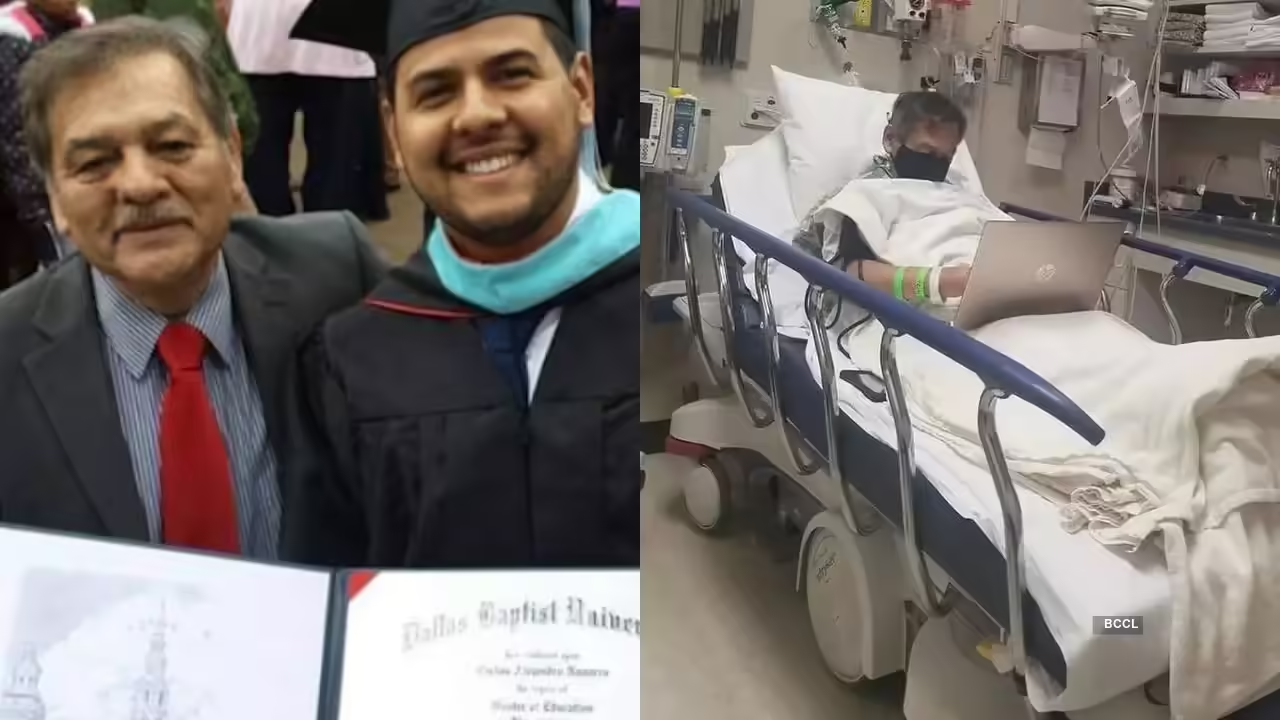
It is easy to read the photo as pure inspiration, and many did. But that is only part of the story. The image also raised uncomfortable questions about work-life balance and about how deeply some professionals internalize responsibility. One later retelling of the story explicitly noted that it sparked reflection on boundaries as much as admiration. That reaction makes sense. A teacher spending final hours grading papers is moving, but it also forces a difficult question: should anyone feel this obligated?
This is what makes the story more than sentimental content. It works on two levels. On one level, it honors a man who clearly cared about his students. On another, it quietly exposes a system in which that level of sacrifice can feel normal. The admiration people expressed online was real. So was the unease. When viewers wrote that teachers do not get enough respect or enough credit, they were not just praising one individual. They were responding to the larger structure that makes stories like this feel both extraordinary and believable.
A Viral Story Reborn Years Later
An important detail in the reporting is that the image was originally shared in 2020 and then went viral again in 2024 through reposts on large social media accounts and follow-up articles. That second wave matters because it shows the story had unusual staying power. Most viral posts burn brightly and disappear. This one resurfaced years later and still generated strong reactions. That usually happens only when a story taps into something unresolved in the culture.
In this case, the unresolved issue is how society sees teachers. The pandemic years intensified public awareness of educational labor, remote grading, emotional strain, and the sheer persistence required of educators. Sandra’s words about teachers worrying about their duties even during a pandemic and a health crisis landed differently because they echoed what millions had already witnessed in schools and homes. The reposting in 2024 did not feel like recycled content. It felt like a reminder that the conditions making the story meaningful had not gone away.
The Human Cost Behind the Hero Narrative

Hero stories are powerful, but they can also flatten the person at the center of them. In this case, it is worth remembering that behind the viral image was a family losing a father. Sandra’s post was born from grief, not branding. One later account even included her regret that she had not simply closed the laptop and spent more time with him in those final hours. Whether or not every retelling included that reflection, it adds an important layer to the story. Dedication can be beautiful, but it can also coexist with loss, unfinished conversations, and the painful realization that work had one more claim on a person’s final day.
That human cost is what keeps the story from turning into a neat lesson. It is not just “look how hardworking this teacher was.” It is also “look how much of himself he gave.” Those are not the same sentence. The first invites applause. The second invites reckoning. If the internet responded so intensely, it may be because people sensed both at once.
What the Public Response Says About Teachers

The wide response to the image revealed something encouraging as well. People still care deeply about teachers. They still recognize the moral seriousness of the job. They still understand, instinctively, that shaping students’ lives is different from simply completing tasks. Many comments on the viral reposts came from people saying they had parents who were teachers, or that they remembered an educator who changed their life. The image became a space where gratitude poured out, perhaps because so many people had never fully expressed it before.
That public gratitude matters, but it also highlights a gap. Respect is meaningful, yet respect without structural support is fragile. Viral praise does not reduce burnout. Condolences do not lighten workloads. Emotional tributes do not change the hidden hours teachers spend grading, planning, answering messages, and holding classrooms together. Stories like this gain power because they reveal that gap between what the profession gives and what it receives in return.
Why This Story Continues to Spread
The reason this story keeps circulating is not only that it is sad. It is that it feels morally legible in an age when many stories do not. People know immediately what they are looking at. They see commitment. They see sacrifice. They see love expressed through routine labor. They see a profession that often asks for more than is visible. And they see a daughter who chose to honor her father not with abstract praise, but with an image that told the truth plainly.
In a media environment full of outrage and distraction, that kind of plain truth can travel far. It cuts through noise because it is emotionally direct. It does not rely on scandal or shock. It relies on recognition. Anyone who has ever loved a teacher, been taught by one, or lived with one can understand the story in seconds. That is why it still moves people years later.
In the end, the viral image of Sandra Venegas’s father grading papers from a hospital bed is not memorable simply because it was his final act. It is memorable because it made visible a kind of devotion that usually remains hidden behind closed classroom doors and late-night routines. It honored one teacher, but it also exposed the larger emotional economy of teaching, where responsibility often spills into every available corner of life. People online called him dedicated, selfless, and inspiring, and those words fit. But the story also leaves behind a harder question about how much quiet sacrifice society asks educators to carry. That is why the photo lingers. It is not just a tribute to one man. It is a portrait of a profession, seen in one devastating moment.