Every Week, a Stranger Visited My Wife’s Grave—Then I Learned the Truth

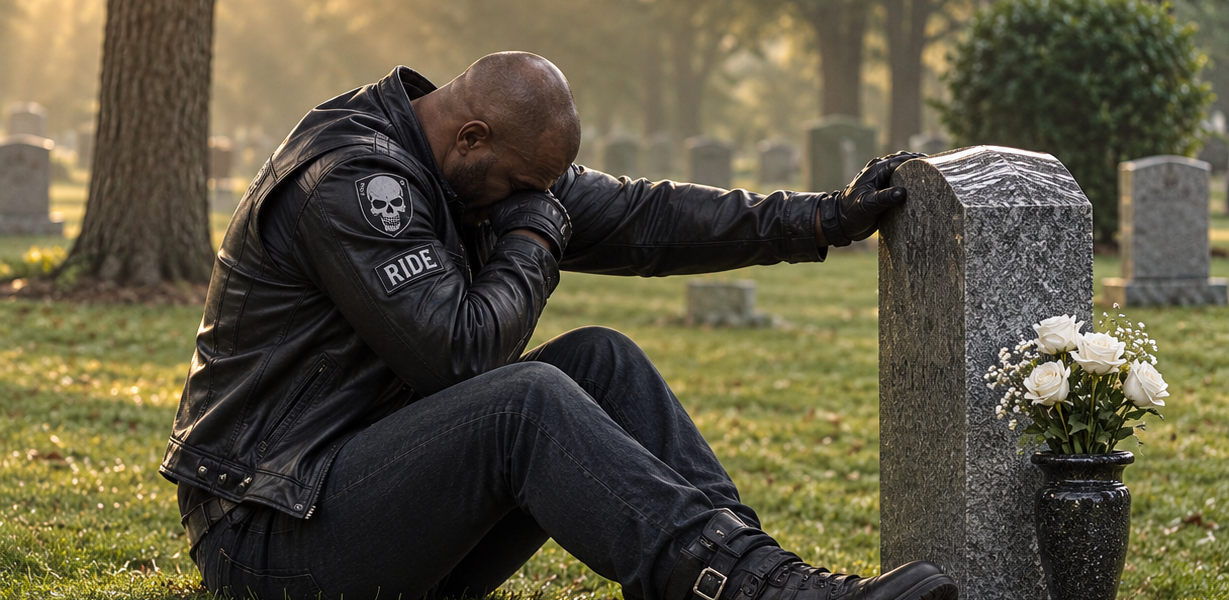
Every Saturday at 2:00 p.m., the black Harley-Davidson pulled up under the cemetery’s large oak tree.
The rider was built like a man who worked with his hands—heavy boots, gray-bearded, wearing a faded leather jacket. He didn’t carry flowers. He didn’t bring a Bible. He just walked straight to my late wife’s headstone, sat in the grass for exactly sixty minutes, and wept when he thought no one was looking. At 3:00 p.m. sharp, he’d rest a hand on the cold stone, stand up, and ride away.
I sat in my car every week, watching him.
It had been fourteen months since breast cancer took Emily at forty-three. My kids and I were still picking up the pieces of an ordinary life—paying bills, going to school, living under a silent shadow. Emily was a pediatric nurse who loved bad jokes, packed extra snacks for everyone, and drove a silver minivan with a broken cup holder. I thought I knew everything about the woman I’d spent twenty years with.
So who was this stranger mourning her with such heavy, devastating grief?
At first, I thought he had the wrong grave. By month three, doubt had curdled into jealousy and fear. You can’t ask dead people for answers, and the unanswered questions were tearing me apart.
On the twenty-sixth Saturday, I finally stepped out of my car.
The afternoon breeze rustled the leaves of the old oak tree as I approached him. The stranger had been sitting beside Emily’s headstone for nearly forty minutes. I had spent the walk over rehearsing a calm, polite opening, but the words tore out of me: “Excuse me.”
He didn’t look up immediately. His hand remained pressed against Emily’s engraved name.
“Can I help you?” he asked softly.
“I think you can,” I replied, my anger flaring. “Who are you?”
He looked up, revealing deep lines around his eyes and a gray-threaded beard. His expression wasn’t defensive—it was unexpectedly gentle. “Are you family?”
“I’m her husband.”
He stood up so fast he nearly stumbled. “Oh… You’re Emily’s husband.”
“So you knew her,” I demanded. “Then explain why you’ve been sitting at my wife’s grave every Saturday for six months.”
He looked down, his voice barely a whisper. “Your wife was my wife…”
My heart stopped. “What did you say?”
“No—I’m sorry, that came out completely wrong!” he panicked, rubbing a hand across his face. “What I meant was… your wife is the reason I still have my family. I come here because I never got to thank her while she was alive.”
The silence hung heavy between us. “Thank her for what?”
“Your wife saved my daughter’s life.”
I stared at him, stunned. “Emily?”
He nodded, looking down at the soft grass. “Would you mind if we sat down? It’s a long story.”
I took a breath and sat across from him. There we were—two strangers separated by a headstone, tied together by a woman neither of us could speak to again.
His name was Mike. He was a forty-seven-year-old mechanic and a single dad to a sixteen-year-old girl named Kylie. Seven years ago, when Kylie was just nine, she began bruising easily and sleeping all day. Then came the emergency room, the quiet consultation room, and the word that shatters every parent: leukemia.
Mike choked back tears as he described watching his little girl lose her hair, holding her stuffed rabbit, while he worked double shifts, sold his tools, and eventually sacrificed his own house just to pay for her care.
To save Kylie, Mike had sold his house, moving into a cramped apartment while his motorcycle club and complete strangers rallied around him with donations, cards, and twenty-dollar bills. He kept every single note.
Yet, a terrifying forty-thousand-dollar wall still blocked Kylie’s treatment.
“I’d sold everything,” Mike recalled, staring down at his hands. “I was working every hour. And I still couldn’t get there. I felt like I was failing my little girl.”
The pressure finally broke him the day Kylie asked him what would happen if the medicine failed. After comforting her, Mike stepped into the hospital hallway and wept uncontrollably.
That was when Emily found him.
“Are you okay?” she had asked.
I smiled through the lump in my throat. I knew that voice. I knew that exact gentle persistence.
Emily sat beside him on the floor, listening as he confessed his deepest fears and his inability to pay for Kylie’s life. When Mike called himself a terrible father, Emily looked at him with unwavering certainty: “A father who has given everything he has for his child isn’t a failure. He’s a father who loves his child more than anything.”
When Mike said he stopped believing in miracles, Emily’s expression softened. “Then let me believe in one for you.”
Two days later, an anonymous donor paid the entire forty thousand dollars. They asked for no credit, no thank-you, and no recognition—just a healed little girl.
The donation didn’t cure Kylie overnight, but it bought her a fighting chance. Mike could finally stop panicking and simply be a father. And eventually, the storm broke: Kylie’s cancer went into remission.
Three years later, Kylie’s doctors delivered the miracle we had all prayed for: she was cancer-free.
“Every time she complains about homework or argues with me about her curfew,” Mike whispered with a watery smile, “I thank God she’s here to complain.”
“How did you find out it was Emily?” I asked.
Mike reached into his leather jacket, retrieving a soft, yellowed slip of paper. “I brought it today.”
As I took it from his hands, the world stopped. The distinctive, familiar handwriting belonged to my wife. Every lowercase loop, every stroke—it was Emily.
The note was brief, written in blue ink:
For Kylie, and for the father who loves her enough to give everything. Please don’t lose hope… No thanks are necessary. Just keep loving your little girl.
“That’s hers, isn’t it?” Mike asked.
“Yes,” I choked out.
Mike explained how he had connected the dots years later, discovering that the compassionate nurse in the hospital hallway was the same woman whose obituary he later read. He had come to her grave every Saturday simply to honor her memory.
The realization stunned me. Forty thousand dollars. Emily had used her aunt’s inheritance to save a little girl’s life without ever mentioning it to me. Not once in all our years of marriage did she take credit for the miracle she had orchestrated in the dark.
Sitting there under the oak tree, tears streamed down my face. I had loved Emily for two decades for her kindness, her humor, and her fierce devotion. But holding that note, I learned something breathtaking: my wife’s heart was even more extraordinary than I ever knew, full of quiet grace that changed the world without ever needing to be thanked.
In the quiet that followed, memories of Emily flooded back. I remembered the nights she returned from the hospital worn out and soft-spoken. I used to think she had just had a hard shift. Now I understood: she had been holding the line between despair and hope for families like Mike’s.
“I came here because I couldn’t say thank you in person,” Mike said. “Every week, I tell her about Kylie. She’s healthy now. She wants to be a pediatric nurse… just like Emily.”
“Just like Emily,” I murmured.
“She even got her driver’s permit last month,” Mike added, a weak smile breaking through his tears.
I couldn’t help but laugh through my own tears. “Emily would have made sure you double-checked her seat belt.”
“And her mirrors,” Mike laughed.
That brief, shared moment of joy broke the shadow of grief that had hung over the grave for months.
“How do you stop being grateful to someone who gave you back your future?” Mike asked, holding my gaze.
I had no words, only a profound realization. Emily didn’t help Mike to be a hero; she helped him because her compassion knew no boundaries. Her legacy extended far beyond our family home—it was beating inside the chest of a teenager planning her own life of service.
As Mike prepared to leave, he mentioned that Kylie had always wanted to pay her respects, but he had held back out of respect for my grief.
“She wants to pass Emily’s kindness on,” Mike said.
I looked down at the soft grass by the stone, then back at the man who had kept vigil here for six months.
“Bring her with you next Saturday,” I said.
Mike looked surprised. “Are you sure? I don’t want to intrude.”
“You’re not intruding, Mike. Emily built a bridge between our families—and there’s plenty of room here for all of us.”
“Next time, don’t sit here alone,” I said, gesturing to the patch of grass beside the headstone. “Sit with me.”
Mike’s face softened, emotion washing over him. “I’d like that very much.”
We shook hands, a unspoken truce forged over a weathered gravestone. Watching him ride off, I felt the suspicion of the past six months evaporate into the quiet afternoon air.
I stayed behind as the sun sank lower, tracing Emily’s loops on the yellowed paper. Why didn’t you tell me? I thought. But I already knew the answer. Emily had always taught our kids that true generosity doesn’t look for an audience. She hadn’t given away an inheritance for praise; she had done it simply because a father was drowning and a little girl needed a chance.
The next Saturday, I was waiting for him under the oak tree with two cups of coffee in hand.
“Hope you take cream,” I called out as he killed his engine.
Mike smiled. “You’re in luck.”
From that day on, the cemetery was no longer a lonely place of mourning. We talked about our kids, laughed at old memories, and let the healing begin.
When Mike finally brought Kylie to meet me, she laid a bouquet of white lilies by Emily’s name. “I’m going to be a nurse,” the girl whispered to the stone, tears spilling down her cheeks. “So I can help people the way you helped me.”
When Kylie threw her arms around me, words weren’t necessary. Emily’s kindness had reached across time, connecting two broken families and filling the void of loss with something beautiful.
In the months ahead, I learned of countless other lives Emily had touched in secret—coats bought for cold children, hot meals brought to exhausted hospital parents, late nights spent comforting frightened kids.
Sitting beside her grave, no longer alone, I finally understood: the true measure of a life isn’t found in what we accumulate, but in the love we give away when no one is watching.
The stranger I once watched with suspicion and fear now sits beside me as a brother.
We still meet every Saturday beneath the shade of that old oak tree. We talk about our kids, our grief, and the quiet grace of an ordinary nurse who changed the world without ever asking for applause.
Emily never received a medal. Her name was never in a headline. But she gave a father his daughter back, and she showed me that the people closest to us often carry unseen light into the dark places of the world.
I still keep her note with our wedding photograph. Whenever I read those faded blue lines, I remember Mike’s question on the day we met: “How do you stop being grateful to someone who gave you back your future?”
The answer is simple: you don’t. You let that gratitude transform you. You pass it on to strangers, to neighbors, to anyone in need of a little hope.
As we prepared to leave the cemetery, Mike pressed his calloused hand against her headstone, whispering his weekly prayer of thanks. I stepped forward and laid my hand beside his on the cold stone.
“Thank you, Emily,” I murmured into the breeze. “For loving us. For saving her. And for teaching me that the true legacy of a life isn’t found in what we build for ourselves, but in the love we give away.”
Sometimes the most beautiful love stories aren’t about two people falling in love. They’re about the quiet kindness one person leaves behind—and the lives that carry that light forward into the world.