“Just Keeping Her Warm”: The Homeless Man Who Saved a Kitten – And How It Changed Three Lives Forever

When a homeless man found a shivering kitten in an alley, he thought he was just giving her one warm night. What happened next will restore your faith in humanity.
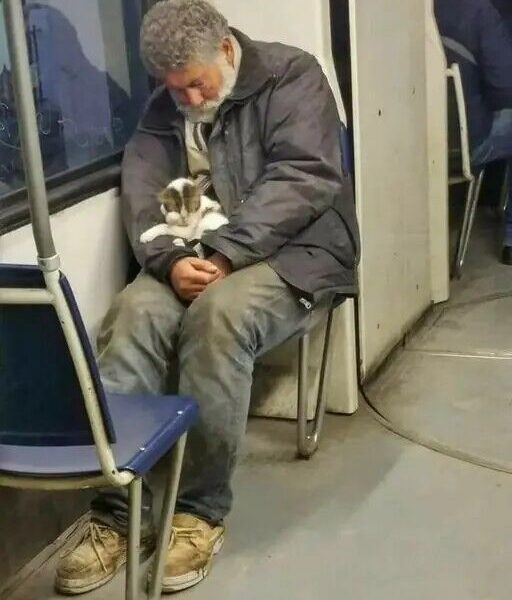
The 10:15 PM Blue Line train rattled through the city like a tired sigh, its fluorescent lights flickering over passengers lost in their phones or nodding off against fogged-up windows. I barely noticed the man at first—just another figure in a worn-out coat, his shoulders hunched against the world. But then I saw what he was cradling in his arms, and my breath caught.
A tiny ball of gray fur, so small it could fit in my palm, was curled against his chest like a living heartbeat. Her paws kneaded rhythmically at the fraying edge of his scarf, her purrs audible even over the screech of the tracks. The contrast was jarring: his chapped hands with dirt under the nails, holding her as delicately as if she were made of glass.
I slid into the seat across from him. Up close, I could see the kitten’s ribs beneath her damp fur, the way her claws snagged on the wool of his sleeve—not trying to escape, just anchoring herself to this stranger who smelled of rain and old bread. “Is she yours?” I asked.
He didn’t look up at first, just ran a calloused thumb over the kitten’s head in a gesture so tender it ached. “No,” he said finally. “She found me.” His voice was rough but quiet, the kind that hadn’t been used much lately.
Three nights earlier, behind a bakery dumpster, he’d heard a sound like crumpled paper. There she was—half-drowned in a puddle, her mews thinner than the alley’s shadows. He’d given her the last bite of his ham sandwich (the meat torn into shreds small enough for her tiny mouth) and wrapped her in the only dry thing he owned: a moth-eaten scarf that still carried the faint scent of cedar from its better days. “Figured I could give her one warm night,” he admitted. “But when morning came, she climbed inside my coat instead of running away.”
I asked where they were going now. That’s when he showed me the napkin—the edges soft from being folded and refolded in his pocket. In smudged blue ink, it read: “She answers to ‘Mina.’ Please don’t leave her. If you find her—bring her home.” On the back, a phone number. And at the bottom, three words that made my throat tighten: “Her little girl.”
The train lurched around a curve, and the man—Silas, he told me—automatically cupped his hand around Mina to steady her. She blinked sleepily at him, her mismatched eyes (one gold, one green) squinting against the light. I noticed then how his coat sleeves were frayed at the cuffs, but the kitten’s fur was clean, free of the dirt that clung to his fingernails. He’d clearly been bathing her somehow.
As stations blurred past, Silas talked in fragments. About how he’d been a mechanic before the factory closed. How his wife’s medical bills ate through their savings long before the cancer took her. How he’d stopped counting the days on the streets when he realized no one was coming to look for him. “But this little thief,” he said, tapping Mina’s nose gently, “she kept stealing my shoelaces like she wanted me to stay put.”
When we reached 6th and Maple, the platform was nearly empty. Silas moved with the cautious gait of someone used to being told to move along, but his grip on Mina never tightened. The promised bench was there, its wood warped by years of weather. We waited as the streetlights buzzed overhead, Mina now alert in Silas’s arms, her ears twitching at every distant siren.
Then—a gasp. A young woman sprinted toward us, her untied sneakers slapping against the concrete. “MINA!” The raw relief in that cry sent shivers down my spine. She collapsed to her knees in front of Silas, her hands fluttering over the kitten like she couldn’t believe it was real. Up close, I could see her chipped nail polish, the dark circles under her eyes. “I’ve been posting flyers for days,” she choked out, pressing Mina to her cheek. The kitten immediately began licking her tears away.
Anya, as she introduced herself, explained through hiccuping breaths that Mina was the last living connection to her mother. “Mom found her in a parking lot the year before she died. Said Mina was her ‘little guardian angel.’ When I had to move after the eviction notice…” She trailed off, shame flashing across her face. The pieces clicked: the hastily scribbled note, the public meeting spot. Anya had been living in her car.
What happened next defied every cynical bone in my body. Anya tried to press a wad of cash into Silas’s hand. He stepped back as if burned. “I didn’t do it for money,” he said, so quietly I almost missed it. Something in his tone made Anya pause. She really looked at him then—not just the stained coat and broken shoes, but the kindness in the way he’d handed Mina over, making sure their fingers never brushed to avoid startling her.
Over terrible gas station coffee (Anya insisted), the conversation took an unexpected turn. Silas mentioned he’d been a volunteer firefighter in his twenties. Anya’s eyes lit up. “The shelter where I shower—they’re desperate for someone to fix their plumbing.” A beat. “It pays $18 an hour.”
Here’s what the napkin didn’t tell you: Anya’s mother had been the social worker who founded Hope’s Corner, a daytime shelter three blocks from that bench. When Silas showed up the next morning, tools borrowed from the janitor’s closet in hand, the director recognized Anya’s description immediately. “Lena’s daughter said you’d come,” she said, handing him a key.
The real twist? That plumbing job turned into a part-time maintenance position. The position turned into a tiny studio apartment above the shelter when Silas mentioned he’d been sleeping behind the library. And Anya—grieving, struggling, but fiercely determined—used her mother’s old contacts to secure a grant for “Lena’s Fund,” a program pairing homeless animal fosters with shelter residents. Silas became their first official caretaker, a role that came with veterinary benefits and, more importantly, a community that didn’t flinch at his past.
Last I heard, Mina—now a plump, glossy-coated diva—divides her time between Anya’s new apartment and Silas’s office at the shelter, where she naps in a donated armchair dubbed “The Throne.” The original napkin is framed above it, a reminder of how one act of compassion can unravel loneliness’s tightest knots.
The Unspoken Truth Beneath This Story
We’re taught to believe help comes from institutions—from social services, from charities, from systems. But sometimes salvation wears a threadbare coat and carries a kitten in its pocket. Sometimes the person who needs rescuing most is the one doing the saving. And sometimes, against all odds, a damp alley and a crumpled napkin can rewrite futures.
So the next time you see someone the world has labeled “invisible,” remember Silas and Mina. Remember that the most powerful forces in this world aren’t money or power, but the willingness to share your last sandwich, to fold a note with shaking hands, to say “I see you” without speaking a word.