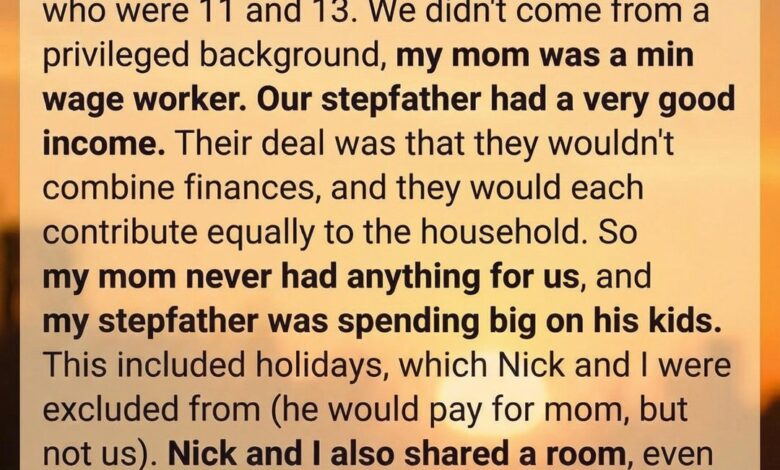

When I was about nine, my mom married my stepfather. I didn’t understand much about blended families then, but I quickly learned how different circumstances can shape childhood. My mom worked a modest job and stretched every dollar to support my older brother, Nick, and me. My stepfather, meanwhile, earned far more and had two children of his own, Cleo and Emma.
They kept their finances separate and contributed equally to the household—fair on paper, but not in reality. My mom stretched herself thin, while my stepfather maintained the lifestyle his income allowed. His kids had their own rooms, new clothes, and regular vacations. Nick and I shared a room, even though a guest room sat empty. We stayed home during trips our stepfather funded, while my mom joined them without us. We learned early how to make do.
Now, at 28, I can look back with more clarity. Recently, during a visit home, my stepfather shocked me with a request: he insisted Nick and I each give $25,000 to help Cleo buy a house. Not a favor—an expectation. Hearing that, I couldn’t help but remember the years we were left behind, the imbalance we quietly lived through.
I answered calmly but firmly: I couldn’t contribute, and it wasn’t my responsibility. For the first time, I didn’t feel guilty for drawing a boundary.
Growing up taught me that fairness isn’t always present, but adulthood gives us the power to protect our peace. I’m grateful for the resilience my childhood built—and confident in choosing a future shaped by my own values, not someone else’s expectations.