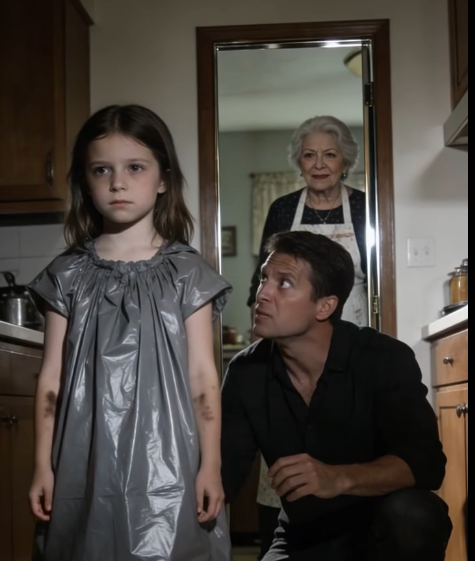
The trash bag wasn’t tied. It hung off her like a bad costume, thin gray plastic clinging to her arms and shoulders, wrinkling where it caught on bruises.

The trash bag wasn’t tied. It hung off her like a bad costume, thin gray plastic clinging to her arms and shoulders, wrinkling where it caught on bruises.
Lily stood in the kitchen doorway and didn’t cry. That was what scared me most. Seven-year-olds cry when they’re hurt. Seven-year-olds run, shout, collapse into you like you’re the last safe place on earth. Lily just looked up with eyes that didn’t belong to a child and said, very quietly, “Grandma said I’m too fat to wear pretty dresses.”
Then she lifted her arms.
The overhead light did the rest. Purple fingerprints—adult hands—pressed into her skin like stamps. Red lines, straight and cruel, dragged across the soft inside of her upper arms. My breath stopped, not because I was shocked, but because something in me went flat and cold, like a switch flipping.
I didn’t ask questions. Not then. Questions were for people who still needed convincing.
I crossed the kitchen, lowered my voice, and kept it steady. “Go wash your hands, baby. Take that off. Daddy’s going to find you something soft.”
She nodded like she’d been trained to obey through fear. She walked away, plastic whispering against tile.
I waited until she was out of sight. Then I opened the drawer where we kept scissors, tape, batteries—junk that mattered when you needed it. My hands didn’t shake. I pulled out my phone and walked into the living room, away from where Lily could hear. I took photos of every mark I’d seen, and then I waited by the hallway until she came back in a long T-shirt, her hair damp from washing, face blank.
“How long?” I asked.
She shrugged. “Just… when Mom lets me go there.”
My wife, Sarah, worked late Tuesdays. Margaret always “helped” on Tuesdays.
I wanted to say Margaret’s name out loud, to taste it like poison. Instead I swallowed the sound and kissed Lily’s forehead. Sweat and fear. The smell of a child trying to be invisible.
“Go watch your show,” I told her. “I’ll be right here.”
She went to the couch and curled in on herself. I watched her for one long minute, burned the image into my brain, then turned to the hook by the door where we kept the keys.
For seven years I’d told myself Margaret was just harsh. Old-fashioned. Proud. The kind of woman who believed love was something you rationed like sugar during a war. I married into the Harrisons thinking their stiff smiles and icy dinners were a family style, not a warning label.
Margaret’s comments had always come with a pleasant tone, like she was doing us a favor.
“She’s a bit soft,” she’d say over roast chicken, eyes measuring Lily like a product. “She needs discipline.”
“You’re spoiling her, David,” she’d tell me, calling it concern. “Pretty dresses are for girls who take care of themselves.”
I’d smiled politely. I’d tried to keep peace. I’d explained, defended, redirected. I’d believed in blood loyalty like it was a religion.
That was my mistake.
I drove to Margaret’s house with the radio off. No music. No distractions. The world narrowed to the hum of tires and the hard rhythm of my pulse. When you’ve spent years believing something is normal, the moment you finally name it for what it is—abuse—your brain starts replaying scenes you excused. Her sharp little digs. Lily’s sudden fear of dessert. Lily pinching her own stomach in the mirror.
I pulled into Margaret’s driveway and sat there for a breath, hands on the wheel, looking at the neat front yard and trimmed hedges. A house that looked like safety.
I walked up and knocked once.
Margaret opened the door wearing an apron, as if she’d been baking goodwill. She smiled immediately, practiced and automatic.
“David,” she said, too bright. “I didn’t expect you.”
She didn’t expect the silence either.
I stepped inside without asking. I didn’t bring Lily. I didn’t bring Sarah. I didn’t bring anger. Anger is loud. Anger gives people a story they can twist into self-defense. I brought calm.
Margaret’s living room was exactly the same as always: plastic covers on the couch that crinkled when you breathed too close, framed family photos where everyone looked stiff and righteous, a faint smell of powder and cheap floral perfume. A shrine to control.
“Where’s Lily?” Margaret asked, peering behind me like she expected the child to appear on command. “Did she tell you about her little tantrum? She was being uncontrollable. I had to be firm.”
That was the moment I realized she truly believed she was right. Not sorry. Not ashamed. Proud.
I walked closer. Margaret lifted her chin slightly, ready for an argument she could win by volume and tears.
And I hugged her.
Not a warm hug. Not a son-in-law hug. A calculated embrace, tight enough to make her stiffen, long enough to make her uncomfortable. I felt her body lock like a door. I smelled her perfume and thought of Lily’s bruises.
Margaret’s hands rose halfway like she didn’t know where to put them. She patted my shoulder once, confused.
“Thank you,” I whispered into her ear, voice calm and dead. “Thank you for loving my daughter.”
Her breath hitched. I felt it. Fear, under the skin.
Then I stepped back, looked at her face, and gave her a small, polite smile—the kind you give a stranger you’ll never see again.
I turned and walked out.
I didn’t slam the door. I didn’t threaten her. I didn’t accuse her. I didn’t give her anything she could argue with. I left her standing in her perfect house with nothing but uncertainty gnawing at her.
In my car, I watched her silhouette in the front window. She looked relieved. Like she’d survived a storm.
She had no idea I’d just started the clock.
That night, after Lily finally fell asleep—still curled tight, still flinching when I tucked the blanket—I sat at the kitchen table and built something. Not a rant. Not a plan made of fantasy. A structure.
First: proof. Photos in multiple locations. Prints in a folder. Dates logged. Notes written down while my memory was clear.
Second: witnesses. I called Lily’s pediatrician the next morning and asked for an urgent appointment. I didn’t hint. I said, “My daughter has bruises. I need you to see them and document everything.”
Doctors don’t need drama. They need facts. The pediatrician’s face hardened as she examined Lily. “This is not accidental,” she said quietly. “This is adult grip bruising.”
Third: the net. I hired a lawyer with a reputation for clean devastation. Not a showy shark. A quiet one. The kind who turns your life into paperwork you can’t outrun.
I didn’t tell Sarah yet. Not because I didn’t trust her, but because shock makes people leak plans. I needed this airtight before Margaret got wind of it.
The texts came, as expected. Margaret couldn’t resist control.
Did she behave today?
Watch her sugar. She’s getting heavy.
You let her get away with too much.
I saved every word. Backed them up. Printed them. Logged them.
Then I turned on the lights in the one place Margaret thought she was untouchable: her church.
Christmas Eve service was packed. Golden candles, choir kids in white, families dressed in their best lies. Margaret sat in the front row like she owned the building. Perfect posture. Perfect hair. Her halo made of reputation.
The pastor invited testimonies—short blessings, quick gratitude. People stood and thanked God for jobs, for healing, for good fortune.
I stood.
Heads turned. People knew me as Margaret’s quiet son-in-law. The reasonable one. The man who didn’t make scenes.
I walked to the microphone with a steady heart.
“I want to talk about family,” I said. “About trust. About the people we hand our children to because we assume love comes with the title.”
Margaret smiled, satisfied, already anticipating a public compliment.
“And I want to talk about the monsters who hide behind respectability.”
Her smile faltered.
I nodded at the tech volunteer. He looked confused until I handed him a small drive.
“Play the folder labeled ‘Christmas Gift,’” I said.
The screen behind the altar flickered.
A close-up of Lily’s bruises filled the church like a slap. The purple fingerprints. The red welts. A hush rolled across the pews—first shock, then something sharper.
Then the audio hit. Margaret’s voice, recorded clean, cruel as ice.
“You little pig. Look at you. Disgusting. No wonder your father doesn’t love you.”
The room made a sound people don’t usually make in church. A collective inhale. A gasp that turned into silence so heavy it felt violent.
Margaret tried to stand. Her legs didn’t cooperate. She sank back down, face draining of color, mouth opening without words.
I didn’t yell. I didn’t rant. I just stated facts like a verdict.
“This is what ‘discipline’ looked like,” I said evenly. “This is what my daughter was told. This is what was done to her.”
The final image showed Lily in that trash bag, eyes hollow. The innocence stripped clean.
Margaret’s reputation didn’t crack. It collapsed. Right there, under warm lights and carols.
The law came the next morning. Quiet. Official. Restraining order. CPS report. Documentation filed. A record that would follow Margaret wherever she ran.
Sarah cried when she saw everything. Not performative tears—broken ones. The kind that come when you realize you protected the wrong person for too long. She held Lily and promised her something real: “You never have to see Grandma again.”
Margaret tried once to approach me weeks later in a grocery store. She looked smaller. Not older—smaller. Like she’d been deflated.
“David,” she whispered. “I didn’t mean to hurt her.”
I turned and looked at her and felt nothing but clarity.
“I know,” I said. “You meant to break her.”
She reached for my arm, desperate. “I’m alone. Everyone left me.”
I leaned in close enough for her to hear me over the store music. “Good,” I said softly. “Now you know how she felt.”
I walked away, and I didn’t look back.
Lily is older now. She wears bright dresses she chooses. She eats when she’s hungry without apology. She laughs loud again, a real laugh, the kind that shakes a room and heals it.
The bruises faded. The trash bag is gone.
But the memory stays with me like a guard at the gate, a reminder carved into bone: you don’t negotiate with someone who hurts your child. You don’t “keep the peace” with a monster.
You turn on the lights.
And you let everyone see what was hiding there.