I never once in my life thought that I would have to bury my own child. That should not happen. Parents are supposed to leave first—that is the natural order of life. But in just a single moment, everything collapsed.
My name is Claire Bennett, and my son, Ethan, was eight years old. He had messy brown hair, a laugh that filled every room, and a habit of asking a hundred questions about the world. He was the kind of child who made strangers smile without even trying.
That morning started like any other. Ethan complained about his cereal being too soggy, then ran to grab his backpack. I reminded him to tie his shoes properly. He rolled his eyes the way kids do, kissed my cheek, and said, “Love you, Mom.”
Those were the last words I ever heard from him.
Later that afternoon, my phone rang while I was folding laundry. The number was unfamiliar. I almost didn’t answer.
A calm voice said, “Ma’am, this is Officer Reynolds. There’s been an accident involving your son.”
The world stopped. I dropped the towel onto the floor.
“No,” I whispered. “That’s not possible.”
But it was.
I drove to the hospital in a blur, my hands shaking so badly I could barely hold the steering wheel. The waiting room smelled like disinfectant and fear. A doctor approached me, his expression already telling me the truth before he spoke.
“I’m so sorry,” he said softly.
I remember screaming, begging, asking them to try again, refusing to understand how a healthy little boy could be gone in one afternoon.
Days later, I stood in front of a small white coffin that looked too light, too wrong. Ethan’s classmates placed drawings beside it. My husband, Daniel, held my hand, but neither of us could feel anything except emptiness.
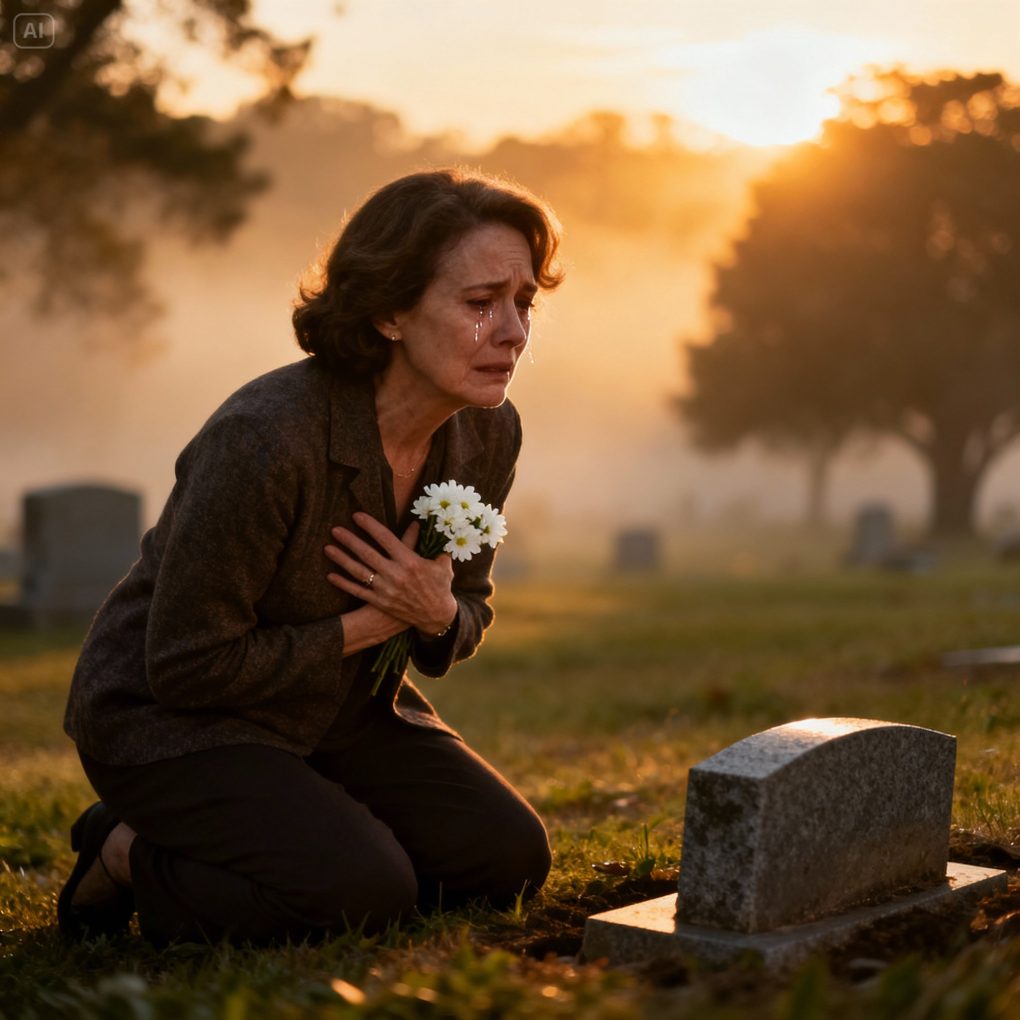
At the cemetery, as the earth began to cover the place where my son would rest forever, my knees nearly gave out.
And in that moment, I realized something terrifying:
This wasn’t just grief.
This was the beginning of learning how to live in a world that had stolen my child’s future… and left me behind to carry it.
The days after the funeral were not dramatic the way movies portray. There was no sudden closure, no comforting peace. There was only silence—thick, endless silence.
Ethan’s room stayed exactly the same. His sneakers were still by the door. His superhero pajamas were folded in the laundry basket. Every object felt like a cruel reminder that time had stopped for him, but not for the rest of the world.
People came by with casseroles and soft voices.
“He’s in a better place.”
“At least you have memories.”
“You’re strong.”
I wanted to scream at every one of them.
Strong? I wasn’t strong. I was shattered.
Daniel tried to hold us together, but grief turned us into strangers living under the same roof. At night, he stared at the ceiling, silent. I cried until my chest hurt, then cried some more when I realized there would never be a day when Ethan walked back through that door.
The hardest part was the ordinary moments.
I reached for two plates at dinner, then froze.
I heard laughter outside and felt anger instead of joy.
I saw a mother holding her son’s hand at the grocery store and had to leave my cart behind because I couldn’t breathe.
One afternoon, I opened Ethan’s school folder. Inside was a spelling test with a gold star and a note from his teacher:
“Ethan has such a bright future.”
I collapsed on the floor.
A future.
That word became unbearable.
Because the truth is, when you lose a child, you don’t only lose them. You lose every birthday that will never happen, every graduation you will never attend, every life milestone that disappears into nothing.
Weeks passed, then months. The world expected healing.
But grief doesn’t follow schedules.
It lives in your bones. It rewrites your identity. I wasn’t just Claire anymore.
I was Ethan’s mother… in the past tense.
And the most painful lesson of all was realizing that no one could truly understand this kind of loss unless they had stood where I stood—before a grave far too small.
For a long time, I believed life was over.
Not in the sense that I wanted to die, but in the sense that nothing could ever feel meaningful again. How could it? My child was gone. The world had taken the person I loved most, and I was supposed to keep going as if it was normal.
But grief changes slowly.
One evening, Daniel sat beside me in Ethan’s room. He picked up a toy car and turned it over in his hands.
“We can’t lose him completely,” he whispered.
I didn’t answer at first. Then I asked, “How do we not?”
Daniel looked at me with tired eyes. “By remembering him out loud.”
That was the first time I realized something important: silence was not honoring Ethan. Silence was erasing him.
So we began, little by little, to speak his name again.
We started a small scholarship fund at his school. Nothing huge—just enough to help one child each year, the way Ethan would have wanted. We donated his books. We planted a tree in the park where he used to play.
None of it brought him back.
Nothing ever could.
But it gave his life weight beyond the moment it ended.
I learned that healing does not mean forgetting. Healing means carrying love and pain together, somehow making room for both.
Even now, I still have days when grief knocks me to the ground. I still ache when I see boys Ethan’s age. I still wonder who he would have become.
But I also know this: Ethan’s life mattered. His story matters. And sharing it keeps him present in the only way I can.
If you’ve ever experienced a loss that changed you forever, or if you’ve ever supported someone through unimaginable grief, I invite you to share your thoughts. How do we keep going after the unthinkable? And how do we honor the people we’ve lost while still learning to live?
Your words might help someone else feel less alone.