Mike’s parents kept repeating the same sentence like it could stitch reality back together.
“Claire, you’ll be released soon,” his mother, Diane Callahan, promised through the glass at the police station. Her pearls looked out of place under fluorescent lights. “This is a misunderstanding. Mike will wake up, explain everything, and you’ll come home.”
I wanted to believe her. I needed to.
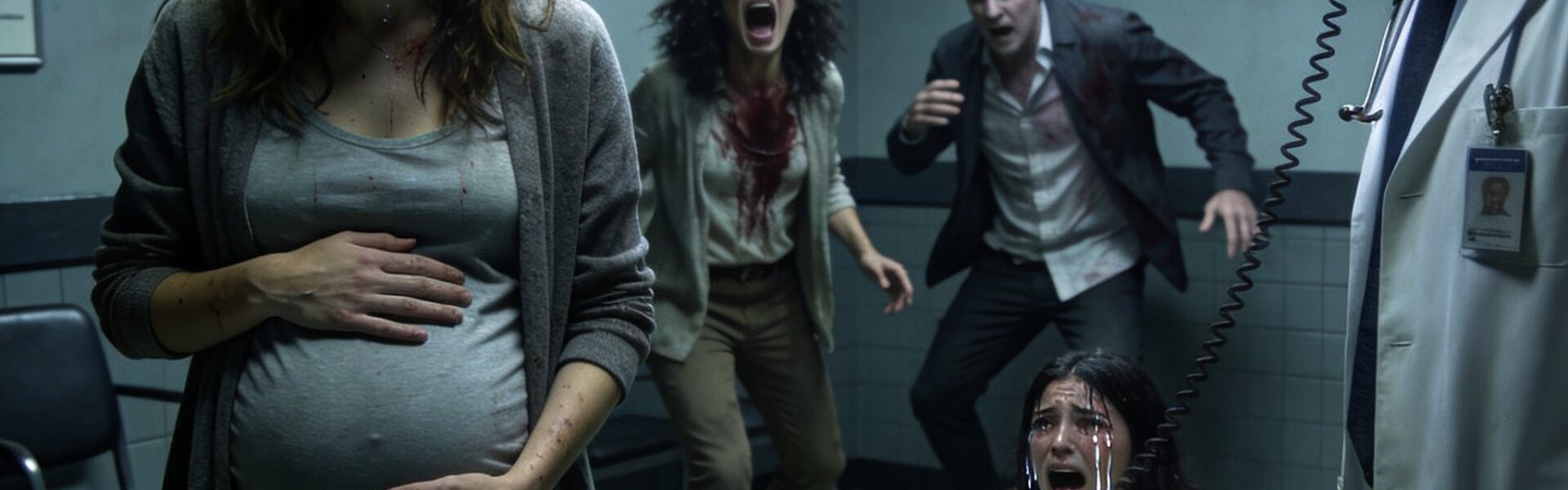
Two hours earlier, I’d been the one screaming for help in the hospital hallway after Mike collapsed. I remembered blood on the sheet. A nurse shouting “clear.” The smell of antiseptic and something burnt. Then the security guards—too fast, too aggressive—pinning my wrists when I tried to follow him into the trauma room.
Now I sat in a hard plastic chair, my hands still marked from zip ties, my stomach turning with nausea that wasn’t just fear.
I was pregnant. Mike was the father. And the only person who could protect us was lying unconscious in a hospital bed.
A desk sergeant’s phone rang. He glanced at the caller ID and frowned.
“It’s the hospital,” he said, then pressed speaker.
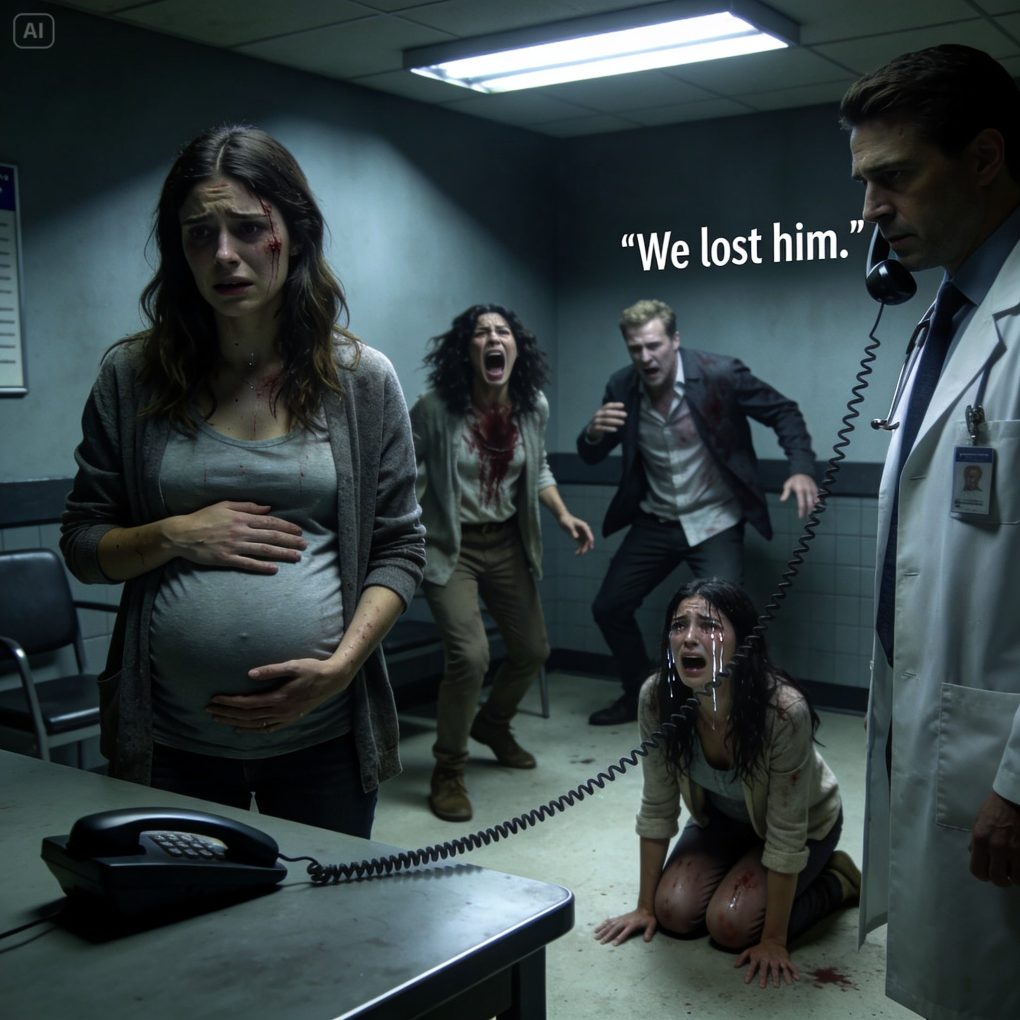
A man’s voice came through—controlled, professional. “This is Dr. Mercer in the ICU. I’m calling regarding Michael Callahan.”
Diane surged forward. “Doctor? Is he—?”
The doctor didn’t soften it. He said three words that shattered the room.
“We lost him.”
For a second the station went silent, like every breath got stolen at once.
Diane screamed—an animal sound. Mike’s father, Graham, grabbed the edge of the counter like his legs stopped working. An officer reached for him instinctively.
And I dropped to my knees, because my body understood before my mind could: Mike was gone, and our baby would never know his voice.
But then something strange happened.
On the speaker, I heard a faint second sound—not the doctor, not the sergeant. A whisper, half-covered by static, like someone close to the microphone.
“Good,” a voice murmured. “Now keep her there.”
My blood went cold.
Because doctors don’t whisper orders to police stations.
And in that moment, I realized the worst part wasn’t that Mike died.
It was that someone wanted me trapped while it happened.
They moved fast after that. Too fast for grief.
An officer lifted me back into the chair. Another tried to usher Diane away from the front desk. The sergeant ended the call with shaking hands and stared at his phone like it had betrayed him too.
I didn’t cry. Not yet. My brain was stuck on the whisper.
“Can I hear that again?” I asked, voice thin. “Please. The end.”
The sergeant hesitated. “Ma’am, that was the hospital—”
“I heard someone else,” I insisted. “Someone said, ‘Keep her there.’”
One younger officer—Officer Reyes—shifted uncomfortably. He’d been watching me since I arrived, like he didn’t quite buy the story that I’d “caused a disturbance” bad enough to detain me.
He stepped closer to the sergeant. “We record station calls, right?”
The sergeant nodded slowly. “Most lines, yes.”
Reyes looked at me. “What happened at the hospital before you were brought in?”
I swallowed hard. “Mike collapsed. I followed the gurney. A security guard told me I wasn’t family. I said I’m pregnant—his fiancée. Then… someone grabbed me from behind. I saw a doctor in a gray coat arguing with a nurse near the medication station. And then security dragged me out.”
Reyes’s eyes narrowed. “Did you touch Mike? His IV? Anything?”
“No,” I said. “I never got close.”
The sergeant made a decision and typed on his computer. “We’re pulling the call recording,” he muttered. “And I’m calling the hospital back—off speaker.”
Diane’s face was blotchy with tears, but there was something else there too—impatience. Like this delay annoyed her.
“Why are you doing this?” she snapped at me. “My son just died!”
Reyes didn’t look away from her. “Ma’am, the hospital typically notifies next of kin directly. Not… a police desk. That’s unusual.”
The sergeant returned, pale. “Hospital operator says Dr. Mercer isn’t on duty tonight.”
My stomach dropped. “Then who called?”
Reyes’s jaw tightened. “Someone who wanted us to believe Mike was dead.”
Within an hour, they confirmed another detail that didn’t fit: the hospital could not provide a time of death to the station because—officially—no death had been declared in Mike’s chart yet.
Which meant the call was either premature…
or staged.
Reyes leaned closer to me and lowered his voice. “If Mike didn’t die naturally,” he said, “the first question is: who benefits from you being locked in here while he ‘dies’?”
I looked through the glass at Diane and Graham—still demanding answers, still crying loudly, still controlling the space.
And the answer landed in my chest like a weight.
If Mike was truly gone, they inherited everything.
If I stayed “unstable” in a police station, I had no voice at all.
At dawn, the station received a second call—this one verified through the hospital operator, routed properly, and answered off speaker.
Officer Reyes listened, then stared at the wall for a long second before turning back to me.
“Claire,” he said carefully, “Michael Callahan is alive.”
My vision blurred. “What?”
“He coded,” Reyes explained. “Flatlined briefly. Someone initiated a resuscitation that shouldn’t have been delayed… but it was. Another physician—Dr. Priya Patel—took over and got a pulse back. The hospital is now treating this as a potential criminal incident.”
Relief hit so hard it almost knocked me over. Then anger followed, hotter and sharper.
“Why would someone call here and say he was dead?” I whispered.
Reyes’s expression was grim. “Because the lie buys time. Time to move paperwork, to control who reaches him, to shape statements while you’re detained.”
Two hours later, Dr. Patel arrived at the station in person with hospital security footage on a tablet. Not dramatic—just precise. The video showed a man in a gray coat near the medication station, hands gloved, swapping a syringe into a tray. It also showed hospital security intercepting me—before I could reach Mike—then steering me toward the exit like that was always the plan.
Dr. Patel looked at me. “They tried to make you the story,” she said. “But you weren’t the danger in that room.”
A warrant followed quickly for the “Dr. Mercer” phone used to call the station. It traced back to a prepaid device purchased with cash—except the store had cameras.
By the afternoon, Diane Callahan’s face was on that footage too, buying the phone herself.
When Reyes told me, my hands went cold.
My future mother-in-law had screamed in a police station… while arranging the lie that Mike was dead.
That night, I finally saw Mike—pale, bruised from compressions, but breathing. His eyes tracked to my belly before they found my face.
“I heard them,” he rasped. “My mom… saying I needed to ‘let go’ before the baby complicates everything.”
I pressed my forehead to his hand, shaking.
Some endings are loud.
This one was quiet: a mother exposed, a false death unraveled, and a truth that almost arrived too late.
If you were in Claire’s position, would you cut Mike’s parents out completely the moment you learned what they did… or wait until the investigation is finished so you don’t risk the case? Share what you’d do—because sometimes the most dangerous people aren’t strangers in the dark… they’re the ones who cry the loudest while hiding the knife.