A Little Girl Whispered, “My Father Wore That Tattoo Too” — And Five Bikers Realized the Past Had Finally Found Them

A Little Girl Whispered, “My Father Wore That Tattoo Too” — And Five Bikers Realized the Past Had Finally Found Them
A Little Girl Whispered, “My Father Wore That Tattoo Too” — And Five Bikers Realized the Past Had Finally Found Them
The bell above the door of Copper Rail Diner rang with its usual tired jingle, a sound so familiar to the regulars that it barely registered anymore, yet on that particular Sunday afternoon it felt oddly sharper, almost intrusive, as if it were warning everyone inside that something irreversible had just crossed the threshold, something that would not politely announce itself before changing lives forever.
Copper Rail was the kind of place where time didn’t exactly stop, but it slowed enough that people stopped noticing its movement, where vinyl booths cracked with age and the coffee tasted permanently of yesterday’s pot, where truckers, retirees, and people avoiding somewhere else all coexisted under buzzing fluorescent lights that never quite warmed the room. Sundays were loud here, especially around noon, when grease sizzled behind the counter, cutlery clinked against ceramic plates, and overlapping conversations blended into a constant, comforting hum.
That hum died abruptly.
Five men sat in the farthest corner booth, backs to the wall, instinctively positioned so they could see every exit, every reflection in the chrome napkin dispensers, every movement that didn’t belong. They wore leather vests heavy with patches and history, the kind of insignia that didn’t need explaining in a town like this, because everyone knew what it meant to belong to the Iron Seraphs Motorcycle Club, even if no one ever said the name out loud.
Mara, the waitress, avoided that corner unless summoned, not because the men were rude—they tipped well and rarely complained—but because there was something about them that bent the air slightly, a quiet gravity born from lives lived hard and fast, from decisions that left scars no amount of time could soften. When Elias, the largest of the five, casually knocked his knuckles against the table for a refill, she jumped despite herself and hurried over with the pot, eyes down, hands moving quickly.
Elias was built like a wall that had learned how to breathe, his beard streaked with silver, his shoulders permanently hunched as if bracing against wind only he could feel. Beside him sat Rowan, the club’s president, his face marked by a jagged scar running from temple to jaw, a souvenir from a decade no one talked about anymore. Rowan stirred his coffee without looking at it, eyes scanning the diner with the alert calm of someone who had learned the hard way that peace was temporary.
Across from them, Cole, lean and restless, dismantled his bacon strip into neat sections while muttering about carburetors and fuel lines, while Mason scrolled through his phone with a gravelly chuckle, sharing half-formed jokes that never quite reached the table. At the edge of the booth, half swallowed by shadow, sat Jude, silent as always, his gaze fixed on the diner’s entrance, as though he’d been waiting for something he couldn’t name.
Then the door opened.
At first, no one understood why the room reacted the way it did, only that the rhythm broke, conversations stuttered, forks paused mid-air, and even the grill seemed to quiet, as if the building itself had drawn a breath and decided not to exhale yet.
A child stood in the doorway.

She couldn’t have been older than ten, her frame slight beneath a denim jacket that sagged at the shoulders, sleeves frayed, elbows patched with mismatched fabric stitched by hands that cared more about function than appearance. Her sneakers were worn thin at the toes, the rubber peeling back like tired skin, evidence of miles walked instead of rides taken. Her hair, dark and hastily tied, escaped its band in uneven strands that brushed her cheeks as she looked around.
But it was her eyes that unsettled the room.
They weren’t wide with curiosity or fear the way children’s eyes usually were; they were steady, searching, carrying a weight that didn’t belong to someone so young, as if she had already learned that the world didn’t slow down for grief, that problems didn’t politely wait for adulthood.
She didn’t look at the empty booths or the counter stools, didn’t ask for help or hesitate in confusion. Her gaze locked immediately onto the corner, onto the five men who had learned to disappear in plain sight, and she began walking toward them with deliberate, measured steps.
“Is she serious?” Cole muttered, his fork hovering uselessly over his plate.
“She’s not lost,” Mason said, his voice dropping. “She knows exactly where she’s going.”
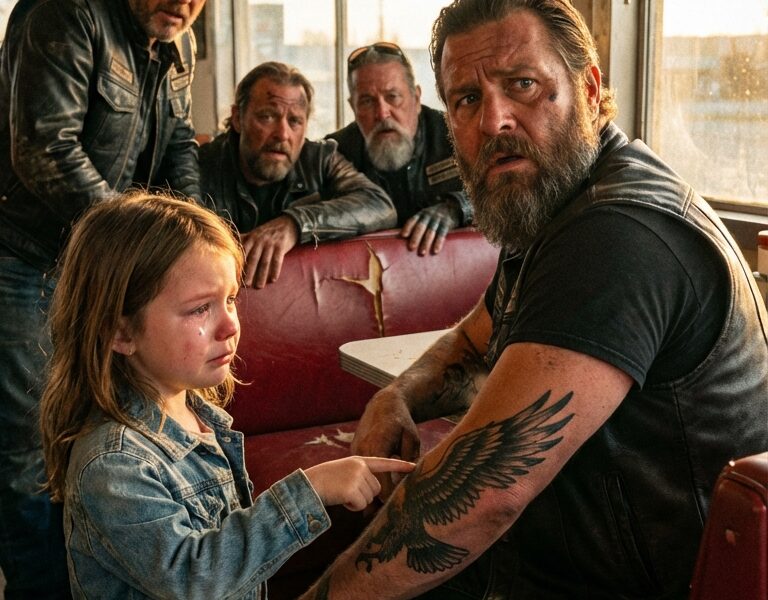
Rowan straightened slightly as the girl stopped a few feet from the table, directly in front of him, close enough that he could see the faint smudge of dirt on her cheek, the way her hands trembled despite her squared shoulders. His right forearm rested on the table, the ink there dark and unmistakable: a black-winged sigil, sharp lines forming a symbol known only to a few, worn by men who had survived a very specific chapter of the club’s past.
“Hey there,” Rowan said carefully, his voice low but even, neither inviting nor dismissive. “You need something, kid?”
She didn’t answer immediately. Instead, she lifted her hand, pointed directly at the tattoo, her finger shaking just enough to betray how hard she was holding herself together, and when she finally spoke, her voice was quiet but clear, carrying far more weight than its volume suggested.
“My dad had that same tattoo.”
Silence collapsed over the diner like a dropped curtain.
Elias froze with his mug halfway to his mouth, coffee sloshing dangerously close to the rim. Cole’s fork clattered onto his plate. Mason’s phone slipped from his grip, hitting the table with a dull thud. Jude leaned forward for the first time since sitting down, his eyes narrowing not with suspicion, but with something closer to shock.
That mark wasn’t decorative. It wasn’t common. It wasn’t even worn anymore.
It belonged to a defunct inner circle, a covert division that existed briefly, dangerously, during a violent era the Iron Seraphs rarely acknowledged. Only a handful of men ever bore it, and fewer still lived long enough to regret it.
Rowan’s expression hardened, not with anger, but with recognition edged in dread. He leaned forward, lowering his voice until it barely carried past the booth.
“Say that again,” he said.
The girl swallowed, her chin lifting as if daring herself not to break. “My father,” she repeated, “had that tattoo. He said it meant you never walked alone. Even after.”
The words struck deeper than she could have known.
Rowan stood slowly, the bench creaking beneath his weight, and moved around the table until he was in front of her, kneeling so they were eye level, his imposing frame shrinking into something gentler, something human.
“What’s your name?” he asked.
“Lena Hart.”
The name rippled across the table with delayed force.
Elias went pale. Jude closed his eyes. Mason whispered a curse under his breath.
Rowan’s voice dropped to a whisper. “Who was your father, Lena?”
She inhaled shakily. “Caleb Hart. But his road name was Warden.”
The twist landed like a punch to the chest.
Warden wasn’t just a brother. He wasn’t just a rider who’d left.
He was the man who’d taken the fall for all of them.
Years ago, during a raid gone wrong, when the Seraphs’ covert arm had been exposed, someone had needed to disappear, to absorb the blame, to sever ties so the rest could survive. Caleb Hart had volunteered, vanishing into prison records and sealed indictments, ensuring the club endured at the cost of his own freedom.
Officially, he’d died years later, quietly, forgotten by the world.
Unofficially, he was legend.
And now his daughter stood in front of them.
“He’s dead,” Rowan said softly, not as a challenge, but as a fact carved deep into memory.
Lena nodded. “He died last winter. Lung disease. The kind you don’t outrun.”
The room seemed to sag.
“He never told me everything,” she continued, voice trembling now despite her resolve. “But he gave me this.” She reached into her jacket and pulled out a folded photograph, edges worn soft, the image faded but unmistakable: five younger men standing in front of roaring bikes, arms slung over shoulders, laughing like the future was promised to them.
On the back, scrawled in shaky ink, were words that made Rowan’s throat close.
If you ever need help, go to Copper Rail. Sundays. They’ll remember. — Dad
“I didn’t know what else to do,” Lena whispered. “My mom’s sick. We’re being evicted. He said if things ever got bad, I should find you.”
Elias stood abruptly, chair scraping loudly, fists clenched. “We failed him,” he said hoarsely.
“No,” Jude replied quietly. “We didn’t. He trusted us to finish the job.”
That afternoon marked the beginning of something none of them expected: not redemption, but responsibility returned.
They didn’t just help Lena and her mother, Naomi. They dismantled the landlord’s intimidation with surgical calm, settled medical debts through old favors and unspoken currencies, and brought Naomi into care she never thought possible. But the real twist came months later, when an old federal file resurfaced, triggered by a hospital background check, revealing that Caleb Hart’s conviction had been built on falsified testimony.
He hadn’t just sacrificed his freedom.
He’d been framed by the very system he protected them from.
Rowan stood at the courthouse steps the day Caleb’s name was officially cleared, holding Lena’s hand, realizing too late that brotherhood wasn’t just about loyalty in the moment, but about accountability across generations.
Caleb Hart didn’t walk away from the road.
He walked into fire so others could keep riding.
And his daughter didn’t come looking for help.
She came to collect a debt of honor that time could not erase.
The Lesson Behind the Story
True loyalty is not proven in moments of celebration or shared victory, but in the quiet years afterward, when the cost of past choices resurfaces in the lives of those who never consented to bear them. Brotherhood, like love, is not measured by proximity or constant presence, but by whether you still show up when the consequences finally arrive, carrying the weight you once let someone else shoulder alone.