
They Told Me My Newborn Was Gone — Until My Eight-Year-Old Son Asked a Question That Silenced an Entire Hospital
They Told Me My Newborn Was Gone — Until My Eight-Year-Old Son Asked a Question That Silenced an Entire Hospital
The day my daughter entered the world, the hospital felt less like a place of healing and more like a stage flooded with blinding light, where every surface gleamed too brightly and every sound echoed longer than it should, and I remember thinking, through the fog of labor and exhaustion, that if joy had a smell, it would never be disinfectant mixed with warm plastic blankets, yet when I finally heard that sharp, unmistakable cry slice through the room, I clung to it like proof that everything I had endured meant something, that the pain had resolved into life, that the universe had, for once, kept its promise.
Then the crying stopped.
At first, I told myself it was normal, that babies paused, that nurses knew what they were doing, that panic was just another side effect of labor, but when seconds stretched into a silence that felt too deliberate, too curated, I tried to lift my head, only to find my body uncooperative, heavy and trembling, as if it belonged to someone else entirely.
That was when a man I had never seen before stepped into my line of vision.
He was tall, wearing a crisp white coat that looked untouched by the chaos of delivery, his name badge angled just enough that I couldn’t read it without straining, his face composed in the way people train themselves to be when they are about to deliver news they believe they are entitled to soften, and behind him stood a nurse who refused to meet my eyes, her hands clasped so tightly in front of her that her knuckles had gone pale.
“I’m sorry,” the man said, his voice measured, practiced, like a line repeated often enough to lose its edges. “There were complications.”
My mind rejected the words instantly, as if they were spoken in a foreign language that shared sounds with English but not meaning. “No,” I whispered, the sound barely leaving my throat. “No. I heard her.”
On the other side of the room, my husband, Daniel Crowe, stood near the window, his shoulders hunched, his hands shoved into his pockets as if he were bracing himself against an impact he had known was coming, his reflection in the glass fractured by the city lights outside, and even then, some distant part of me registered that he still hadn’t looked at me.
I searched the room for someone who might anchor me, and found instead his mother.
Margaret Crowe leaned in close, close enough that I could smell her perfume, something floral and old-fashioned that had always made me feel like I was being evaluated rather than embraced, and her lips brushed my ear as she whispered, her voice calm, almost serene, “God spared us from her blood.”
The room tilted.
My vision blurred, the ceiling lights smearing into white halos as my heart began to pound so hard I thought it might rupture something inside me, and I looked past Margaret, desperate for an ally, only to find Daniel’s sister, Rebecca, standing stiffly by the sink, her hands folded so tightly that her fingers trembled, offering me a smile so thin and brittle it looked like it might shatter under the weight of truth.
I tried to sit up, instinct screaming at me to move, to reach, to demand proof, but pain tore through my body like punishment, and the nurse finally rushed forward, pressing me back gently.
“Please, ma’am,” she murmured. “You need to rest.”
“Bring her to me,” I begged, my voice breaking. “Just let me see her. Please.”
The man in the white coat shook his head once, decisively. “That wouldn’t be in your best interest.”
Margaret’s hand landed on my shoulder, patting it the way one might comfort a stranger. “Sometimes,” she said softly, “this kind of loss is a blessing in disguise.”
Something lodged in my throat then, something that felt like it might be a scream if I let it surface, and before I could stop it, tears slid down the sides of my face and into my hair, hot and unstoppable.
That was when my son appeared.

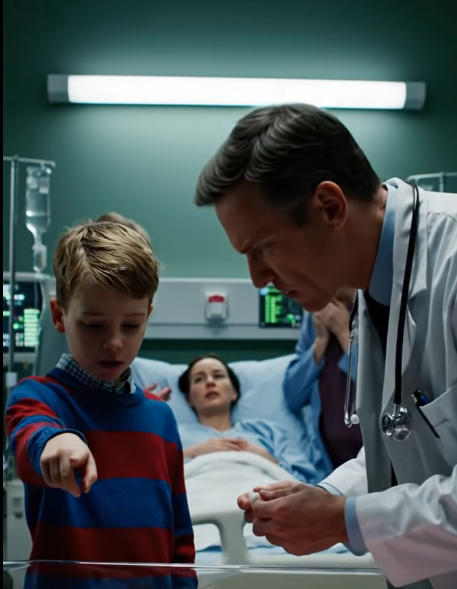
Eli, eight years old, all elbows and freckles and missing one front tooth, slipped quietly into the room from the hallway where my sister had been watching him, his eyes wide as he took in the scene, his gaze moving from my face to Daniel’s rigid posture to Margaret’s too-composed expression, like he was assembling a puzzle no one had bothered to explain.
He climbed onto the chair beside my bed and tugged gently at my sleeve.
“Mom?” he whispered.
I turned toward him, grasping at the sound of his voice like a lifeline. “What is it, sweetheart?”
Eli swallowed hard, then pointed past the doctor toward the nurse’s cart parked near the door, where a paper cup, a bottle, and a small clear bag half-hidden beneath gauze sat unnoticed, ordinary, almost forgettable.
His voice dropped to a whisper, but somehow it filled the room.
“Mom… should I give the doctor the powder Grandma always mixes into the milk?”
The air vanished.
Every face froze. Every sound died. The nurse’s hands stopped mid-motion. Daniel’s head snapped around so fast it startled me. Margaret’s face drained of color so completely it looked like the blood had been pulled from her skin in one swift motion.
And the man in the white coat — finally — looked afraid.
For a full second, nobody breathed.
“What did you say?” I asked Eli, my voice thin and unreal.
He frowned slightly, confused by the sudden tension. “The powder,” he repeated. “Grandma keeps it in her purse. She said it helps babies sleep so they don’t cry so much. She mixed it in the bottle when we visited last time. She said not to tell.”
Margaret’s hand shot out and clamped around Eli’s wrist. “Stop talking,” she hissed, her voice sharp enough to cut.
Daniel finally moved. “Mom,” he said, but it sounded more like a plea than a command.
The nurse on the far side of the bed — her badge read CARTER — stepped backward slowly, her eyes darting between Margaret’s grip on my son and the small clear bag on the cart. “Ma’am,” she said to me, her voice steady but tight, “I’m going to get the charge nurse.”
“There’s no need for that,” the doctor snapped, stepping forward.
“Get her,” Carter repeated, louder now, as she pressed the call button on the wall.
Margaret released Eli as if his skin had burned her, then smoothed her blouse and tried to regain control of her voice. “This is ridiculous,” she said. “A child is upset. He’s imagining things.”
“No,” Rebecca whispered, her brittle smile gone, replaced by something raw and terrified. “He’s not.”
Something inside me sharpened then, like a fog lifting. The turned badge. The rehearsed lines. The nurse who wouldn’t meet my eyes. The way grief had been handed to me before I could ask for proof.
“Where is my baby?” I demanded, my voice louder than I thought it could be.
The doctor exhaled sharply. “Mrs. Crowe, you’ve been through a traumatic delivery. You’re disoriented.”
“I’m not disoriented,” I snapped. “I’m a mother.”
Footsteps hurried down the hall, and a woman in navy scrubs entered, authority radiating from her posture. CHARGE NURSE HERNANDEZ read the room in seconds.
“What’s going on?” she asked.
Eli pointed again. “Grandma’s powder,” he whispered. “She said the baby would be quieter.”
Hernandez’s jaw tightened. “Lock down this room,” she said. “No one leaves.”
From there, the truth unraveled faster than anyone could contain it.
Security arrived. Logs were pulled. Cameras reviewed. A text buzzed onto my phone from an unknown number: SHE’S ALIVE. NICU, ROOM 14. DON’T TRUST THEM.
My blood turned to ice.
When they wheeled me into the NICU and I saw her — my daughter, breathing, fragile, alive — something inside me broke open and healed all at once.
Later, the investigation would reveal everything: the sedative mixed into milk, the falsified documentation, the quiet complicity, the motive rooted not in mercy but control, bloodlines, and fear of inheritance.
But my daughter lived.
Because an eight-year-old boy asked a question no one was prepared to answer.
The Lesson
Evil does not always arrive with violence or shouting; sometimes it comes disguised as authority, tradition, or concern, relying on silence, exhaustion, and the assumption that a mother in pain will not be believed. Truth often survives not because the powerful protect it, but because someone innocent speaks when others choose comfort over courage. Listen carefully to the voices we dismiss — children, women, the exhausted, the grieving — because they are often the ones holding the last thread between loss and life.