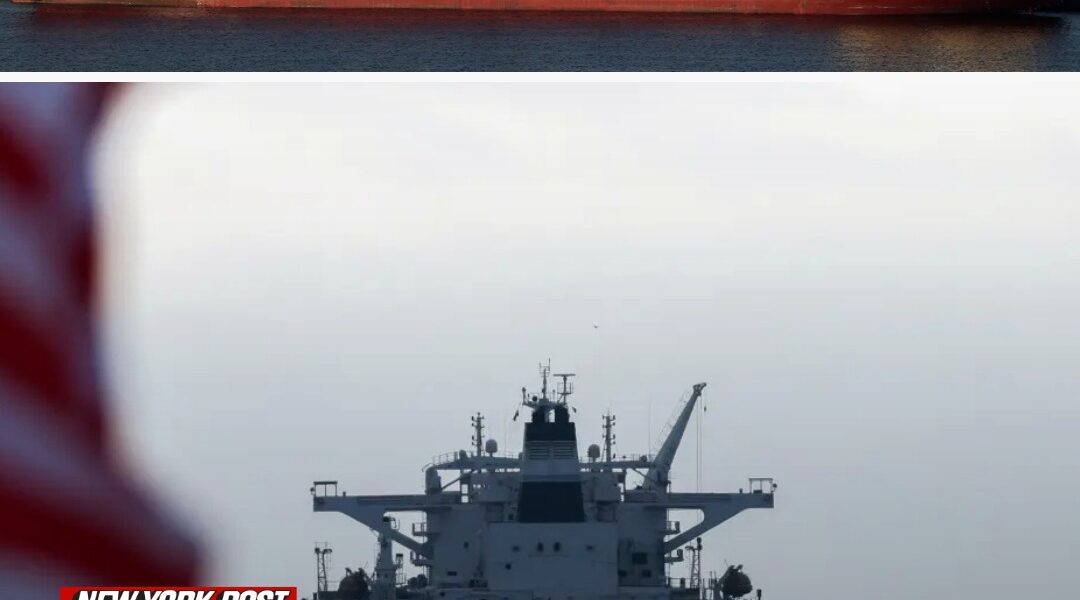
Drone strike torches oil tanker in Strait of Hormuz as Iran’s blockade halts global shipping

Drone strike torches oil tanker in Strait of Hormuz as Iran’s blockade halts global shipping
A commercial oil tanker was set ablaze in the Strait of Hormuz after it was struck by an Iranian suicide drone, the country’s Islamic Revolutionary Guard Corps said Saturday, with a US Navy mission to safeguard ships through the region possibly still weeks away.
The IRGC claimed the tanker — the Prima, sailing under a Maltese flag — had ignored repeated warnings not to enter the strait, according to Tasnim News Agency, Iran’s state media.
The flow of oil through the strait — one of the world’s most vital energy arteries connecting the Persian Gulf with the Gulf of Oman and the Arabian Sea which sees roughly 20 million barrels of oil, about 20% of global supply, pass through it daily — has ground to a near-total halt since Iran declared it closed at the start of the war.

As a result, US oil prices shot up $20 a barrel in just a week, surging to $90 a barrel Friday, sparking recession fears if the US doesn’t neutralize the IRGC’s threat in the region soon.
Late Saturday, President Trump downplayed concerns about spiking oil prices.
“That’ll get healed very quickly,” he said aboard Air Force One.
The president wouldn’t directly say what steps, if any, he planned to to take to tackle rising gas and oil prices — including authorizing a release from the country’s Strategic Petroleum Reserve.
“There were some I would do it, just to take a little of the pressure off. But I think that – the oil pressure, but there’s a lot of oil. We’ve got a lot of oil,” he said.
The strait, which sits between Iran and Oman, is governed by international maritime law that is supposed to guarantee everyone passage. But historically, Iran has had the greatest ability to influence passage through it during times of conflict.
After the killing of the Iran Supreme Leader Ayatollah Ali Khamenei, the Islamic Republic vowed to retaliate by targeting the critical route.
“If anyone tries to pass … the navy will set those ships ablaze,” promised Ebrahim Jabari, a senior adviser to the IRGC’s commander-in-chief on Monday.
“We will not allow a single drop of oil to leave the region. Oil price will reach $200 in the coming days,” he vowed.

The IRGC later claimed the strait remained open, but stated that any US or Israeli ship trying to pass through would be attacked.
“We did not close the Strait of Hormuz and will not, but we will target ships belonging to the U.S. regime and the Zionist entity transiting the Strait of Hormuz,” an IRGC spokesman said Friday.
In any case, ship traffic through the strait is virtually non-existent, with hundreds of tankers sitting idle in the Indian Ocean, as they fear being sunk by an Iranian drone if they cross.
Follow The Post’s coverage of the United States’ airstrikes on Iran:
- Follow live updates on the US and Israel’s war with Iran
- Black clouds, massive fireballs fill Tehran skies following Israeli strikes on oil storage sites
- Senior Iranian leader issues chilling warning to Trump following continued US-Israeli air strikes: ‘He must pay the price’
- ‘Central’ Iranian airport targeted in massive attack after Trump warned of ‘complete destruction’
- Iran’s favored next supreme leader wounded in Israeli air attack: reports
In response, Trump on Tuesday had said the US Navy could begin escorting oil tankers through the strait.
“No matter what, the United States will ensure the free flow of energy to the world,” he said.
No escort mission had been launched as of Saturday, and earlier this week the White House would not commit to a timeline. According to a former US Navy commander, the military needs to make more of a dent in Iran’s war machine before it can send a convoy, and a mission is likely at least three to four weeks away.
“You have to set the conditions – have the enemy attrited,” Retired Rear Admiral Mark Montgomery, who was part of Operation Earnest Will in 1987, told The Post.

“If it’s just one missile or two drones being fired, you can handle that. What you can’t handle is a swarm – one of the tankers is going to get hit,” said Montgomery.
Energy Secretary Chris Wright said the US will escort ships through the strait “as soon as it’s reasonable to do so.”
Washington Friday announced a $20 billion insurance plan for vessels travelling through the strait – an extraordinary intervention signaling the White House fears the issue won’t resolve quickly – but the move did little in the immediate to convince ship owners to risk their lives and resume travel.
“All eyes are on the US Navy,” Peter Doran, adjunct senior fellow at Washington-based Foundation for Defense of Democracies, told The Post.
By escorting vessels through the Strait, the Navy would essentially provide a protective shield by shooting down any Iranian drone or missile that attempts to strike oil ships.
“We’re looking at a test of wills and the test of naval power, the IRGC versus the US Navy,” he said. “The US Navy is absolutely likely to win that contest, but all eyes would like to see action from the Navy.”
Only nine large vessels have managed to get through the strait over the past week, Doran said.
But even once a US Navy convoy arrives, escorting the hundreds of ships that are stuck is a months-long mission, Montgomery said. With pressure on oil prices continuing to mount, the US would need to find alternative ways to procure oil to avoid a serious economic downturn, he said.
Meanwhile, Kuwait Petroleum Corporation declared a “force majeure” on Saturday, and began cutting oil output, following suit after Iraq and Qatar — as the bottleneck has oil-producing countries running out of storage.
LEAVE A RESPONSE





What do you think? Post a comment.