In a merciless Montana blizzard, a grieving recluse rescues a dying dog and her puppies, only to uncover his trusted friend’s horrifying secret, leading to a chilling confrontation, justice, and an unexpected redemption that shatters silence and restores purpose again

In a merciless Montana blizzard, a grieving recluse rescues a dying dog and her puppies, only to uncover his trusted friend’s horrifying secret, leading to a chilling confrontation, justice, and an unexpected redemption that shatters silence and restores purpose again
In a merciless Montana blizzard, a grieving recluse rescues a dying dog and her puppies, only to uncover his trusted friend’s horrifying secret, leading to a chilling confrontation, justice, and an unexpected redemption that shatters silence and restores purpose again.
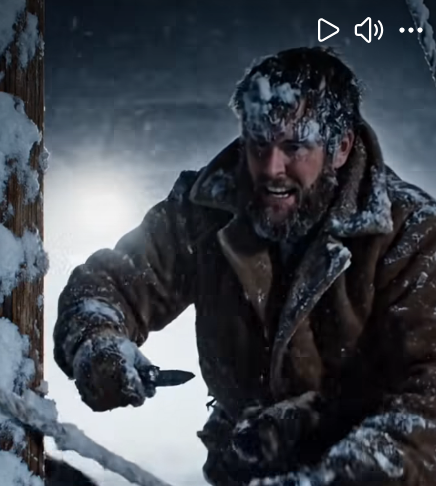
The storm didn’t arrive in Montana that night—it swallowed it whole. One minute there had been a horizon, faint and gray but still there if you squinted hard enough, and the next it was gone, erased like a chalk line wiped clean by an impatient hand. Snow didn’t fall so much as surge sideways, driven by a wind that had lost all sense of direction, slamming into anything that dared exist in its path. Out there, past the last stretch of county road where fences stopped trying to pretend they mattered, the world narrowed into two things: what you could see in your headlights, and everything else trying to kill you.
I remember gripping the steering wheel of my old pickup so tightly that my fingers went numb long before the cold could do the job for it. The truck—an aging Ford I’d kept running more out of stubbornness than skill—rattled under the assault of the wind, its frame groaning like it had opinions about my life choices. My headlights barely cut through the storm; they didn’t illuminate the road so much as stab weakly into the chaos, like two tired candles fighting a losing battle against the dark.
My name’s Rowan Hale, though most people who used to know me just called me Row. These days, not many people use my name at all, and that suits me just fine.
There was a time when I fixed things for a living—engines, fences, busted heaters, whatever needed a steady hand and a bit of patience. I liked that kind of work because problems made sense. You could trace them back to a cause, follow a line from broken to repaired, and when you were done, you knew you’d made something right again.
Then my wife, Mara, got sick.
And there wasn’t a wrench or a blueprint in the world that could fix that.
She was gone in less than a year, and when the house went quiet afterward, it didn’t feel like peace—it felt like something had been hollowed out from the inside and left standing out of habit. People tried to help. They always do. They brought casseroles, said the right things, asked how I was holding up in voices that were careful and a little too soft. I hated all of it. Not because they meant harm, but because there wasn’t an answer they could accept.
So I left.
Not the state, not entirely, but far enough that “dropping by” became inconvenient and then, eventually, unthinkable. I found a place outside a stretch of nothing where the nearest neighbor was a mile and a half away and kept to himself even more than I did. It was quiet out there. Honest quiet. The kind that didn’t expect anything from you.
That night, though, the quiet had teeth.
I wasn’t supposed to be on that road in the first place. I’d stayed too long in town picking up supplies—feed, fuel, a few things I didn’t really need but bought anyway just to justify the trip. By the time I started back, the storm had already begun closing in, slow at first, then all at once. I told myself I knew these roads. Told myself I’d driven them in worse.
That was a lie I didn’t realize I was telling until it was too late to turn around.
For the last ten miles, I couldn’t tell if I was still on the road or drifting off into open land. The markers were buried, the ditches invisible, the world flattened into one endless sheet of white. The wind shoved at the truck from every angle, trying to bully it into surrender, and more than once I felt the back tires lose their grip just enough to remind me how small I was out there.
I slowed to a crawl, leaning forward like that would somehow help me see better, my breath fogging the inside of the windshield despite the heater working overtime. The radio had long since dissolved into static, and the only sound left was the wind—howling, relentless, like something alive and angry.
And then I saw it.
Not clearly. Not even fully. Just a flicker—a shape where there shouldn’t have been one. Dark against the white, low to the ground, gone almost as soon as it appeared at the edge of my headlights.
I almost kept driving.
That’s the part I think about sometimes. How easy it would’ve been to convince myself I imagined it. A trick of the light. A branch. A shadow that didn’t matter.
But there was something about the stillness of it, the way it didn’t react to the storm at all, that stuck with me.
I hit the brakes.
The truck fishtailed immediately, sliding sideways just enough to make my heart slam against my ribs. I corrected, overcorrected, and finally brought it to a shaky stop that felt more like luck than skill. For a moment, I just sat there, engine idling, hands still locked around the wheel.
“Probably nothing,” I muttered to no one, my voice sounding too loud in the cab.
I almost believed it.
Almost.
Instead, I reached for the flashlight I kept wedged between the seats, grabbed my coat tighter around me, and shoved the door open.
The cold didn’t greet me—it attacked.
It cut straight through the layers, sharp and immediate, stealing the air from my lungs in one brutal breath. The wind hit next, nearly ripping the door from my grip, and for a second I had to brace myself just to stay upright.
Snow came at me sideways, stinging any exposed skin, filling my boots as I stepped out into drifts that reached halfway to my knees. I flicked on the flashlight, its beam cutting a narrow tunnel through the storm.
Ten feet ahead, I found the shape.
A dog.
A German Shepherd, or what was left of one in that moment, tied to a utility pole with a thick nylon rope that had frozen solid, turning it into something closer to a steel bar than anything flexible. The dog was curled into herself as tightly as she could manage, her body shaking in small, violent tremors that didn’t look like they’d last much longer.
Her fur was matted with ice and something darker—blood, frozen into jagged clumps along her side.
“Hey,” I said, my voice catching in my throat. “Hey, easy… I got you.”

She lifted her head, slow and heavy, like it took everything she had left to do even that. Her eyes were clouded, rimmed with frost, but they found me anyway. There was no aggression in them. No fear, even. Just… exhaustion. The kind that comes when something has already decided how your story ends.
That’s when I saw the puppies.
Five of them, scattered around her in the snow.
Two were already gone—still, silent, their small bodies half-buried in drifting powder. One was trying to move, dragging itself weakly toward its mother, tiny legs slipping uselessly on the ice.
Something inside me shifted hard enough it almost felt physical.
I didn’t think anymore. I just moved.
Back to the truck, fumbling for the wire cutters I kept in the glove box, my fingers already stiff and clumsy. Back to the pole, kneeling in the snow as I hacked at the frozen rope, each cut sending a sharp snap through the air as the fibers broke under pressure.
“Hold on,” I muttered, though I had no idea if she could even hear me over the wind. “Just… hold on.”
It took longer than it should have. Everything did, out there.
When the last strand finally gave, the rope falling away uselessly, the dog didn’t run.
She didn’t even try.
She just collapsed.
I swore under my breath, dropping the cutters and scooping up the closest puppy, then another, tucking them inside my coat against my chest. They were so small, so cold, but I could feel faint movement—life, stubborn and flickering.
The third one that was still alive barely made a sound when I picked it up.
The mother was heavier than I expected, dead weight in my arms as I dragged, then lifted, then half-carried her back to the truck, fighting the wind every step of the way.
By the time I slammed the door shut behind us, my lungs burned and my hands were shaking so badly I could barely get the key turned.
“Stay with me,” I said, more to myself than to her.
The drive back to the cabin is something I remember in fragments—the way I kept one hand inside my coat, feeling for the tiny movements of the puppies, the way I talked out loud just to keep myself from slipping into panic, the way the storm seemed to press closer the further I went.
When I finally reached the cabin, the porch light barely visible through the white, it felt less like arriving home and more like escaping something that had decided to let me go.
Inside, everything became urgent and slow at the same time.
Fire. Towels. Heat.
I laid the mother dog near the stove, wrapped in blankets, and went to work on the puppies, rubbing them gently, willing warmth back into their tiny bodies. I heated milk, fed them drop by drop, careful not to rush it. Time stretched, folded in on itself, measured only by breath and movement and the fragile rhythm of survival.
Hours passed without me noticing.
Sometime near dawn, the storm outside finally began to lose its edge, the wind settling into something less furious, though no less cold. Inside, the fire had burned down to a steady glow, casting long shadows across the room.
The mother dog stirred.
It was subtle at first—a shift, a breath that sounded a little less shallow. Then her eyes opened, clearer now, focusing on the room, on me.
“Hey,” I said quietly, crouching beside her. “You made it.”
She didn’t move much, just blinked slowly, then—after a moment—reached out and licked my hand.
It was a small thing. A simple gesture.
But it hit harder than I expected.
I swallowed, blinking against a sudden tightness in my chest, and reached to gently move the fur around her ear, checking for injuries I might’ve missed.
That’s when I saw it.
A tattoo.
Small. Precise. Inked into the pale skin inside her ear—a symbol that didn’t belong to any shelter I knew, didn’t match any standard marking I’d ever seen.
A clean, blue anchor.
With two initials beneath it.
“R.K.”
My stomach dropped.
Because I knew that mark.
Everyone in town did.
Ronan Keene.
The local veterinarian.
The man who’d come by my place a few times over the past couple of years, checking on the old barn cat I never admitted I cared about. The man who’d brought over supplies during my first winter out there, unasked, like it was just something neighbors did. The man who, on more than one quiet evening, had sat on my porch with a drink in hand and talked about everything and nothing until the silence didn’t feel so heavy.
He had that same anchor tattooed on his forearm.
Said he got it years back, before he settled in Montana. Said it meant something about survival, about holding steady when everything else tried to pull you under.
I looked from the dog to the puppies, then back to the mark.
And suddenly, pieces started lining up in a way I didn’t want them to.
The rope. The location. The fact that no one else would’ve been out there in that storm.
This wasn’t abandonment.
It was disposal.
A slow, calculated kind of cruelty that relied on the storm to erase the evidence.
I sat back on my heels, the room suddenly feeling smaller, the air heavier.
“Ronan…” I said under my breath, the name tasting wrong.
For a long time, I just sat there, listening to the fire crackle, the soft, uneven breathing of the dog, the faint squeaks of the puppies nestled together for warmth.
And then, slowly, a different kind of clarity settled in.
The kind that doesn’t come from emotion, but from decision.
By the time the sun pushed weakly through the storm’s aftermath, I knew exactly what I was going to do.
I didn’t call the sheriff.
Not yet.
Instead, I picked up the phone and dialed Ronan.
Kept my voice steady when he answered.
“Took a wrong turn last night,” I said. “Found a dog in bad shape near my place. Thought you might want to take a look. It’s… pretty bad.”
He didn’t hesitate.
“Be there in an hour,” he said.
Of course he would.
He had a reputation to maintain.
What he didn’t know was that I’d already made a second call. Then a third.
And when Ronan Keene walked through my door later that morning, medical bag in hand, wearing that same calm, reassuring expression people trusted him for…
He wasn’t walking into a rescue.
He was walking into the truth.
And this time, there was nowhere for it to disappear.
Lesson of the story:
Trust is built quietly, over time, through small acts that make us believe in people without question. But betrayal, when it comes, often hides behind that same trust, waiting for the moment it can no longer be ignored. The hardest truth is that not everyone who appears kind is good—but the deeper truth is that doing the right thing, even when it costs you a relationship, is what ultimately restores your sense of self. Sometimes, the storm doesn’t just destroy—it reveals.