He Was About To Be Executed At Dawn For A Crime He Didn’t Commit — But A Rat Ended Up Saving His Life

He Was About To Be Executed At Dawn For A Crime He Didn’t Commit — But A Rat Ended Up Saving His Life
He was supposed to die at dawn for a crime he never committed. No one believed him. No one cared. And the only creature that stayed with him in the darkness was a rat.
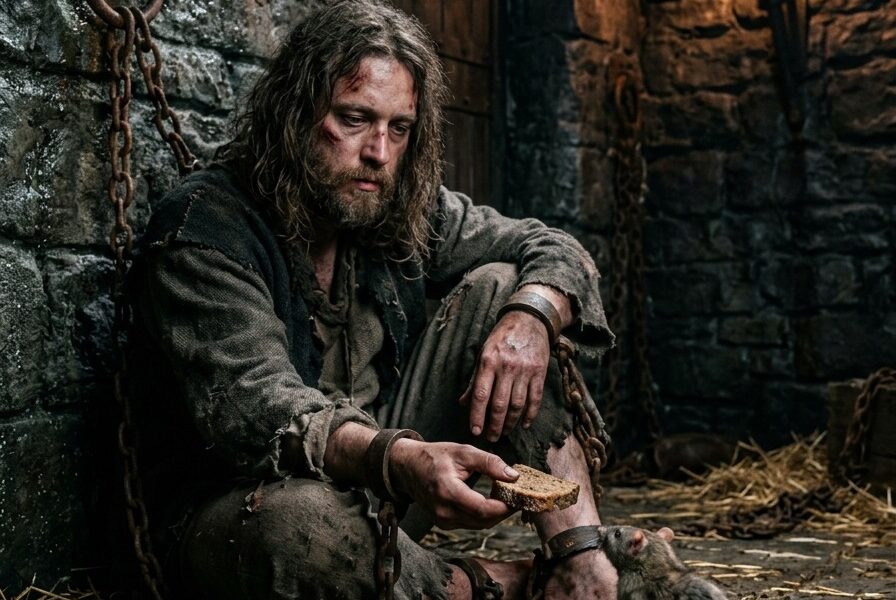
Bruno held the crust of bread in his shaking hand and didn’t move.
The rat didn’t move either.
It crouched near the crack in the wall, thin as a shadow, ribs showing through its gray fur. Its eyes were bright—too bright for a creature that lived in a place where hope went to die. Most prisoners would have chased it away immediately. Some would have tried to crush it just to feel powerful for a second. In a cell where food meant survival, nothing was shared.
But Bruno didn’t throw the bread.
He had already lost too much to become cruel.
Hunger hollowed him out. The darkness swallowed whole days. The accusation—false, humiliating, impossible to escape—pressed on his chest like a weight that never lifted. Still, one small part of him refused to disappear: the part that remembered what it meant to be human.
The rat crept closer, sniffing.
Bruno swallowed hard. Slowly, almost carefully, he broke the bread in two.
“I suppose you’re trapped here too,” he murmured, his voice barely more than breath.
He tossed half toward the crack.
The rat froze, then darted forward and seized the piece with both paws, chewing with frantic urgency. Bruno watched in silence. The gesture was absurd. Sharing his last food with a rat? Ridiculous. And yet something inside him shifted—something fragile, something that reminded him he wasn’t entirely lost.
“Eat,” he whispered. “At least one of us will.”
The rat lifted its head for a moment, whiskers trembling, then vanished into the crack again.
Bruno leaned back against the damp stone. Nothing happened. No miracle. No voice from heaven. No guard opening the door to apologize.
But for the first time in weeks, the silence didn’t feel completely empty.
The rat came back the next night.
Bruno had been waiting for it.
He had hidden a small piece of bread beneath the straw even though it meant going to sleep hungrier than usual. When the rat appeared near the same corner, cautious but determined, he held the bread out.
“Don’t get used to this,” he muttered with a faint, tired smile. “I barely have enough for myself.”
The rat took it, but instead of fleeing immediately, it stayed. Bruno noticed a scar across its back and a torn ear. Not a young one. A survivor.
After that, it returned every night.
Bruno began to talk to it—not because he thought he had lost his mind, but because the little creature was the only living thing that came near him without hatred.
“I used to work in the governor’s house,” he told it one night. “I knew every corner of that place. I never stole a coin in my life.”
Another night he whispered, “His name was Gaston. He smiled when they accused me. I knew then it was over.”
And once, when the cold became unbearable, he admitted the truth he hadn’t dared to say aloud before:
“The worst part isn’t dying. It’s knowing nobody believed me.”
The rat listened, ate, disappeared, and returned again. Sometimes its nose brushed his fingers before it left. Bruno began to wait for it the way a man waits for a light in the distance.

Then one evening he heard the guards talking outside the cell.
“There’s no more room in the lower chambers,” one of them said. “The governor wants everything cleared before the archduke arrives.”
“Then start with the ring thief,” the other replied. “Hang him at dawn on Thursday. Nobody will miss him.”
Bruno didn’t breathe.
Thursday. Dawn.
The words echoed in his head until the cell felt smaller than ever. Before that moment, he had only been waiting. Now his death had a time and a shape: rope, scaffold, silence.
That night the rat came again.
Bruno dropped all the bread he had in front of it.
“All of it,” he whispered. “I won’t need it anymore.”
The rat sniffed the bread, then him, as if something had changed. Finally it dragged the piece toward the crack and disappeared.
Bruno closed his eyes. Tears slipped down his face without a sound. He wasn’t crying only because he would die. He was crying because he would die as a thief in everyone’s memory. Because the truth would never matter. Because the world would continue as if nothing had happened.
Still, one thought stayed with him:
At least he hadn’t become cruel.
He didn’t know how long he slept before a strange sound woke him.
Scraping. Quick, urgent.
He opened his eyes.
The rat was there again, tugging something across the floor—a torn piece of red cloth with a golden edge. It dropped the cloth in front of him and ran toward the crack, then turned as if calling him.
Bruno frowned. That fabric… he knew it. The governor’s senior servants wore uniforms lined with dark red cloth trimmed in gold.
Like Gaston.
A cold sensation ran through him.
The rat slipped into the crack again, restless. Bruno crawled closer. Around the hole, the stone felt soft, damp. He pressed harder. The mortar crumbled slightly under his fingers.
Rats had been gnawing there for weeks. Maybe months. Water had weakened the wall.
Hope sparked—dangerous, fragile, but impossible to ignore.
Bruno began to dig.
His nails split. Dust filled his mouth. The stone resisted, then shifted a little. He kept going, desperate now. Piece by piece, the wall gave way until a narrow opening appeared. Cold air brushed his face from the other side.
The rat waited ahead, barely visible in the darkness.
Bruno forced himself through the gap, inch by painful inch, until he fell into a narrow tunnel behind the wall. It smelled of mold and stagnant water, but it led away from the cell. Away from the gallows.
He crawled forward, following the rat.
The tunnel twisted, sloped downward, then turned again. Finally it opened into a forgotten storage room beneath the prison. From there, a broken staircase led up toward a door.
Voices drifted from above.
Bruno climbed slowly, every movement burning. He reached a cracked grate and looked through.
Inside the room stood the warden.
And Gaston.
Gaston held a heavy bag that clinked when he moved it.
“Tomorrow at dawn it’ll be over,” he said calmly. “Once he’s dead, no one will question anything.”
Bruno’s heart pounded so loudly he feared they would hear it.
“You’re paying a lot for this,” the warden muttered.
“I’m paying for silence,” Gaston replied. “I put the ring under his mattress myself. He was getting too trusted. Too honest. People like that become dangerous.”
The words hit Bruno like a blow.
Proof. The truth. Finally.
But he was still trapped behind the grate, weak and barely able to stand.
Then the rat darted into the room, knocking a bottle off the table. Glass shattered. Both men turned.
In that single distracted moment, Bruno reached through the bars and grabbed the ring of keys hanging nearby. They slipped from his fingers once, then he caught them again.
Gaston turned back—and saw the hand.
“It’s him!” he shouted, stumbling backward. “That’s impossible!”
Bruno unlocked the grate and stepped into the light, pale as a ghost.
“I heard everything,” he said, his voice hoarse but steady.
The warden stared at Gaston. The bag of coins lay open on the floor. The silence lasted only a few seconds, but it was enough.
“Arrest him,” the warden ordered suddenly.
Gaston shouted, denied everything, tried to run. The guards dragged him down. The confession came before dawn.

The gallows stood ready in the square when the sun rose.
But Bruno was not the one standing beneath it.
Instead, he stood beside the governor, thin and exhausted, while the truth was read aloud. The crowd that had cursed him weeks before now stared in stunned silence. Some avoided his eyes. Some looked ashamed. Others simply looked afraid.
Bruno felt no triumph.
Only relief. And a strange, quiet sadness.
Later, when he stepped outside the prison for the first time as a free man, something brushed his ankle. He looked down.
The rat sat near the wall, its torn ear unmistakable.
Bruno knelt despite the pain in his body.
“So it was you,” he whispered.
The rat twitched its whiskers, then vanished between the stones.
Bruno smiled faintly.
He had almost died forgotten, condemned by lies. Yet the creature everyone despised had been the one to show him the way out—and the way to the truth.
From that day on, he never forgot what he had learned in the darkness:
Kindness is never wasted.
Truth always finds a way through.
And sometimes the smallest, most unwanted creature can save a life when the world refuses to.