They Laughed When I Said I Could Tame The Most Dangerous Horse On The Ranch—But They Had No Idea It Was Never About Control
It was about understanding.
In San Lorenzo, everyone knew one thing without needing to say it out loud—power didn’t belong to the law, and it didn’t belong to the people.
It belonged to Don Alejandro Garza.
He was the kind of man who didn’t just own land, but owned silence, the kind that made people lower their voices when they spoke his name and look away when something felt wrong. His tequila empire stretched across the hills of Jalisco, and so did his influence, shaping lives in ways no one dared to challenge.
Ten years earlier, my father had tried.
And it cost him everything.
I still remember the way he used to walk before that day, steady, proud, someone who worked with animals like they were partners, not tools. But after Alejandro forced him onto a fighting bull for his own amusement, something broke that never healed, and the man who came home was no longer the one I had known.
Now he moved slowly, leaning on a cane, carrying pain that no doctor in our village could fix.
The surgery he needed cost fifty thousand pesos.
And we didn’t have it.
So when I heard about the horse, I didn’t hesitate.
“They’re offering money to anyone who can ride it,” I said, standing in the doorway of our small house.
My father looked up immediately, his face tightening.
“No,” he said. “Don’t even think about it.”
For illustrative purposes only
“I have to,” I replied.
“That animal has already sent grown men to the hospital,” he insisted, his voice rising. “And Garza wants exactly that. He wants someone else to fall.”
“I’m not going to fight the horse,” I said quietly. “I’m going to listen to him.”
He shook his head, not convinced, not reassured, but he didn’t stop me.
Maybe because somewhere deep down, he knew we had no other choice.
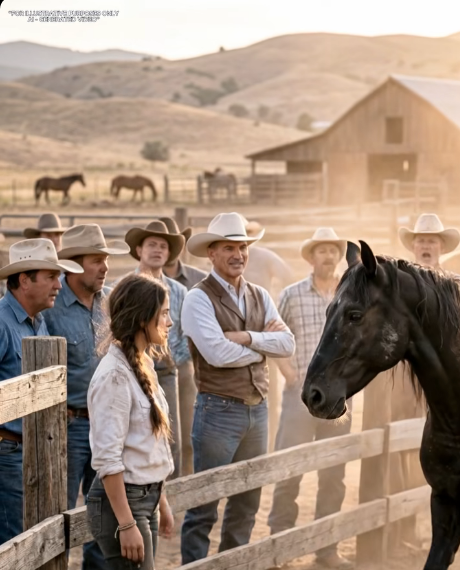
The ranch was already crowded when I arrived, filled with men in polished boots and wide hats, their confidence fading one by one as they were thrown into the dust. The air smelled of sweat, fear, and something sharper underneath, something that didn’t belong to the animal itself.
El Diablo stood inside the corral.
Massive.
Dark.
Breathing like a storm waiting to break.
Alejandro noticed me immediately.
Of course he did.
“Well, well,” he said with a slow smile. “If it isn’t Mateo’s daughter.”
Laughter spread through the crowd, not loud, but enough.
“Let’s see if she falls harder than her father did.”
I didn’t respond.
I stepped forward.
Inside the corral, the noise faded behind me, replaced by something heavier, something more real. El Diablo slammed his hooves against the ground, his body tense, his eyes wild, but I didn’t move toward him right away.
I stood still.
Letting him see me.
Minutes passed.
The crowd grew restless.
“She’s scared,” someone shouted.
“Give her ten seconds!”
But this wasn’t fear.
This was patience.
I lowered my shoulders, softened my stance, and let my breathing slow until it matched the rhythm of his. I didn’t look directly into his eyes, because animals don’t see that as trust, they see it as challenge, and challenge was the last thing he needed.
Step by step, I moved closer.
When he lashed out, striking the ground and throwing dust into the air, I didn’t flinch, because the anger in him wasn’t aggression, it was pain, and pain always speaks before it listens.
“Easy,” I murmured softly.
When I reached out my hand, I wasn’t offering control.
I was offering calm.
The moment he hesitated, I knew.
He stepped forward slowly, his massive body trembling with exhaustion rather than rage, and when his muzzle touched my palm, the entire world seemed to pause.
That was when I saw it.
The bit.
Hidden beneath the straps, pressed cruelly into his mouth, rusted and barbed, cutting into flesh with every movement, turning every command into pain.
“You were never the problem,” I whispered.
Without hesitation, I reached up and removed it, ignoring the gasps from the crowd as the metal dropped to the ground with a dull, final sound.
Everything changed.
El Diablo exhaled deeply, his body lowering, the tension leaving him as if something had finally been released. He leaned into me, not as a beast to be conquered, but as something that had been waiting to be understood.
I climbed onto his back.
For illustrative purposes only
He didn’t resist.
We moved together, slowly at first, then with growing ease, circling the arena as silence replaced the laughter that had filled it moments before.
By the third lap, I guided him straight toward Alejandro.
He wasn’t smiling anymore.
“This is your secret,” I said, my voice carrying across the crowd as I pointed to the blood-stained bit on the ground. “You don’t train animals. You break them until they don’t fight back.”
The crowd shifted.
Murmurs turned into voices.
Voices turned into anger.
“You did the same to my father,” I continued. “And you call that strength?”
For the first time, Alejandro had no answer.
A man stepped forward, picking up the cruel metal and throwing it at his feet.
“Pay her,” he said. “Now.”
The money came quickly after that, not as a reward, but as something forced, something he could no longer deny.
I took it.
Because my father needed it.
But I wasn’t finished.
“The horse comes with me,” I said.
Alejandro didn’t argue.
Not this time.
As I rode out of the ranch, the sound behind me wasn’t laughter anymore.
It was applause.
When I reached home, my father was waiting, his grip tight on his cane, his eyes fixed on the horse beside me.
“You did it,” he whispered.
“No,” I said softly. “We did.”
With that money, he got his surgery.
With that horse, we gave something back.
And with that day, San Lorenzo learned something it had forgotten.
Strength isn’t about forcing something to submit.
It’s about knowing when to stop hurting it… long enough to let it breathe.