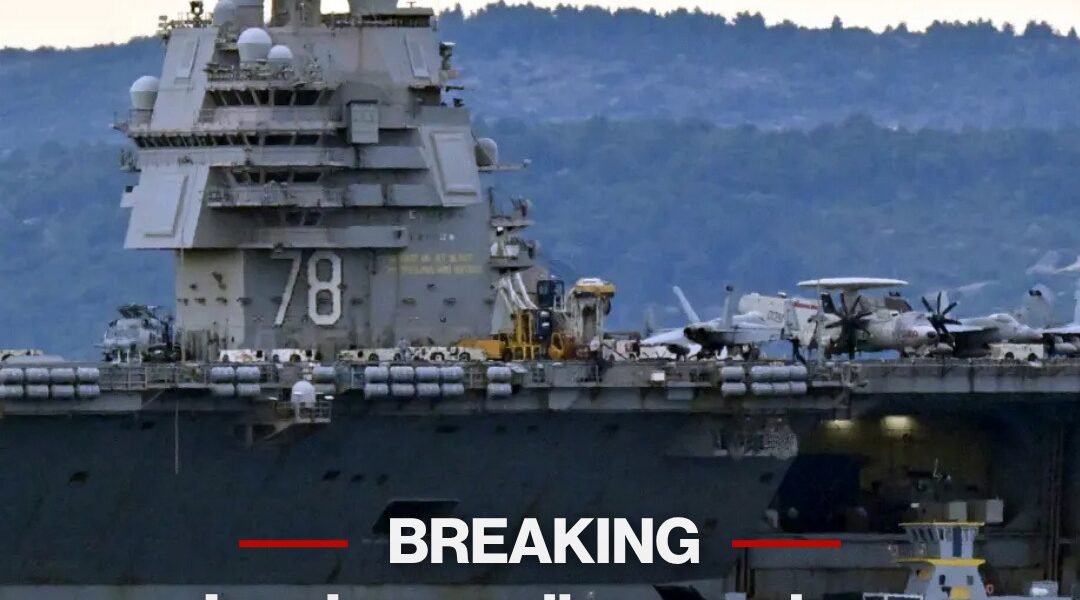
Iran issues dire warning about President Trump’s Strait of Hormuz blockade: ‘Forceful response’

Iran issues dire warning about President Trump’s Strait of Hormuz blockade: ‘Forceful response’
WASHINGTON — Iran warned Sunday that military vessels approaching the Strait of Hormuz would be a violation of the fragile cease-fire and face a “strong and forceful response” — following President Trump’s announcement of a blockade on the critical oil chokepoint.
Trump announced plans earlier Sunday to stop “any and all Ships trying to enter, or leave” the waterway until there’s a point where all oil is allowed to go in and out without obstruction from Iran.
Iran’s Islamic Revolutionary Guard Corps Navy hit back, insisting it has “full control” of the Strait and that the waterway remains open for non-military vessels.


“Contrary to the false claims of certain enemy officials, the Strait of Hormuz is open for the passage of non-military vessels under smart control and management, in accordance with specific regulations,” the naval forces said in a statement, according to two semi-official Iranian news agencies.
The IRGC warned that any approach by military vessels toward the Strait would be treated as a violation of a cease-fire agreement.
Trump claimed that the cease-fire deal last week meant that Iran would allow the Strait of Hormuz, where over a fifth of the world’s seaborne oil supplies flow through annually, to be reopened.
But Iran has been accused of attempting to charge tolls on vessels going through and claimed that it lost track of the mines it laid down, scaring off ships from traversing the beleaguered waterway. The tolls would violate Trump’s cease-fire condition that the Strait of Hormuz remain open.
Despite Iran’s threats to view the deployment of a military vessel through the Strait as a violation of the cease-fire, the US claims that two American Navy destroyers went through it Saturday and took down an Iranian drone.

Vice President JD Vance led a delegation of US negotiators to meet with Iranian officials in Islamabad, Pakistan, from Friday to Saturday. After nearly 21 hours of deliberations, Vance announced that a deal hadn’t been reached, and the US team left.
Iranian state media has since said that there are no plans for another round of peace talks.
“Iran is not in a hurry, and until the US agrees to a reasonable deal, there will be no change in the situation of the Strait of Hormuz,” the Fars News Agency reported, quoting an unnamed Iranian official.

A US official briefed on the negotiations with Iran claimed there were half a dozen major red lines raised during the talks.
This included demands that Iran end all of its enrichment of uranium, dismantle its nuclear enrichment facilities, retrieve the highly enriched uranium buried underground, participate in a broader peace framework with regional allies, end funding for terrorist proxies, and fully reopen the Strait of Hormuz.
“The meeting went well, most points were agreed to, but the only point that really mattered, NUCLEAR, was not,” Trump later reflected on Truth Social.

Trump announced that the US will “begin the process of blockading” the Strait of Hormuz in response, but didn’t lay out an exact timeline for when that’ll be completely in effect.
“At some point, we will reach an ‘ALL BEING ALLOWED TO GO IN, ALL BEING ALLOWED TO GO OUT’ basis, but Iran has not allowed that to happen,” Trump added. “The United States of America will never be extorted.”
The US has also deployed minesweepers to the Strait of Hormuz to rebuild confidence among oil vessels seeking to traverse the critical chokepoint in the future.
“We will also begin destroying the mines the Iranians laid in the Straits. Any Iranian who fires at us, or at peaceful vessels, will be BLOWN TO HELL!” Trump warned.