The Dog Would Not Leave Her Side Until Love Spoke Louder Than Silence

The Dog Would Not Leave Her Side Until Love Spoke Louder Than Silence
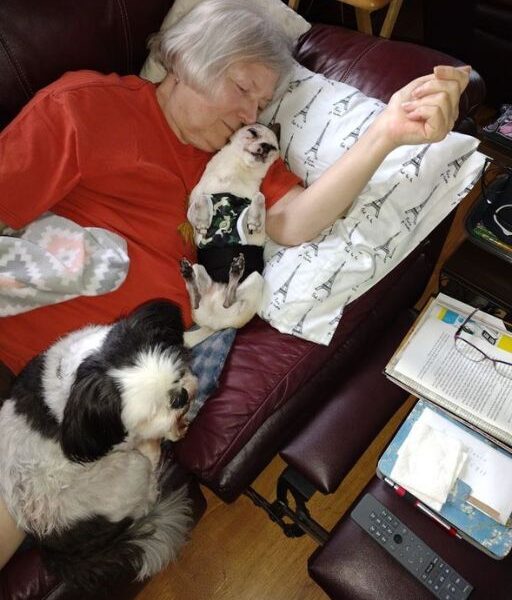
Every day at exactly four in the afternoon, my grandmother followed the same ritual, settling into her recliner as if the chair itself knew her shape. Coco, her elderly Chihuahua, curled against her chest, while Max, the Shih Tzu, guarded her feet like a loyal watchman. She always said the dogs loved the rhythm of her breathing, and I believed her—until the day that rhythm nearly disappeared. I walked in with her mail expecting her familiar hum, but the house felt unnaturally still. She sat with her eyes closed, a faint smile on her lips, Coco pressed tightly against her neck as if holding her there. When I called her name, she didn’t answer. Her skin was warm, her breathing shallow, and her hand trembled almost imperceptibly. Coco growled softly when I moved closer, protective in a way that sent a chill through me, and that’s when I noticed the empty pill bottle beside her glasses and felt the floor drop out from under me.
Panic took over as instinct replaced thought. I called for help, my voice shaking as I explained what I saw, while Max began whining and racing toward the door as if he, too, knew something was wrong. Paramedics arrived quickly, moving with practiced urgency, gently easing Coco away so they could help her. The little dog protested, reaching toward her as if refusing to accept any distance between them. At the hospital, time stretched endlessly under harsh lights while I replayed every quiet moment I’d overlooked in recent weeks—the silence, the long stares out the window, the way grief had slowly wrapped itself around her after losing my grandfather. When the doctor finally told me she was stable, relief hit so hard my knees nearly buckled. Physically she would recover, he said, but emotionally she needed more than rest. She needed connection, honesty, and support.
Weeks later, as we watched the sun sink behind the trees, she squeezed my hand and smiled with something like peace. She told me the dogs had saved her twice—once by refusing to move, and again by reminding her that love does not leave quietly. I understood then how easily pain hides in familiar routines, and how vital it is to notice when something feels off, even slightly. Love does not always announce itself loudly. Sometimes it growls softly, stays stubbornly close, or shows up simply by being there when someone cannot ask for help. And sometimes, that quiet persistence is what brings someone back.