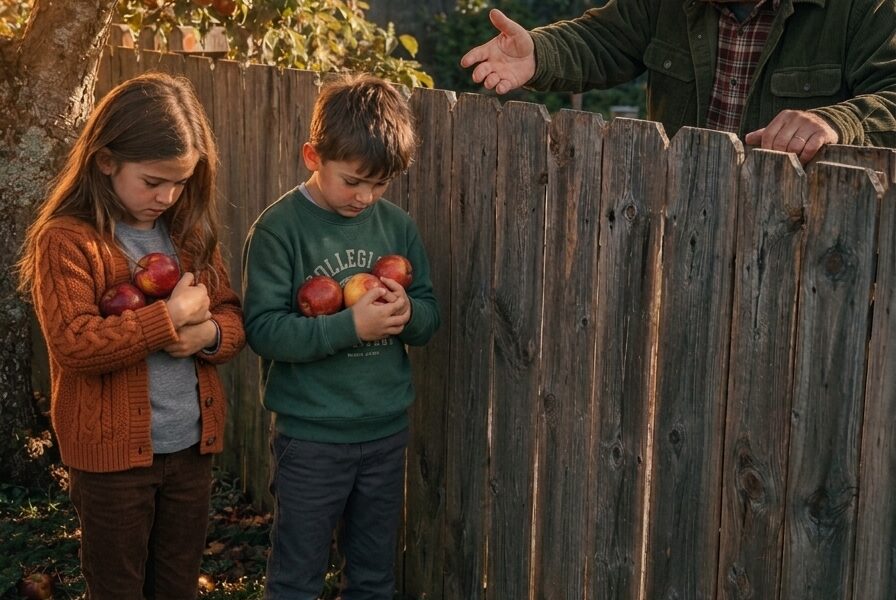

The conflict began when six-year-old Maya and nine-year-old Leo decided, on their own, to gather the fallen apples scattered across their yard and return them to where they believed they belonged: the fence line separating their property from Dale Mercer’s. Their reasoning seemed simple — the tree belonged to him, so naturally, the apples must belong to him too. But that simple idea changed the moment Dale appeared. He immediately claimed ownership of every apple he could see and ordered the children to hand them over, including the ones buried deep inside the flower beds and hidden beneath the swing set. When he called them “thieves,” Maya burst into tears. Leo didn’t cry. Instead, he stood completely still, saying nothing, but the silence on his face revealed that the words had hurt him just as deeply. Claire and Rob, their parents, could have easily turned the moment into a heated argument beside the fence, but they refused to give Dale that satisfaction. Rob, relying on his habit of responding slowly and deliberately rather than reacting in anger, proposed something far more measured: for the remainder of the season, they would collect every apple that landed on their side, turn the entire harvest into food, donate everything to the local food bank, and then calmly tell Dale exactly what they had done.
Over the next two weekends, the family transformed hundreds of pounds of tart, undersized apples into jars of applesauce and apple butter, bags filled with dried apple rings, and jugs of fresh cider. Maya peeled the apples and carefully labeled the containers, Leo cored and quartered them, Claire took charge of the canning, while Rob handled the cooking and organization. Slowly, their work filled the kitchen with rows upon rows of glass jars and neatly packed paper bags, each one representing an apple Dale had once demanded they surrender. When they delivered everything to the food bank, the coordinator admired Maya’s hand-drawn labels and immediately recognized how much work had gone into every peeled, sliced, and preserved apple. Then came the letter to Dale — calm, factual, and impossible to misunderstand. They documented his words and actions, explained how deeply the children had been hurt, and described their decision to donate the entire harvest that had fallen on their side of the tree he insisted was his. They made one thing clear: their children were not thieves, and they wanted Dale to understand “what kind of family you live next to.” Dale never offered an apology, but something changed anyway. He eventually appeared at their door carrying a bag of apples from his own tree, and over time, he began leaving surplus apples for their continuing food bank project. The tree still stretches across the invisible boundary, the stain on the shed has never completely disappeared, and Maya and Leo now understand something far more complicated than simply knowing what belongs to whom: they have experienced the difference between what is technically yours and what is actually right — and learned that sometimes, quietly transforming a small act of meanness into something useful for others can become its own kind of justice.