My Mother-in-Law Couldn’t Show Affection—Until I Discovered Her Secret Gifts

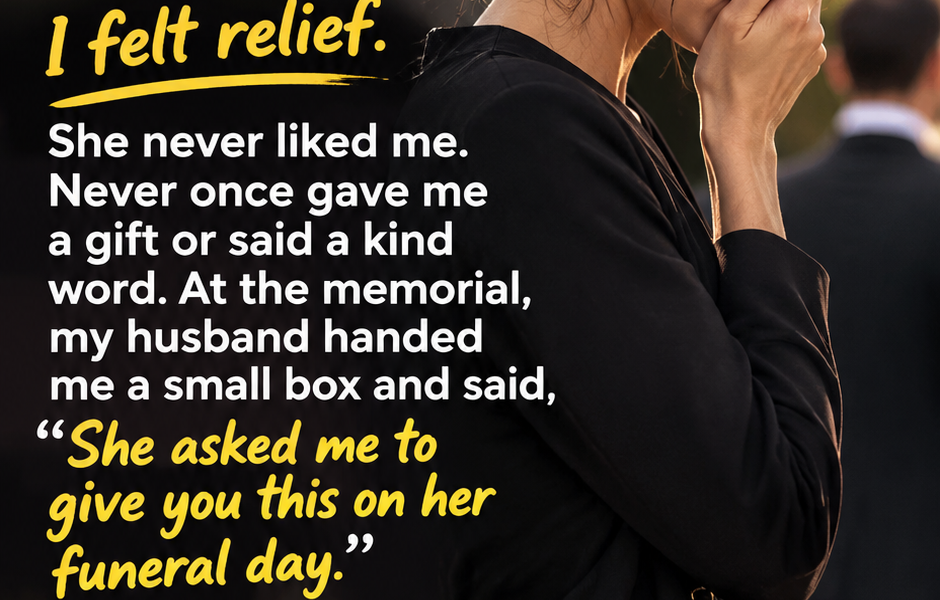
When my mother-in-law died, my first emotion wasn’t grief. It was relief.
And I hated myself for it.
For fifteen years, I had been an outsider in her eyes. She criticized my cooking, judged my parenting, and threw quiet, cutting insults at every family gathering. In all our years together, she never offered a hug, a birthday gift, or called me “daughter.” When she finally passed after a long illness, I only cried at the funeral because everyone else was crying.
Standing by her grave, listening to friends praise her warmth and generosity, I wondered if we had known two completely different women.
As the crowd dispersed, my husband walked over to me, his eyes bloodshot. He handed me a small wooden box. “Mom wanted you to have this today,” he whispered.
Inside was a silver key and a folded letter in her handwriting. My hands trembled as I unfolded it:
If you are reading this, I am gone. There are things I never had the courage to say while I was alive. I know you believed I hated you. Maybe I made sure you did.
The truth is far more shameful: you reminded me too much of myself.
When I was young, I married into this family and was treated exact same way by my own mother-in-law. Every insult, every tear cried in silence… I didn’t break the cycle. I passed it on to you. That is my greatest regret.
The letter directed us to a dusty, hidden cedar chest in her attic. When we unlocked it, what we found shattered every assumption I had lived with for over a decade.
Inside were dozens of photo albums filled with photos of me—at my wedding, in the hospital holding my newborns, at holiday dinners. She had been watching from the background all along. Beneath the albums sat years of neatly wrapped, ungiven presents: “For your first Mother’s Day.” “For your birthday.” “For the Christmas I couldn’t say I was proud of you.”
At the bottom lay a journal. For fifteen years, she had written about me nearly every week:
“She makes my son smile.”
“The children adore her.”
“She is a better mother than I ever was.”
Pride and generational trauma had trapped her in silence until it was too late. Her final line read: “Please don’t let my grandchildren inherit my silence.”
Months later, when my own daughter slammed her bedroom door after an argument, I felt those same cold, defensive words rising in my throat. But I stopped. I knocked gently, pulled her close, and said, “I love you more than my pride.”
Some people inherit money. Some inherit houses. Some inherit wounds.
In our family, the cycle ended with me.


