
Sheriff Carl Gaines leaned back until the springs in his swivel chair groaned, propping his dust-caked Justin boots on the desk. Between us, held up like a punchline he’d laughed at a hundred times before, hung my fourteen-year-old son’s X-ray—a stark, milky fractal tracing the broken radius in Drew’s forearm.
“Boys roughhouse,” Gaines said, his voice slow and thick as molasses poured over gravel.
I didn’t rise to the bait. I didn’t clench my fists or let the heat creep up my neck. When he saw he wasn’t getting a rise out of me, his dismissive smirk thinned, sharpening into something uglier, older, and far meaner. “In this county, I decide how things are handled. What are you going to do about it?”
He wanted noise. He wanted a threat, a red-faced surge of fatherly rage, a single mistake he could write up, cuff, and bury deep beneath the county courthouse.
Instead, I took Drew home, sat him down on the couch with an ice pack, and opened my laptop.
I didn’t sleep that night. I built an altar out of facts. I logged dates, times, and specific hallway blind spots where the security cameras conveniently glitched. I noted the locker room corners, the names of teachers whose eyes slid sideways when Neil Gaines walked by, and the exact phrasing coaches used when they whispered don’t go making trouble for yourself. I called Helena, establishing a chain of custody for every report, routing emails past the county line and directly into state channels that didn’t answer to a local badge.
Then the quiet calls began. Stories arrived in low whispers across grease-stained garage workbenches and dark back porches. Families who had swallowed their own grief for years started handing me their broken pieces. Each recollection was another fracture in the myth of the Sheriff’s untouchable son.
Three days later, dark state SUVs rolled past the blinking yellow light on Main Street. For the first time in thirty years, Carl Gaines wasn’t the only man in county limits asking questions.
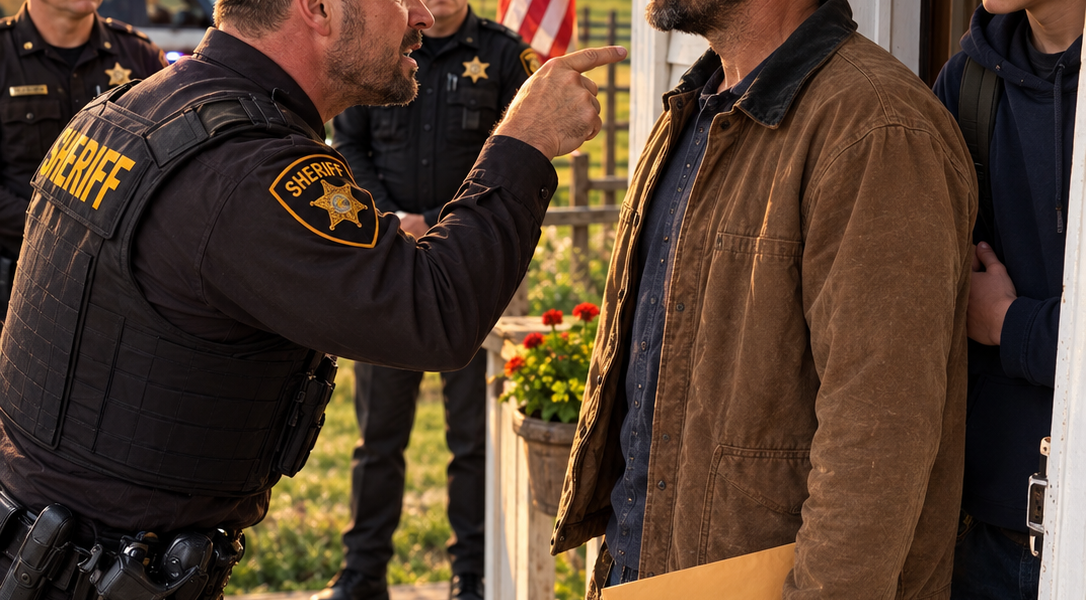
When he came stomping up my front porch that evening, three deputies trailing in his wake, his face was the color of raw beef. His index finger jabbed air an inch from my nose. “This is your doing,” he snarled, trying to crowd the doorway, carrying himself like the house, the land, and my son’s broken bones were all personal property of the Sheriff’s Department.
The old version of me—the Army Ranger who knew precisely how many seconds it took to break a man’s throat and put him through a porch railing—surged hard and hot in my chest. Muscles locked. Adrenaline hit like battery acid.
Then I heard the sound behind me: Drew’s shallow, careful breathing. The faint scrape of his cast against his ribs as he stood near the hallway, still carrying the terrible weight of believing he’d somehow been weak for getting hurt.
I stepped onto the top board, just far enough to fill the doorframe and shield my son.
“No,” I said, keeping my voice flat as a frozen lake. “This is responsibility.”
The purr of an engine cut through the silence as an unmarked state vehicle rolled up to the curb. Deputy Parsons stepped out first, followed by two plainclothes investigators carrying a thick cardboard accordion folder filled with names that stretched far beyond my family’s.
When Parsons told Gaines to step off my porch and hand over his sidearm, the Sheriff tried to laugh. It came out thin, high, and rattled—the sound of a man realizing the walls of the room he thought he owned had suddenly dissolved.
The fall didn’t come in a dramatic standoff. It came in the sterile hum of a state courtroom under cold fluorescent lights. It was the quiet, methodical reading of official findings that dismantled him—page after page documenting what he had allowed, what he had covered up, and the intimidation tactics he’d used to keep a small town under his thumb. Gaines lost his badge before the month was out. Neil was transferred to a juvenile facility and formally charged, while the boys who’d sheltered under his shadow were forced to face a legal system that no longer bowed to their last name.
Some neighbors turned their heads when we passed them in the grocery aisle. But others started speaking to us again—cautiously at first, like people recovering their voices after a long illness.
By late May, Drew’s cast came off. The skin underneath was pale and tender, but his arm healed faster than his understanding that he had done nothing wrong by telling the truth. On the last day of school, I sat in the truck and watched him walk across the gravel parking lot toward me. He looked taller, his shoulders squared, the shadow of a flinch entirely gone from his stride.
“It’s different now,” he said, sliding into the passenger seat.
He was right. The town still had its quiet corners, but they no longer belonged to Carl Gaines. They belonged to the people who had finally decided to break the silence.